Close
Back


From now on you can download videos from our website
If you would also like to subscribe to the newsletter and receive our latest updates, click on the button below.
Enter the email address you registered with and we will send you a code to reset your password.
The password must be at least 12 characters long, no spaces, include upper/lowercase letters, numbers and symbols.
Click the button to return to the page you were on and log in with your new password.
Admiral Giuseppe Cavo Dragone, Chair of the NATO Military Committee:
Good afternoon, thank you for being here.
It has almost become a habit to say that we meet at a time of unprecedented security challenges.
But it is true: the security environment continues to evolve.
And yet, in spite of challenges thrown at us, we remain steady on safeguarding the security of more than one billion people across the Euro-Atlantic area.
That is what we do at NATO, around the clock, and what we have focussed on, during this 2-day meeting.
We began by paying tribute to the men and women in uniform who work —24/7— often silently, to keep our nations safe.
And we honoured those who have been wounded, and who made the ultimate sacrifice: their example reminds us that security is never given or assumed.
From our discussions, three main conclusions stand out.
First: the Alliance is united. We may have robust exchanges of views, at times, but I saw a clear and distinctive convergence: on the military threats we face, and on the direction of travel we must undertake.
Second: the Alliance is resilient. We are absorbing shocks and learning fast, so we are ready in this demanding environment.
Third: the Alliance is dynamic, not static; we are adapting, because we must, in order to deliver on our core tasks.
Our motto: adapt while we deter.
We have demonstrated this ability constantly, throughout the last year; and effectively, in face of all circumstances.
My fellow Strategic Commanders — SACEUR and SACT —will elaborate on how we keep on doing that, by turning a steady approach to security into practical military effects.
A few points from our discussion stand out:
Our support to Ukraine remains strong, as our number one priority. Because Ukraine’s fight is not only about Ukraine, it is about our collective security too.
Ukrainian fight is our fight.
All the initiatives we have in place to contribute to the right of Ukraine to defend itself are delivering, and all Allies are committed in contributing.
But we can and we must do more.
And our support will endure.
In this respect: let me praise the Ukrainian soldiers, as I did with their Chief of Armed Force, in videoconference.
Their courage, discipline, resilience, adaptability and determination are truly exemplary.
Looking at the future peace, hopefully soon, we also had a fruitful discussion on the ongoing efforts carried out by the Coalition of Willing, in synch with the Alliance mission.
After Ukraine, we discussed security on a 360-degree perspective, across all domains: in Europe, on the Southern Flank, and across the North Atlantic.
We also discussed the Arctic, of course, a region of strategic relevance for NATO, where we have military exercises and training activities already pre-planned, for the months to come.
On another topic, we also confirmed that the time to invest smarter and faster in capabilities and new technologies is now, taking stock of the commitments made in The Hague, turning pledges into delivery.
And we all agree about the need to convey this sense of urgency to the political authorities, and to the defence industry, as our objective is to have an Alliance “ready to fight tonight.”
One final point to note: after a very constructive consultation, we also approved a successful distribution of all command responsibilities in the NATO Command Structure, among the 32 Allies. A true demonstration of fair, responsible burden sharing.
To conclude, let me highlight how none of this could be achieved by working in isolation.
All Allies recognised the value of cooperating with our partners across the globe in dealing with security, which is not anymore regional. It is global.
Many Allies also recognised how our collaboration and complementarity with the European Union remain key, and that a stronger EU means a stronger NATO.
Meetings with Indo-Pacific partners (Australia, New Zealand, Japan and the Republic of Korea), as well as with Georgia and Ukraine, have been another great opportunity to further deepen this valuable cooperation, an integral part of our daily work.
Without further ado, l hand over to SACEUR, and then SACT.
Then, to your questions. Thank you for your attention.
General Alexus G. Grynkewich, Supreme Allied Commander Europe:
Good afternoon, everyone.
It’s great to speak with you today—alongside Admiral Cavo Dragone and Admiral Vandier—after our productive sessions this week.
It was a privilege to meet with the Chiefs of Defense and discuss what Allied Command Operations is doing to build warfighting readiness and strengthen our deterrence posture.
We’re achieving this through our Forward Land Forces on the Eastern Flank;
Through exercises, like Steadfast Dart, which marks the second full deployment of the new Allied Reaction Force;
And through enhanced vigilance activities, like Baltic Sentry and Eastern Sentry.
I recently returned from Romania, and before that Slovakia, where I was impressed by the quality and interoperability of our forces. These forces are the foundation of this strong Alliance, which continues to gain strength each and every day.
Back in early January, I also had the opportunity to visit our two newest Allies, Finland and Sweden, where I witnessed how their militaries are uniquely positioned to strengthen NATO’s Northern Flank, and Arctic security.
Having seen Finnish Border Guards and Swedish Marines in action, I’ll just say that no-one should doubt our readiness.
Meanwhile, as President Trump and his team continue to work tirelessly towards peace in Ukraine, another topic this week was NATO’s vital support through our NATO Security Assistance and Training – Ukraine mission (NSATU).
It’s clear Ukrainian security is closely linked to European security, and both the Comprehensive Ukraine Requirements List (CURL) and Prioritized Ukraine Requirements List (PURL) remain essential to Ukraine’s defense.
NSATU plays a key role in coordinating and delivering assistance through these mechanisms.
Finally, if you’d allow, I’d like to take a moment to acknowledge the Deputy Supreme Allied Commander Europe, Royal Navy Admiral Sir Keith Blount, who will leave us in March. Sir Keith has done a phenomenal job, relentless in his pursuit of enhancing our deterrence and collective defense.
SHAPE and all of Allied Command Operations will miss his steady hand and his quintessentially British sense of humor.
I also want to thank him for his leadership and friendship, and wish him all the best in retirement.
Thankfully, we are incredibly fortunate to have Air Chief Marshal Sir Johnny Stringer, selected to take over the role when Sir Keith departs in March.
Johnny brings a wealth of experience and credibility to the role, having most recently served as the Deputy Commander of Allied Air Command.
I look forward to continuing to focus on warfighting readiness and strengthening our deterrence as Johnny steps into this essential role.
Thanks again, and I look forward to your questions.
Admiral Pierre Vandier, Supreme Allied Commander Transformation:
Thank you Grynch, Pino,
Good afternoon everyone.
As ACT, my focus today is accelerating NATO’s transformation, turning speed into operational advantage.
Because war is changing fast.
The world is changing fast.
And today, speed decides the outcome.
Time is the currency of conflict.
More than money.
Do we have time?
AI, drones, robots, and digital tech are shrinking decision cycles and raising the tempo of operations.
We're past debating what we must change…the question now is how fast we deliver at scale.
If not now, when? If not us, who?
That's why we're here: to keep NATO ready for today's fight while preparing for tomorrow by focusing on what works now.
At ACT, our job is clear: move the Alliance from thought to action. Be ready to win next wars, the best way to deter our adversaries and keeping our one billion citizens safe.
We turn battlefield lessons, science, and operational reality into tools and in training and make them more relevant for all Allies.
The 3.5% defence pledge gives us real momentum for mid-term capabilities.
But ACT is also driving change now through concrete projects that speed up tech adoption as we did last year on Task Force X.
And build forces that are more agile, more tough, and more lethal.
We focus today on three priorities:
Firstly, we need mass and autonomy.
Modern war demands scale and tempo.
In the Allies rearmament effort, we are working to include new tools and new technologies that will increase both resilience and lethality. Robotics, IT and space are extraordinary accelerators of military power. They have been at the roots of Ukraine’s sustained ability to resist Russian aggression.
We are working to incorporate these technologies across every aspect of our forces.
Second, we need a modern cloud enabled command and control.
Modern war is a war of tempo: time is the commodity.
We need to decide faster, to sync better, and to act first.
This requires secure data, robust links, and a digital backbone that can connect Allied forces at speed.
Advanced modelling shows that modern multi-domain C2 delivers a clear, measurable edge.
Third, we need training and readiness.
This year, together with ACO, we launched “Audacious training”, a renewed way to train our forces, leveraging the latest technologies while preparing our forces to constantly adapt in a volatile environment.
Through Audacious Training, we ensure NATO forces can deploy, link up, and operate together at scale against any adversary.
This is how we keep NATO strong: adapt faster, train harder, stay ahead.
Thank you.
James Mates, ITV News - James Mates from ITV NEWS in London. Admiral or SACEUR, whoever is best qualified to answer this. Could you give us any more details on the deal that was agreed between the Secretary General and President Trump last night? Specifically, does this deal grant the United States sovereign bases in Greenland, and if so, has the Danish government signed off on that?
Chair of the NATO Military Committee (CMC), Admiral Cavo Dragone - Well, we're at a very early stage. Of course, we know that there has been set a framework, the framework among Greenland, Denmark and the US, but we are still waiting for direction, and then, from then on, we will start doing our business, which is military planning and whatever is necessary to fulfill and to honour the guidance we still have to receive.
James Mates - [inaudible]
CMC, Admiral Cavo Dragone - Nothing yet, and we are just knowing that there is a framework, and we will work on that as soon as they give us, NATO, all the frame.
Dan Michaels, Wall Street Journal - Thank you. Dan Michaels, with the Wall Street Journal. For all of you, I'm curious. You're trying to plan for a more unified NATO for the future, but we've just been through a week that essentially pitted Allies against Allies, with even discussion of one Ally using military force against one or more others. How difficult does this make your work, and how do you manage to get on with what you're doing when there are distractions like this and potentially put your forces in conflict with each other? Thank you.
Supreme Allied Commander Europe (SACEUR), General Alexus Grynkevich - Thanks for the question. I guess I would characterize our session this week as entirely focused on what military leaders are supposed to be focused on, which is ensuring the defence and deterrence of the Euro Atlantic area. And we're united in that, we remain strong in that. And we, of course, are aware of the political discussions that are going on, but there was never a military dimension to those discussions that made its way down to us. So, we remain strong, we remain united, and we remain ready.
CMC, Admiral Cavo Dragone - We have great, great proof that what Grynch just said is what happened. Because right in this week, we had this meeting, the Military Committee CHODs session, with the top-level military leaders. And I tell you what it was something totally, I mean, uneventful from this point of view, and totally swift.
Mattia Bagnoli, ANSA - Can you hear me? Yes. My first question was to SACEUR. I would like to know if in your planning, in your strategy. At the moment, it is foreseen or starting a possibility to activate an Arctic Sentry sort of operation, if the leaders gives you the go ahead and what that would entail, technically? And to the others too, I would like to know- when we now are talking about Arctic security, what, in your view, it is needed on top of what we already have to secure that particular region? For instance, the Russians have nuclear-powered icebreakers. I don't think I’m mistaken that NATO has one of those. So, what, in terms of capabilities we should prepare and increase to tackle security challenges in that particular region. Thank you.
SACEUR, General Grynkevich - Okay, thanks. I'll start- first off, just on the potential for an Arctic mission. We call it Arctic Sentry, or something else- we've done no planning yet. We have not received political guidance to move out. We're aware of discussions about this, of course, and therefore we're doing some thinking about how we would organize for it, but no planning has started yet. But we're ready. We've got a ton of expertise at SHAPE Headquarters and across all the Allied Command Operations that could be applied to this. One of the things that we recently did was realign the boundaries of our joint operations areas that put all of the Nordic nations and the Arctic under one command, our Joint Force Command in Norfolk, so that command is very well postured to continue looking at Arctic issues. So, whether there's an operation or not, I'd also just emphasize- across SACEURs area of responsibility, we have a 360-degree approach to the threat. So, as we look at implementing our deterrence and defence of the Euro-Atlantic area and that strategy, we have already been executing a number of operations in the Arctic over the time that have been in command, and before, we'll continue to do so. And then we'll weigh on political guidance for any specific enhancements to that.
Supreme Allied Commander Transformation (SACT), Admiral Pierre Vandier - I compliment on the fact that if you look at the Cold War, this was a critical area to consider. So, you had a lot of activities in the area. Today, the global climate change changed the access to this area, and so the opening of the routes, the maritime routes, creates another question, and the control of this area is very important for NATO, for the countries that have continuous at-sea deterrence, because the access to the area will change. You have considered so space and ballistic issues, where the global threat we are facing needs to have a better look forward on what's going on from space. And so, we have to work on the technical issues with new technologies, on this specific environment.
Andrea Palasciano, Bloomberg - SACEUR, I want to ask you, there's obviously been a lot of talk about Greenland and the Arctic, and I know you've already said that there is an increased activity in the High North coming from Russia, coming from China. But I do want to ask you, like, in this specific moment where Arctic security is so high on the agenda, in the assessment of what's going on up there, is there anything particularly concerning? Have there been any recent changes in the security situation in the Arctic? Thank you.
SACEUR, General Grynkevich - Yeah, really thankful for that question. I think one of the most concerning changes in the security situation has been the growing collaboration between Russia and China in the Arctic. And we've seen that over the last several years, it's been both in the maritime domain with increased joint patrols, as well as in the air domain, with long range bomber patrols being conducted jointly. So, the activity that they're doing together is definitely increasing at any time our competitors or potential adversaries are doing that. It's something that we need to pay attention to.
Andrew Gray, Reuters - Thank you. Andrew Gray from Reuters, very simple question for the Admiral and for SACEUR- is Greenland currently sufficiently well-protected?
CMC, Admiral Cavo Dragone - I think, I mean, we are having a lot of work going on. I mean, we have been planning that before anything. And just consider two indications pretty strong, and we have, in the past, decided to have another Joint Force Command-Norfolk, which will be handling the area. And also the importance of the area has also indicated the two nations that were formally, they were neutral, and now they joined the Alliance, Finland and Sweden. So, it means we are focused also on, on the Arctic, and we are, I mean, we are also getting more capability to be able to work and operate in that type of climate, which is challenging, but I would say yes, and we will, we will do more, but ‘Grynch’.
SACEUR, General Grynkevich - Thanks, Chair. A couple of thoughts. There is ongoing activity in the Arctic that is being conducted not under the North Atlantic Treaty Organization or Allied Command Operations, but by a sister command, NORAD, the North American Aerospace Defense Command, bilateral command between two Allies, the United States and Canada. That exercise is called Noble Defender. It's executing out of Pituffik Space Base. And we have Canadian fighters. We have US tankers. And I stay very closely in touch with the Commander of NORAD on these activities as SACEURs AOR overlaps with the NORAD-NORTHCOM area of responsibility. So, there is activity going up there. I would just say, we also need to look forward a little bit. One of our jobs as military leaders is not just to think about the here and now, but how can those future threats that manifest, that growing collaboration, how will that threaten us next summer cycle, and the summer after that? And so, some of the things that we need to do in the Arctic to enhance our security are long-lead items, including, you know, installation of new sensors and detection capabilities. So, all of those things are constantly in our cross-check. We're constantly trying to enhance our posture and think of ways that nations can enhance our posture in the Arctic.
Max Delaney, AFP - Thanks a lot, Max Delaney, AFP. A couple of questions for SACEUR. You say that you're not yet planning for any mission in the Arctic. Are you planning any exercises on Greenland in the near future, after the discussions around Greenland? And then secondly, you have Eastern Sentry, you have Baltic Sentry, now potentially Arctic Sentry. All the focus in recent days has been on the Arctic. Do you feel that NATO risks being stretched too thinly, and that you'd risk losing focus on the main threat from the East?
SACEUR, General Grynkevich - Thanks for the question. There are a few exercises that are planned upcoming in the Arctic over the coming months. I'll refer you to my public affairs officer. You can get some details on that to you. But none on Greenland itself, as I mentioned, NORAD is executing some of those exercises in close coordination with us, but none on Greenland. As far if we are tasked to do some other vigilance activity, the Alliance has plenty of capacity here to meet all the requirements. And, you know, leveraging our North American side of the Atlantic, the Transatlantic Alliance, to provide some of those capabilities, especially in the maritime and air domain, there's a lot of synergy with how we can do this based on the geography.
Vlad Ungar, Romanian Public TV - Hello, Romanian Public Television. My question is for SACEUR, what key courses of action does the Alliance intend to pursue this year to ensure the protection and strengthening of NATO strategic interest in the Black Sea region?
SACEUR, General Grynkevich - Thanks. I was just in Romania over the early time of this week. And I guess a couple of things. We're doing a lot there right now, in the Black Sea region, we have two Forward Land Forces in Bulgaria, led by the Italians, in Romania, led by the French. And I was able to visit the French Forward Land Forces. And maybe I'll just tell you a quick story. I think this is the heart of transatlantic solidarity. You had an American SACEUR go to visit our Multinational Corps South-East, commanded by a three-star Romanian officer who had a Canadian Sergeant Major by his side. And then the three of us went out into the field to visit the colonel, the French colonel, the Commander of the 501st Regiment, who formed the core of that Forward Land Force. But it wasn't just French soldiers over there. There were soldiers from Luxembourg, from Belgium, and from Spain. They were all part of that Forward Land Force. And they told me about how they were coordinating with the Italian Forward Land Force in Bulgaria to think about how they would coordinate their manoeuvre under the Multinational Corps and Multinational Division that we have there. So, you see all the nations that are involved in transatlantic security and the Black Sea region security, in kind of one vignette, if you will. Of course, the land forces aren't the only domain that we're concerned about. Eastern Sentry is a big part of what we're looking at. And that goes for counter-UAS capabilities and enhancing our counter-UAS detection and engagement capabilities. We've been working with LANDCOM and with SACT on options to take the lessons of Ukraine and reinforce Eastern Sentry with some of those capabilities. And of course, we're building a very flexible way to move larger missile defence capabilities and fighter capabilities to the point of need. So, I think there's going to be a lot of activity in the Black Sea region. I'm extremely excited about it, having been there, and I hope to go back in summer, because it was pretty cold.
Teri Schultz, Deutsche Welle - Thank you. Teri Schultz, with DW over here. Thank you to the General and the Admiral. First, a sort of technical question. SACEUR, are there any security gaps that could be improved if, for example, the United States had actual ownership of the land on which its hypothetical bases were sitting? I know that there’s not a lot of precedent for that, but it's a question that's coming up. And then to you and the Admiral, of course, you're reassuring everyone that Greenland is not in any immediate danger, but you have the Prime Minister of Greenland warning his citizens to prepare for an invasion, with any sort of 360-degree security. Of course, what citizens feel is also part of your responsibility. So, what would you tell the Greenlandic citizens who very much fear the current situation, and not from Russia or China? Thank you.
CMC, Admiral Cavo Dragone – And [General Grynkewich] you can jump in of course. The reassurance that we have this kind of framework, I mean- I think that it should be enough to know that, I mean, negotiations are going on. I mean, they're discussing at the political level. There is no, no any kind of, I don't think they should have any kind of fear, because it's, it's something that has been stated clearly that, I mean, they're talking about the best, the best solution for everybody. Since it's a three-party discussion, negotiation, with Greenland, I mean, they are represented. So, I think I’m pretty confident there should be no fear, from my point of view, trying to put myself in their shoes.
SACEUR, General Grynkevich - I think I would say to the citizens of the one billion citizens across the Alliance, including those in Greenland, that our collective commitment to Article Five remains ironclad.
Teri Schultz, DW - On the sovereignty question?
SACEUR, General Grynkevich - Yeah, I don't, I don't think I can comment on that. There's a number of things that intersect here that are beyond my remit, if you will. So, you know, Golden Dome and those sorts of things. I don't understand all the technical details for it, so I'd refer you to others. Thank you.
Lara Jakes, The New York Times - Hi, thank you. Lara Jakes with the New York Times. Also, for the General and Admiral Cavo Dragone please. As initial details of the Secretary General's conceptual framework for securing the Arctic, including Greenland, are being discussed both here, in capitals and also in NATO Headquarters, to what extent did the CHODs this week and their missions voice support for it? Thank you.
SACEUR, General Grynkevich - Yeah, I'll just say we had no discussion about that security framework. We found out about it when everyone else did, when it hit the news yesterday, so there was, even though it's been reported elsewhere, that we had some military discussion, but it's not correct.
Lara Jakes - [inaudible]
SACEUR, General Grynkevich - Not about that framework. No, Ma’am.
Mark Carlson, Associated Press - Hello, Mark from Associated Press. I have a question for Mr. SACEUR, since the Alliance has changed with the addition of Sweden and Finland, can you talk about what capabilities the Alliance has and what members are best suited to actually do military warfare in the High North, where it's very cold, their conditions are very challenging. What type of resources do you have? Enough icebreakers to, you know, make it through the High North? What Allies are best suited to do warfare there?
SACEUR, General Grynkevich – Thanks. I tell you, Sweden and Finland and the capabilities that I saw on my trip there were very impressive. There was one point, I’ll tell another story, if you don't mind. We were getting a demonstration in the archipelago of some of the Swedish Marines’ capabilities. And there was a Swedish Marine Lieutenant Colonel who was describing a scene in the background where they had a couple of vessels coming ashore with Marines that were assaulting the island that we were on, as a demonstration of their capabilities. He pointed up in the air and showed a few drones that were doing reconnaissance. And then he goes, and we also have close reconnaissance capabilities. And if you look right here, and literally under our feet, who had just come up out of that icy-cold water were two Swedish Marines who had been diving, doing close reconnaissance. So, I mean, what a demonstration of capability up in the Arctic. So, clearly the Swedes, the Finns, all the Nordic countries, Norway, Denmark, have tremendous capabilities that they bring to bare every single day up there. Other near-Arctic nations also have the ability to operate in that area. The United States has operated over the last several months up in the Arctic, north of the coast of Norway. So there, even countries that are a little further away, have some relevant capabilities up there. And I'm confident that if we're tasked to do any specific mission or just to continue our general approach to the Arctic, we’re well postured.
SACT, Admiral Vandier - Yeah, I would add something. Just to point out that the equipment of NATO is led by a process, which is NDPP. You heard about the NATO Defence Planning Process, which is a strong process, which is linking the plans that are made by SACEUR and the capabilities the Allies need to procure. And so, this is a consistent, long-term plan. And so, we are not running from a topic to another one. And so, it's a 360-degrees plans that have been endorsed by the Allies. So, we are working on this process in a continuous pace. We are at the end of the Phase Five and working on the next political guidance that will arrive in 2027.
CMC, Admiral Cavo Dragone - Let me add just one thing. I mean, of course, the capabilities have been highlighted, probably by ‘Grynch’. But also, the southern nations are sending standing troops and units to train in extreme cold weather. When I was, when I was Italian, I used to send some units there to be acquainted and trained in extreme cold weather. They came back frozen, but happy.
Will Denselow, Feature News Story - Will Denselow, with Feature Story News. In Davos, Japan's defence minister, talked of a importance of strategic, the strategic importance in the Indo Pacific. He talked about growing cooperation. You mentioned it as well in your opening remarks, Mr. Chairman. What exactly does that deepening cooperation look like, and why is there a growing strategic importance? Thank you.
CMC, Admiral Cavo Dragone - I'll take it. I mean, we have the Indo-Pacific partners with us today, yesterday, and I've been in Japan, in the Republic of Korea last year, and I will go to New Zealand and Australia this year. The thing, the basic thing is that, I mean, security is not anymore regional, it’s global. And whatever is happening there has some effect here, and vice versa. Just think about 12,000 North Koreans fighting in Europe. That's just one idea. The thing is that we have a lot of things in common. Of course, the way China is behaving there and also elsewhere. They know it, and we are exchanging information. And so, information sharing is the first one. Standardization and interoperability. We used to do that, sending there, for example, Carrier Strike Groups from Europe. Or wings, I mean aircraft wings, there, to be to train with major complex exercises. Cyber, cognitive warfare. All of these are fields in which you are exchanging a lot of information. And we will do more. Today, we just agreed that we need to improve our cooperation, and we will do that. But we are really, I tell you, we are like-minded. We are sharing the same fear and sharing the same threat, and the same ideas.
Olivier Baube, AFP – Olivier Baube, AFP. At Davos, President Trump and President Zelenskyy are meeting together, so there might be some kind of announcement. So, my question is to SACEUR, is NATO ready to implement a peace plan, which will be announced or not, but at the moment, are you ready to play your part in this peace process? Thank you.
SACEUR, General Grynkevich - Thanks for the question. You know, first off, I think we all applaud President Trump's efforts to achieve peace in Ukraine, given the incredible amount of carnage that we see on the battlefield there. As SACEUR, our responsibility is to help the Ukrainians be as strong as they possibly can. I suspect that we continue to do that in peacetime, although the parameters of the peace deal will be what defines that, but we're ready to do whatever we're asked. Thank you.
Moderator - Thank you very much, gentlemen. This concludes our press conference. Thank you for being with us.


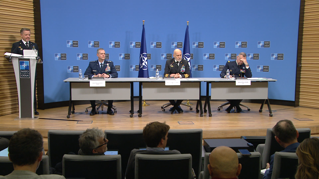
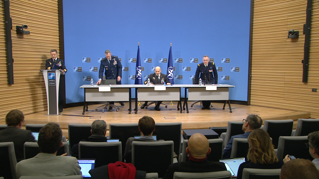
Joint Press Conference by the Chair of the NATO Military Committee (CMC), Admiral Giuseppe Cavo Dragone, the Supreme Allied Commander Europe (SACEUR), General Alexus G. Grynkewich, and the Supreme Allied Commander Transformation (SACT), Admiral Pierre Vandier
Joint Press Conference by the Chair of the NATO Military Committee (CMC), Admiral Giuseppe Cavo Dragone, the Supreme Allied Commander Europe (SACEUR), General Alexus G. Grynkewich, and the Supreme Allied Commander Transformation (SACT), Admiral Pierre Vandier
Joint Press Conference by the Chair of the NATO Military Committee (CMC), Admiral Giuseppe Cavo Dragone, the Supreme Allied Commander Europe (SACEUR), General Alexus G. Grynkewich, and the Supreme Allied Commander Transformation (SACT), Admiral Pierre Vandier
Joint Press Conference by the Chair of the NATO Military Committee (CMC), Admiral Giuseppe Cavo Dragone, the Supreme Allied Commander Europe (SACEUR), General Alexus G. Grynkewich, and the Supreme Allied Commander Transformation (SACT), Admiral Pierre Vandier
The Chair of the NATO Military Committee (CMC), Admiral Giuseppe Cavo Dragone
The Supreme Allied Commander Europe (SACEUR), General Alexus G. Grynkewich
The Supreme Allied Commander Transformation (SACT), Admiral Pierre Vandier
Joint press conference by the Chair of the NATO Military Committee, the Supreme Allied Commander Europe and the Supreme Allied Commander Transformation