
Close
Back


From now on you can download videos from our website
If you would also like to subscribe to the newsletter and receive our latest updates, click on the button below.
Enter the email address you registered with and we will send you a code to reset your password.
The password must be at least 12 characters long, no spaces, include upper/lowercase letters, numbers and symbols.
Click the button to return to the page you were on and log in with your new password.
04 February 2021
2 MIN READ
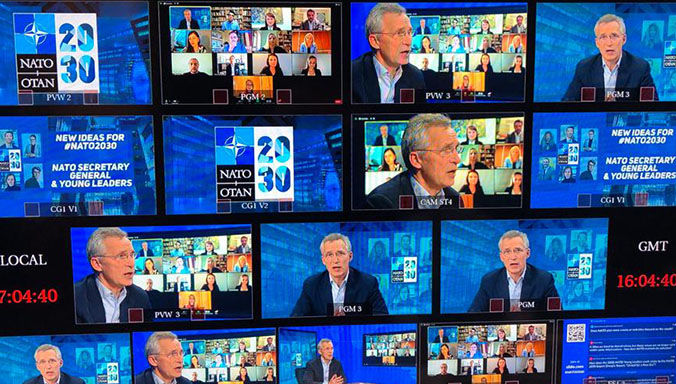
On Thursday 4 February 2021, NATO’s Secretary General engaged with the NATO 2030 Young Leaders Group on their vision of the future of the transatlantic Alliance, one that “guards its strengths and values with the one hand and embraces change with the other”.
The engagement was part of the “New Ideas for NATO 2030” online event, organized in partnership with Chatham House. “Your generation has the greatest stake in our future”, Jens Stoltenberg said, “So it is essential that your voices are heard”.
The Group laid out concrete recommendations on how to strengthen the Alliance based on “a more comprehensive, holistic, and inclusive understanding of security towards the 2030s”. The recommendations are articulated around five leading themes: defence and deterrence; NATO values; NATO partnerships and cooperation; climate change and emerging disruptive technologies. They are further elaborated in a 24-page report entitled NATO 2030: Embrace the change, guard the values – A report by the NATO 2030 Young Leaders Group, for this Generation and the Next.
The NATO 2030 Young Leaders Group was established at the NATO 2030 Youth Summit on 9 November 2020, as part of NATO’s 2030 initiative to make sure the Alliance remains ready to face tomorrow’s challenges.
NATO’s Secretary General thanked the Young Leaders for their bold ideas and ambitious advice on NATO’s future. “Together, we can make NATO stronger to keep our nations safe on both sides of the Atlantic”, he said.
The Group is composed of 14 emerging leaders from across the Alliance that have been selected from prominent young leadership programmes: Alice Billon-Galland, Don Ceder, Martin Dimitrov, Cori Fleser, Anne-Marie Imafidon, Gyde Jensen, Katarina Kertysova, Tania Latici, Jan Lukačevič, Claudia Maneggia, Andrea G. Rodríguez, Māra Šteinberga, Ulrik Trolle Smed, and Kevin Vuong.
After the Young Leaders’ Group’s engagement, students from 10 universities concluded NATO’s first policy hackathon, which started on 29 January 2021, and pitch their ideas for NATO 2030 live in front of a jury of experts. The winning team will be announced later today.
Based on these and other inputs, NATO Secretary General Jens Stoltenberg will make his strategic-level recommendations on NATO 2030 to Alliance leaders at their summit in Brussels in the first half of this year.