
Close
Back


From now on you can download videos from our website
If you would also like to subscribe to the newsletter and receive our latest updates, click on the button below.
Enter the email address you registered with and we will send you a code to reset your password.
The password must be at least 12 characters long, no spaces, include upper/lowercase letters, numbers and symbols.
Click the button to return to the page you were on and log in with your new password.
14 February 2020
1 MIN READ
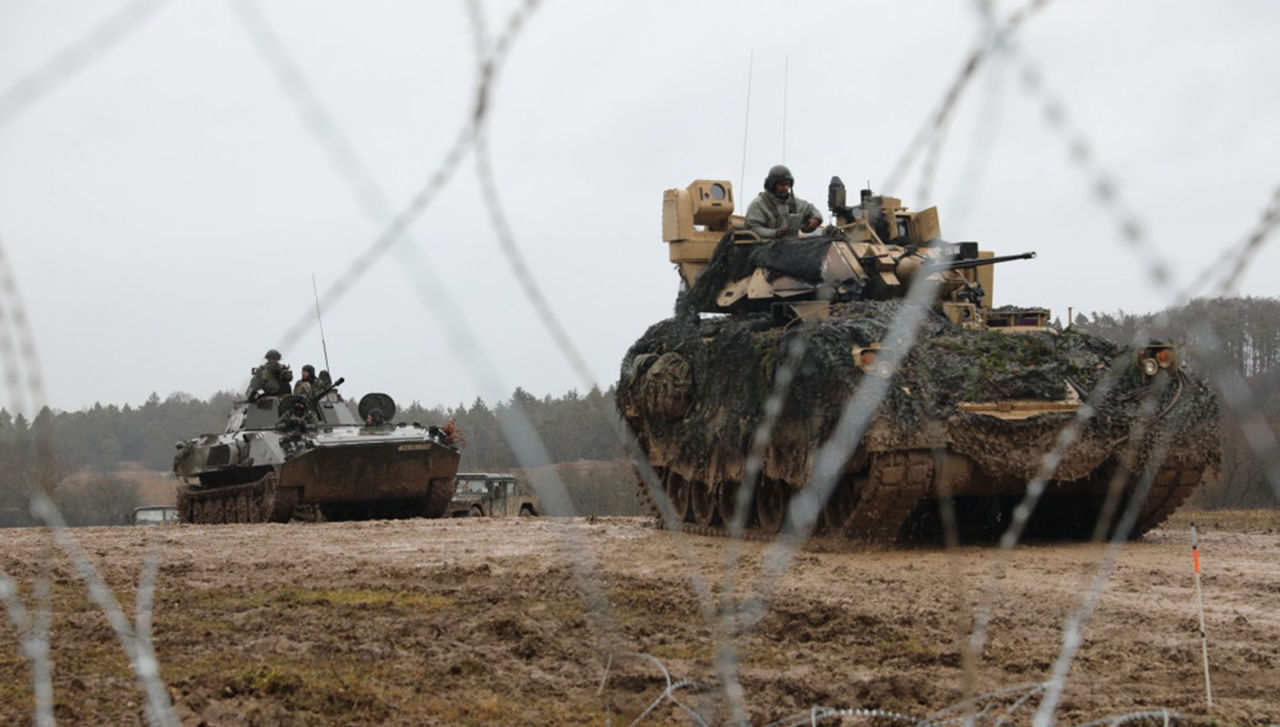
From 20 January to 4 February 2020, approximately 5400 participants from 16 different NATO Allies and partner nations took part in Exercise Combined Resolve XIII at the Joint Multinational Readiness Centre (JMRC) in Hohenfels, Germany. The Joint Multinational Readiness Center’s (JMRC) robust exercise and after-action review systems offer precious opportunities to both institutionalize NATO standards across several Allied and Partner nations, and to improve NATO standards themselves. The exercise aimed to test and enhance multinational battlegroups’ combined response and mobility capacity, defensive readiness, and interoperability between Allies.
To identify lessons and interoperability gaps, the NATO Standardization Office (NSO) sends personnel to observe selected multinational exercises. The NSO proactively works to improve readiness across Allies’ forces, as well as NATO standards themselves. By participating in multinational exercises, the NSO is able to use the observations to make current standards more relevant. Spreading the “culture of readiness” across the entire Alliance is only possible by using NATO’s programmes together, synergistically. The NSO is keen to cooperate with national exercise centers hosting multinational exercises to ensure that observations and lessons on multinational interoperability are captured in NATO’s standards, reviewed by its committees and integrated into its capability development programmes.
NATO standardization is the development and implementation of concepts, doctrines, procedures, material specifications, and terminology to achieve and maintain the required levels of compatibility, interchangeability or commonality needed to achieve interoperability. It is one of the primary tools to enable interoperability. Allies have designated five interoperability tools. Among these are standardization, evaluations, exercises, and lessons learned. With regards to lesson learned, it is vital for the Alliance to continue learning lessons instead of losing them. This poses a challenge, as it is significantly more complex to institute lessons across a broad group of Allied and Partner nations.
Advancing interoperability and ensuring cooperation between National forces within NATO formations is especially important to Alliance deterrence, cohesion and credibility. This is especially critical today because Allies’ technology-enabled forces are increasingly complex and inter-dependent. NATO’s deeply multinational tactical land formations require implemented doctrines now more than ever before.