
Close
Back


From now on you can download videos from our website
If you would also like to subscribe to the newsletter and receive our latest updates, click on the button below.
Enter the email address you registered with and we will send you a code to reset your password.
The password must be at least 12 characters long, no spaces, include upper/lowercase letters, numbers and symbols.
Click the button to return to the page you were on and log in with your new password.
17 January 2020
1 MIN READ
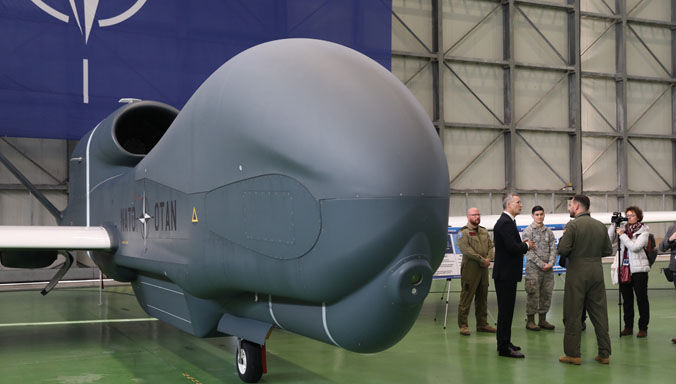
NATO Secretary General Jens Stoltenberg welcomed the arrival of two Alliance Ground Surveillance (AGS) remotely piloted aircraft at a ceremony in Sigonella, Italy on Friday (17 January 2020). The Secretary General outlined the importance of the AGS system, which will enable commanders to identify threats and view conditions on the ground, in any weather. “One single drone can watch over a territory with the comparable size of Poland,” he said.
The new unarmed surveillance aircraft can also fly for over 30 hours at a time. “It can reach the High North and the Sahel, the Middle East and the Atlantic,” said the Secretary General. When all five NATO RQ-4D aircraft are operational, the Alliance will be able to monitor and help protect two large regions around the clock. The AGS system will be collectively owned and operated by all NATO Allies. All Allies will benefit from the intelligence derived from AGS surveillance and reconnaissance missions.
Addressing military officials and industry, the Secretary General thanked Italy for hosting the AGS system, and praised the commanders at Sigonella Air Base. “Today, NATO is filling an important intelligence, surveillance and reconnaissance capability gap,” he said. He also congratulated the NATO AGS Management Organization and the NATO AGS Management Agency for the delivery of this milestone.
Six hundred personnel from across the Alliance will operate the AGS system. “They are our newest force,” said Mr Stoltenberg. He stressed that AGS is a visible demonstration of NATO’s commitment to innovation.