
Close
Back


From now on you can download videos from our website
If you would also like to subscribe to the newsletter and receive our latest updates, click on the button below.
Enter the email address you registered with and we will send you a code to reset your password.
The password must be at least 12 characters long, no spaces, include upper/lowercase letters, numbers and symbols.
Click the button to return to the page you were on and log in with your new password.
30 November 2015
2 MIN READ
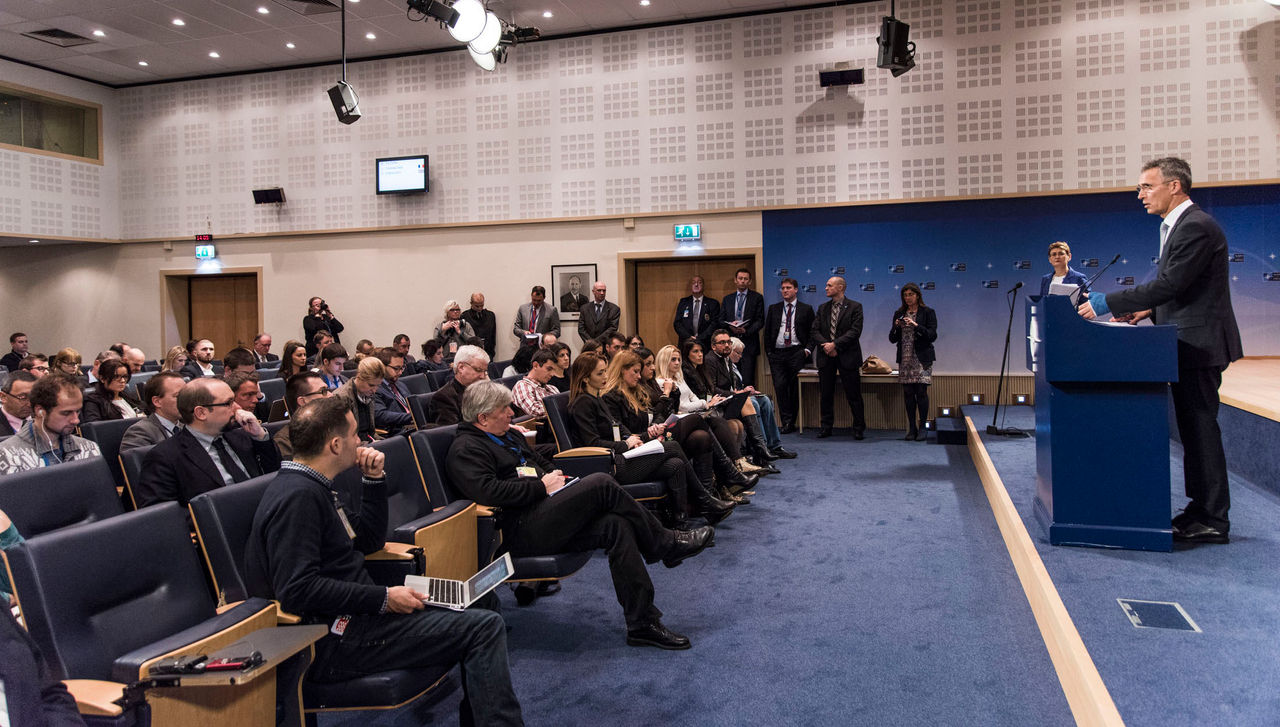
Afghanistan, challenges from the south, relations with Russia, support for Ukraine and Montenegro’s bid to join the Alliance will dominate the agenda of the two-day meeting of NATO Foreign ministers which starts on Tuesday (1 December 2015). “We face unprecedented security challenges both at home and abroad. NATO is responding to these challenges and I expect Foreign Ministers to take important decisions to further enhance our security,” Secretary General Jens Stoltenberg said.
The ministerial starts with a meeting on Afghanistan with Afghan Foreign Minister Salahuddin Rabbani and other operational partners participating in the Resolute Support mission. The ministers will look at how Allies and partners will continue the mission to train, advise and assist the Afghan security forces during 2016. They will also launch work to look at how the security forces will be financed from 2018-2020.
The second session will focus on challenges the Alliance faces to the south. The European Union’s High Representative for Foreign Affairs and Security Policy Federica Mogherini will take part to discuss the security implications of events to the south. “This is important because the risks we see can only be addressed by a coordinated international response,” Mr. Stoltenberg said. He added that NATO is already increasing the readiness and preparedness of its forces, as well as enhancing intelligence and situational awareness in the region and working on further assurance measures to support Turkey. The Secretary General said that at the ministerial, Allies will also reinforce support for partners in North Africa and the Middle East.
The ministers are also expected to adopt NATO’s new hybrid warfare strategy, which will help Allies to prepare, deter and defend against hybrid attacks. They will hold a discussion on how to take forward relations with Russia in wake of Russia’s actions in Ukraine and its military build-up in NATO’s neighbourhood. “We need to restore predictability in our relations,” the Secretary General said. He said that ministers will seek to modernise the rules governing military activities in Europe, including observation and notification of exercises.
At the start of the second day, ministers will decide whether to invite Montenegro to begin accession talks to join NATO. The ministerial will wrap up with a meeting of the NATO-Ukraine Commission with Ukraine Foreign Minister Pavlo Klimkin to discuss Ukraine’s reform path and review NATO’s practical support to Ukraine.