
Close
Back


From now on you can download videos from our website
If you would also like to subscribe to the newsletter and receive our latest updates, click on the button below.
Enter the email address you registered with and we will send you a code to reset your password.
The password must be at least 12 characters long, no spaces, include upper/lowercase letters, numbers and symbols.
Click the button to return to the page you were on and log in with your new password.
25 November 2013
1 MIN READ
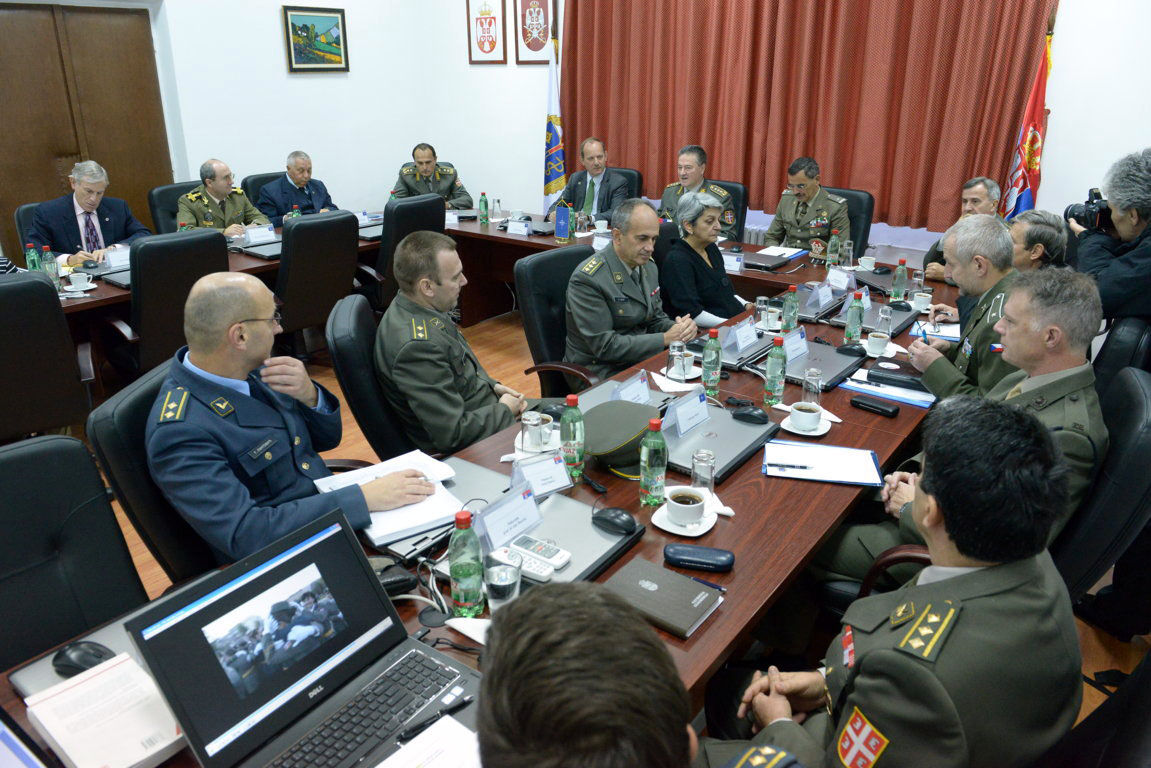
A team of experts visited the University of Defence and the Non-Commissioned Officers Training Centre in Belgrade, Serbia, on 10 and 11 October. The aim was to explore opportunities to improve the existing defence education system and further develop the capacity of officers and non-commissioned officers.
The visit followed an invitation from the Rector of the Serbian University of Defence to experts from NATO’s Defence Education Enhancement Programme (DEEP). NATO and Austria co-led the team, which included experts from Austria, the Czech Republic, Romania and the United States, as well as representatives from NATO’s International Military Staff and Allied Command Transformation.
Enhanced education and training are among the issues that will be covered by the Individual Partnership Action Plan (IPAP) that NATO is currently developing in Serbia. The country is particularly interested in further developing a professional military education and training system for officers and non-commissioned officers which meets international standards.
During the visit, agreement was reached in principle to develop international cooperation through DEEP. Work will focus on faculty and curriculum development, based on the Bologna Process which is designed to ensure comparability in the standards and quality of higher education qualifications in many European countries.
DEEPs are tailored programmes through which the Alliance advises partners on how to build, develop and reform educational institutions in the security, defence and military domain. Projects are currently running in 11 countries: Afghanistan, Armenia, Azerbaijan, Georgia, Iraq, Kazakhstan, Mauritania, Moldova, Mongolia, Ukraine and Uzbekistan. They focus in particular on faculty building and curriculum development, covering areas such as teaching methodology, leadership and operational planning.
Austria is the first partner country to co-lead a Defence Education Enhancement Programme in support of another partner.