
Close
Back


From now on you can download videos from our website
If you would also like to subscribe to the newsletter and receive our latest updates, click on the button below.
Enter the email address you registered with and we will send you a code to reset your password.
The password must be at least 12 characters long, no spaces, include upper/lowercase letters, numbers and symbols.
Click the button to return to the page you were on and log in with your new password.
29 May 2009
2 MIN READ
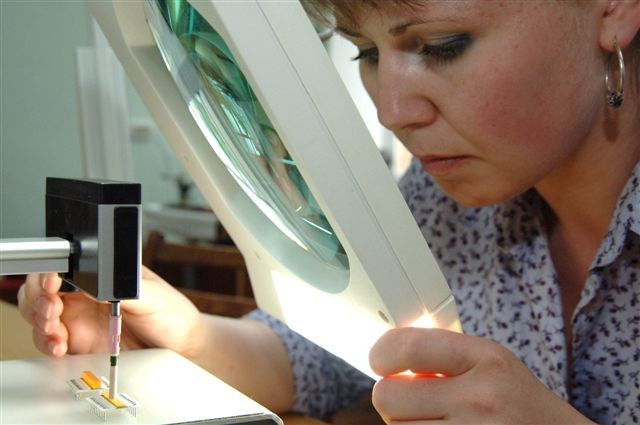
The Joint NATO-Ukraine Working Group for Scientific and Environmental Cooperation met at NATO Headquarters on 29 May to review progress in key projects and to identify areas for further work through the Science for Peace and Security (SPS) Programme.
Ukraine’s Deputy Minister for Education and Science, Dr Maksym Strikha, stated that his country’s priorities include information technology, cyber defence, environmental security, food safety, bioscience and biotechnology.
Cyber defence is a particularly important issue for Ukraine. The country has very broad networks connecting large industrial facilities, power plants and transportation facilities that could be at risk. This is also an area in which Ukraine has signficant research and development potential. Cooperation in cyber security features in Ukraine’s first Annual National Programme, along with other activities related to Defence Against Terrorism.
In the area of environmental security, two key projects are currently in the pipeline. One concerns the decontamination of the soil and groundwater in the area of the Priluki airbase. Another is aimed at monitoring the risk of flooding around the Pripyat River, which is highly polluted by radioactive isotopes as a result of passing through the Chernobyl Exclusion Zone. The contamination risk also concerns neighbouring Belarus and Russia, and the area has been identified as an environmental security hotspot under the ENVSEC initiative.¹
The Joint Working Group also reviewed the status of a project aimed at developing an advanced X-Ray Generator in Kharkov. This technology will generate radiation with special characteristics for use in unique applications in medicine, biology and physics. The project is now back on track, after suffering delays and funding difficulties, and should be completed by 2010.
Another important area of discussion was the Ukraine Research and Academic Network (URAN), which has been set up with the support of NATO. It provides hundreds of scientists at 56 institutions across Ukraine with access to international resources such as academic journals and databases, as well as the European Union’s research and education network, GEANT.
The URAN initiative is helping to better integrate Ukrainian researchers with the world’s scientific and academic community. The Ukrainian government intends to invest 1.15 million UAH in the the further development of the network.
1. The Environment and Security Initiative (ENVSEC) was launched by the Organisation for Security and Cooperation in Europe, the United Nations Environment Programme and the United Nations Development Programme in 2002. NATO became associated with the initiative in 2004 in order to coordinate related activities, in particular under the NATO SPS Programme (www. envsec.org).