
Close
Back


From now on you can download videos from our website
If you would also like to subscribe to the newsletter and receive our latest updates, click on the button below.
Enter the email address you registered with and we will send you a code to reset your password.
The password must be at least 12 characters long, no spaces, include upper/lowercase letters, numbers and symbols.
Click the button to return to the page you were on and log in with your new password.
(As delivered)
Deputy Prime Minister Kosiniak-Kamysz, dear Władysław,
Thank you for the warm welcome to Poland and here in Bemowo Piskie.
We are here indeed to thank the servicemen and women who serve as part of NATO’s Forward Land Forces, led here in Poland by the United States as the framework nation. As well as US troops, this base hosts troops from Romania, Croatia, the UK and of course Poland. And indeed, many of them will spend the holiday period away from their families, standing watch. Keeping us all safe, and enhancing our deterrence and defence posture on NATO’s eastern flank.
The Forward Land Forces here in Bemowo Piskie are just one example of how Allies come together in service of our shared security. It is also an example of Poland’s many contributions to our collective deterrence and defence.
On the land, at sea and in the air, Poland’s military continues to grow stronger. You are showing leadership by investing over 4.5% of GDP in defence with that number set to rise even further in 2026. Next year, you will begin receiving F-35 fighter jets, and I welcome your plans to increase the strength of your armed forces to 300,000 personnel by 2035. 300,000 by 2035.
You host key elements of NATO’s military infrastructure, including Headquarters Multinational Corps Northeast and an air policing base at Malbork. Poland also provides crucial support to Ukraine – something we are all committed to, not only as the push for peace continues, but well beyond. Ukraine’s security is ours – Poland knows this well.
Since the start of Russia’s full-scale invasion, you have allocated more than 4 billion euros in military aid to Ukraine, including 100 million dollars to PURL – which provides essential US equipment to Ukraine – and welcomed also so many Ukrainians fleeing the horrors of war.
Poland also hosts critical facilities supporting our efforts to help Ukraine, including a crucial logistics hub for NATO’s support to Ukraine, as well as the Joint Analysis, Training and Education Centre – JATEC - in Bydgoszcz.
In response to repeated incursions into NATO airspace on the eastern flank, including here in Poland, we launched Eastern Sentry. Eastern Sentry – much like Baltic Sentry, launched earlier this year – has strengthened our collective defence. It adds flexibility and it adds resilience to NATO’s posture on the eastern flank and sends a clear message: as a defensive Alliance, we are ready to deter and defend, from the Black Sea to High North – and beyond.
Bottom line – NATO stands united and ready. To deter aggression and defend our freedom and security. And to continue our vital support to Ukraine.
Dear Władysław, thank you so much for your steadfast support to our transatlantic Alliance.
Question – POLSAT News
I have a question to the Secretary General, Mark Rutte. My question is as follows: I would like to ask about information that has been present in social media, in the social space, about potential guarantees for Ukraine from the Allies within the NATO. President Zelenskyy suggested recently that Ukraine might actually give up on their plans and aspirations to be a NATO member, in exchange for such security guarantees. My question is, do you imagine that? Can you, envisage this situation, that Ukraine would get some guarantees in terms of security, something modelled along the lines of the fifth article, and could it happen against the will of Russia?
NATO Secretary General Mark Rutte
Let me answer in two. One on NATO membership for Ukraine. There is a principle and a practical element here. The principal element, as you know, is that any country in the Euro-Atlantic area can apply for membership. That's the Washington Treaty. And in the Washington Summit last year, in Washington in 2024, Allies agreed on the irreversible path of Ukraine into NATO. And there is a practical element. And the practical element is that, as we speak, a couple of Allies are saying they will not give their consent, and therefore will withhold unanimity to Ukraine entering NATO. A country like Hungary, the United States, Slovakia, and maybe a couple of others. So that's the practical point of it.
So that leaves us then with the question, if a peace deal is done on Ukraine, a long-term ceasefire or a full peace deal, how do we prevent the Russians from ever attacking Ukraine again? How do we prevent a repeat of what happened after Minsk II in 2014, 2015?
And this is where the security guarantees come in place. And the security guarantees, as they are currently being designed, have three layers. Layer one is Ukrainian Armed Forces. They will be, of course, like in Poland and everywhere in NATO territory, in this case, outside NATO territory, in Ukraine, will be the first line of defence.
The second line of defence is, of course, what the Coalition of the Willing, under the leadership United Kingdom and France have been designing over the last couple of months. How can the Europeans help here, together with Canada, to make sure that the peace will be sustained.
And the US, and this is the third element of this. The American president said in August that he wants the US to be part of those security guarantees. And at the moment, discussions are ongoing, what that exactly would mean, and how then this collective package of security guarantees would look like. That's currently the debate going on.
It's extremely important, because indeed, after the peace deal, if not NATO, and NATO, for practical reasons, is not possible now, how do we prevent a further attack of the Russians? And Putin has to know that after a peace deal, if he will try to attack Ukraine again, the reaction will be devastating, and this is exactly how we are designing these
security guarantees.


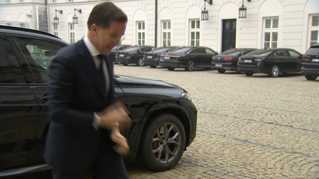
NATO Secretary General Mark Rutte meets with Karol Nawrocki, President of Poland
NATO Secretary General Mark Rutte meets with Karol Nawrocki, President of Poland
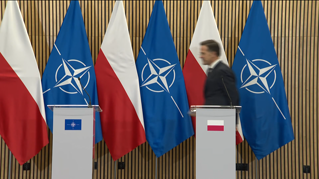
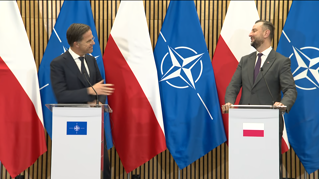
Joint press conference by the NATO Secretary General Mark Rutte with Władysław Kosiniak-Kamysz, Deputy Prime Minister and Minister of Defence of Poland
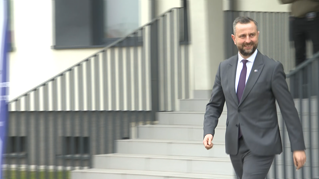
NATO Secretary General Mark Rutte meets with Władysław Kosiniak-Kamysz, Deputy Prime Minister and Minister of Defence of Poland
Joint press conference by the NATO Secretary General Mark Rutte with Władysław Kosiniak-Kamysz, Deputy Prime Minister and Minister of Defence of Poland
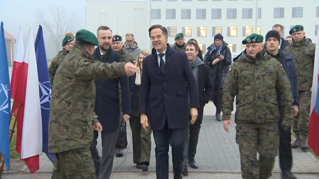
NATO Secretary General Mark Rutte with the troops of the NATO Forward Land Forces Battlegroup deployed at Bemowo Piskie.
NATO Secretary General Mark Rutte with the troops of the NATO Forward Land Forces Battlegroup deployed at Bemowo Piskie.
NATO Secretary General Mark Rutte with the troops of the NATO Forward Land Forces Battlegroup deployed at Bemowo Piskie.
NATO Secretary General Mark Rutte with the troops of the NATO Forward Land Forces Battlegroup deployed at Bemowo Piskie.
NATO Secretary General Mark Rutte with the troops of the NATO Forward Land Forces Battlegroup deployed at Bemowo Piskie.
NATO Secretary General Mark Rutte with the troops of the NATO Forward Land Forces Battlegroup deployed at Bemowo Piskie.
NATO Secretary General Mark Rutte with the troops of the NATO Forward Land Forces Battlegroup deployed at Bemowo Piskie.
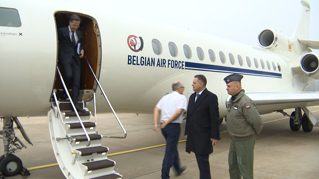
NATO Secretary General visits Poland

18 December 2025