
Close
Back


From now on you can download videos from our website
If you would also like to subscribe to the newsletter and receive our latest updates, click on the button below.
Enter the email address you registered with and we will send you a code to reset your password.
The password must be at least 12 characters long, no spaces, include upper/lowercase letters, numbers and symbols.
Click the button to return to the page you were on and log in with your new password.
03 February 2026
3 MIN READ
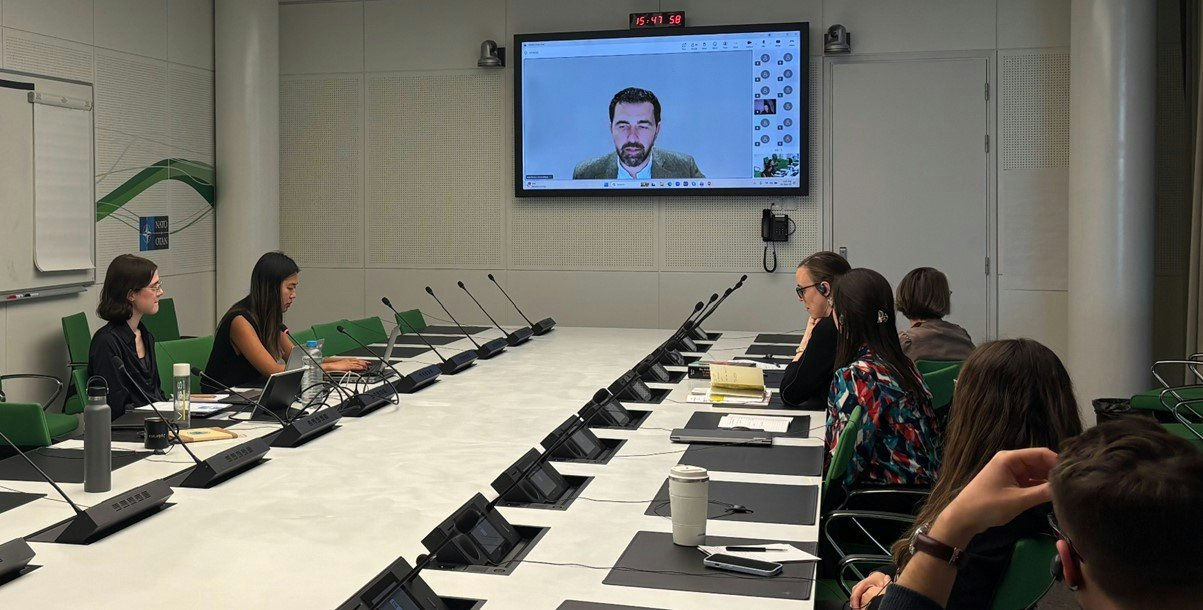
On the 5th November 2025, the IMS Office of the Gender Advisor hosted its monthly Deep Dive, after marking the 25th anniversary of UNSCR 1325. This iteration examined the “weaponisation” of gender by strategic competitors resulting in potential threats to the Alliance. The discussion highlighted how, by developing a better understanding of how social and cultural dynamics influence the tactics, techniques and procedures of potential threats to the Alliance, we can contribute to a key, strategic objective: gaining a cognitive edge, hence out-thinking our adversaries and strengthening our defence posture.
The session featured Dr Míla O’Sullivan, researcher at the Institute of International Relations, Prague and lecturer at Charles University, Prague; Dr Joshua Roose, Associate Professor of Politics at Deakin University, Melbourne; and Dr Zeynep Sütalan, former Academic Advisor for the Gender in Terrorism and Counterterrorism workshop series at the NATO Centre of Excellence for Defence Against Terrorism (COE-DAT), in Türkiye.
Dr O’Sullivan examined how Russia uses gendered narratives, both in its operations and as a legitimating tool for its war on Ukraine. She explained how Russia frames its war on Ukraine as protecting the so-called ‘Russian world’ from the ‘decadent West’. Domestic and international anti-gender narratives inform Russia’s conduct of war and tactics in Ukraine: bombing maternity hospitals and kindergartens, the use of conflict-related sexual violence, and the sexual torture of Prisoners of War and civilians in Russian captivity. In contrast, in Ukraine, women continue to play an active and visible role in military and civilian resistance to Russia’s invasion.
Dr Roose discussed how Russia weaponises masculinity as a cultural narrative tied to ideas of honour and belonging, which enable national and personal identity to be linked. Within the framework of this narrative, promoted also by the media, schools and religious institutions, he explained how Russia can offer a path for both personal and national redemption. In this example, Dr Roose explained how, through the war, Russia seeks to restore its empire and status following the fall of the Soviet Union. Finally, speaking of China, he also mentioned ongoing state efforts to ‘re-masculinise’ youth, in response to popular anxieties about ‘soft men’ created by online and popular culture.
Later, Dr Sütalan described how gender can play a relevant role in terrorist groups’ recruitment strategies and operation. Through weaponising masculinity and femininity, terrorist groups can offer identity and purpose to both men and women. According to the ideologies of different terrorist groups, women’s participation may be framed as either a tool of empowerment, or as reproducing the nation through raising believers. Understanding the role of gender in terrorist groups delivers important operational insights. For example, female terrorists may have tactical advantages, as stereotypical ideas about “who is a terrorist” may enable them to pass undetected through security checks, to carry out suicide bombings, or act as couriers.
The internet is a key environment where such concerns are playing out, notably as a forum for recruitment for terrorist groups, or as a digital extension of their activities. All three speakers underlined how anti-gender narratives are being used to weaken societal resilience, particularly via social media.
A leitmotiv of all interventions was the fact that gender perspectives are not an add-on that can ‘be left for better times’, but an integral part of understanding how conflicts are conceived, prepared, legitimised, conducted, and sustained. For NATO, this recalls the relevance of cultural narratives as early warning indicators and strategic intelligence, as well as investing in civil society to support societal resistance in countering information threats.