
Close
Back


From now on you can download videos from our website
If you would also like to subscribe to the newsletter and receive our latest updates, click on the button below.
Enter the email address you registered with and we will send you a code to reset your password.
The password must be at least 12 characters long, no spaces, include upper/lowercase letters, numbers and symbols.
Click the button to return to the page you were on and log in with your new password.
30 November 2023
2 MIN READ
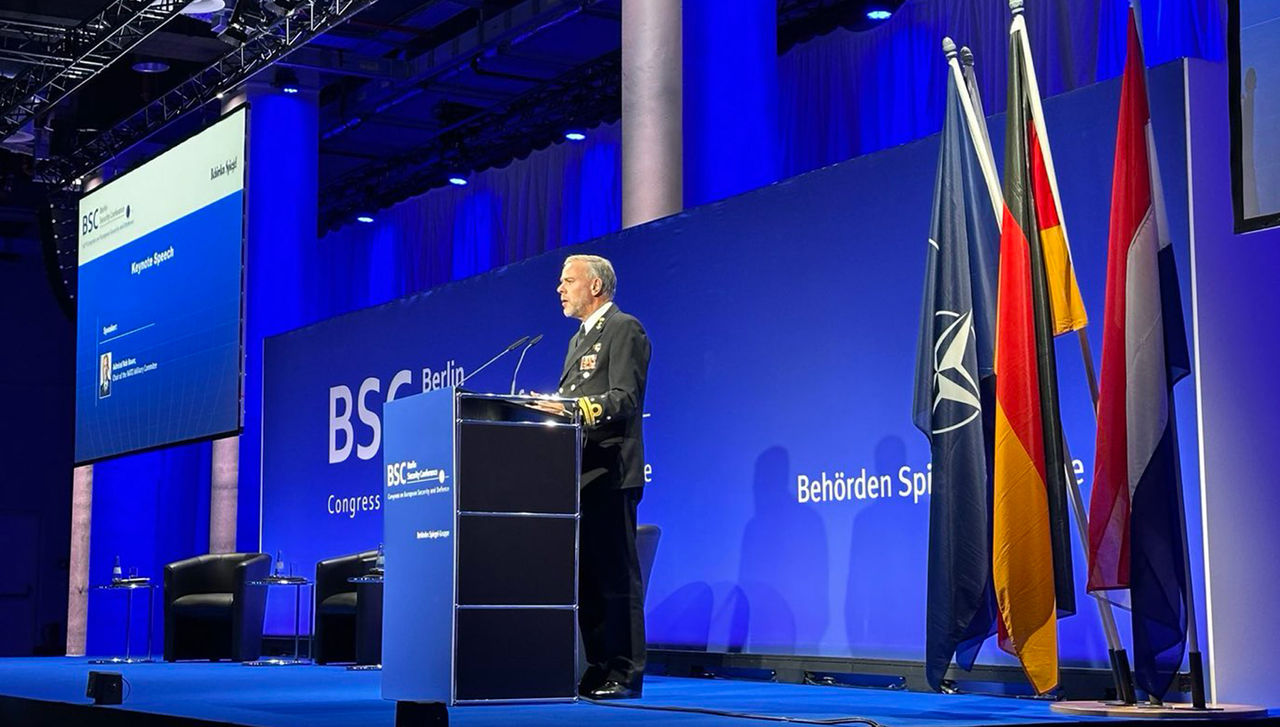
On 29-30 November 2023, the Chair of the NATO Military Committee, Admiral Rob Bauer attended the 22nd edition of the Berlin Security Conference, where he delivered a keynote address on "NATO in a New Era of Collective Defence".
Arriving in Berlin in the evening of the 29th November, Admiral Bauer started his visit by attending the IBM BSC Executive Dinner, alongside representatives of major defence companies and military experts as well as military representatives from a number of Allied countries. Addressing the participants, the Chair delivered a poignant plea for defence industry, governments and investors to work more closely together, especially in response to the current security environment. “This new era of Collective Defence is an opportunity for us to redefine the military–industrial complex. Both the private and public sector need to fundamentally change their approach. We have the momentum to change the system. To move away from a restricted focus on efficiency and focus on effectiveness again. To move away from the policy of producing ‘just enough, just in time’. And start producing higher volumes of stocks and creating more spare capacity”, he underlined.
The following day, Admiral Bauer headed to the main stage to deliver his keynote address on “NATO in a New Era of Collective Defence”, in which he noted the Alliance’s ongoing adaptation to the changed security environment. “The NATO military authorities have been monitoring Russia’s pattern of aggression for many years, and we have adapted our defence plans accordingly. We have developed several military strategies and plans that outline how we will protect ourselves - now and in the future - against the two main threats listed in the new Strategic Concept: Russia and Terrorist Groups. Our regional plans – agreed at the Vilnius Summit last July – are the most comprehensive defence plans NATO has had since the end of the Cold War”, he added.
Continuing, he stated that while strategies are in place to deter and defend against any threat, in any domain and geographical area, work still needed to be done: “Militarily, there are many more steps to be taken to get where we want to be for our collective defence. However, the responsibility for freedom does not lie on the shoulders of those in uniform alone. In order to strengthen our collective defence and at the same time support Ukraine in its existential fight, we need a whole of society approach. We need public and private actors to change their mind-set, from an era in which everything was plannable, foreseeable, controllable, focused on efficiency to an era where anything can happen at any time. An era in which we need to expect the unexpected. For that, we need both Allied Armed Forces and Allied societies to become ‘Kriegstüchtig’: fit to fight”.
Wrapping up his remarks, Admiral Bauer reminded the audience of NATO’s defensive nature. “NATO is the most successful Alliance in history, not because of any aggressive display of military strength or territory we have brutally conquered. We are the most successful Alliance in history because of the peace we have brought. The countries we have united. And the conflicts we have prevented from spiralling out of control. Because of our ability to “win the war before the war”. But we also need to see the world for what it is and not what we wish it to be. Preparing for war is not aggressive. It is the only way to maintain peace”, he concluded.