
Close
Back


From now on you can download videos from our website
If you would also like to subscribe to the newsletter and receive our latest updates, click on the button below.
Enter the email address you registered with and we will send you a code to reset your password.
The password must be at least 12 characters long, no spaces, include upper/lowercase letters, numbers and symbols.
Click the button to return to the page you were on and log in with your new password.
20 November 2023
2 MIN READ
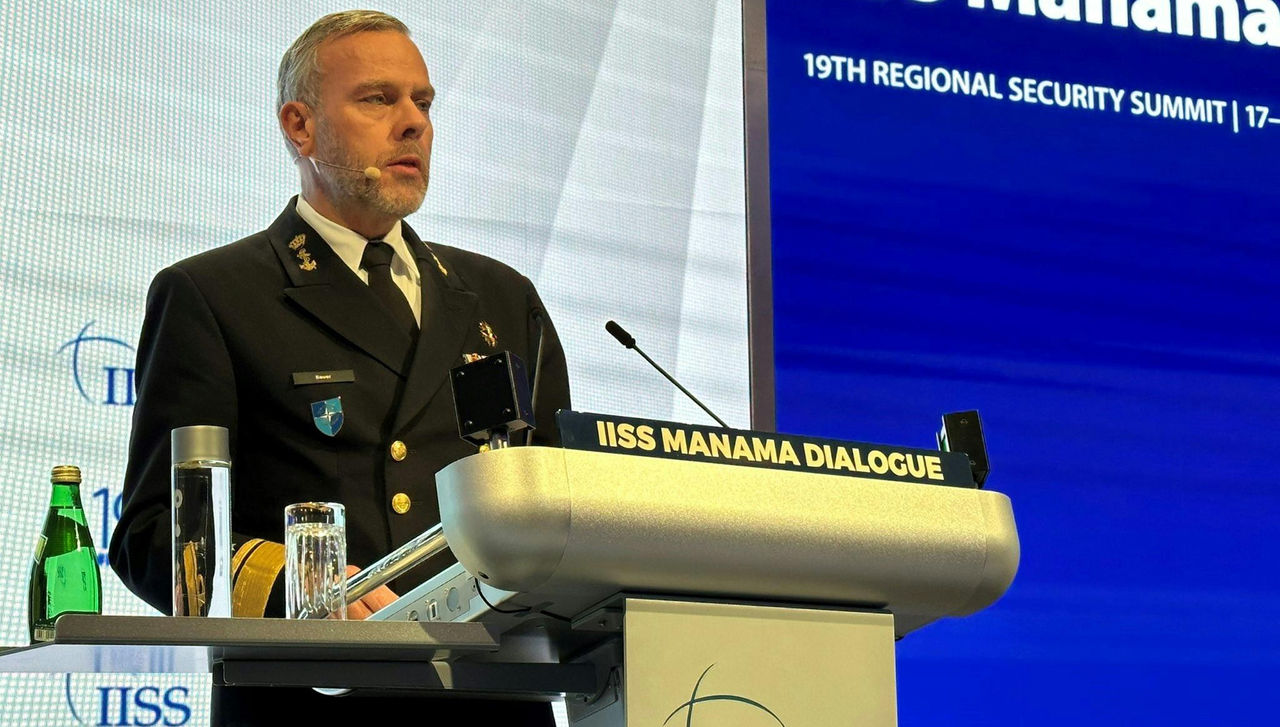
From 17 to 19 November 2023, the Chair of the NATO Military Committee, Admiral Rob Bauer, and the Assistant Secretary General for Political Affairs and Security Policy, Ambassador Boris Ruge, attended the IISS Manama Dialogue in Bahrain. NATO’s key message at this conference was that it wants to find ways to deepen Partnerships in its Southern neighbourhood. Admiral Bauer expressed this during a panel discussion on “Strategies and Capabilities”. In addition, the NATO delegation had a number of bilateral meetings with representatives of Bahrain, Saudi Arabia, Iraq, France and Germany.
In the panel discussion on defence modernisation, Admiral Bauer spoke alongside Dr Khalid Al-Biyari, Assistant Minister for Executive Affairs at the Saudi Arabian Ministry of Defence and Admiral Tony Radakin, United Kingdom Chief of the Defence Staff. In his opening remarks, the Chair explained that cooperative security essentially underpins the other two core tasks of the Alliance: collective defence and crisis management. “With the security situation being as volatile as it is, NATO wants and needs to invest more time and energy in our partnerships around the world.”
Admiral Bauer stated that NATO has decades of cooperation to build on, through the frameworks of the Istanbul Cooperation Initiative and the Mediterranean dialogue. Cooperation with Partners ranges from information exchange, military education and training to operating side by side in a NATO mission or operation. “Military cooperation with Partners means that you have access to new ways of working and different threat perceptions, as well as potential new solutions. It strengthens defence and deterrence for all parties involved”, he underscored.
Attending the conference was also an opportunity to interact and meet with representatives of Nations present in the MENA region. The NATO delegation had bilateral meetings with:
Admiral Bauer noted the importance of building dialogue and cooperation with both NATO Partners and designated contact Nations. “The MENA region has always been of strategic importance to NATO. NATO Nations share many of the same challenges as the Nations in the region, such as those posed by extremists groups, terrorism or nuclear proliferation; but they have different approaches to tackling these challenges. Therefore, through dialogue and cooperation we can learn best practices and improve the way we respond to these global threats”, he emphasised.
At the Vilnius Summit earlier this year, Allies launched a deep reflection on NATO’s relationship with its southern neighbourhood. Secretary General Jens Stoltenberg has appointed a group of independent experts to support a review of NATO’s approach to its southern neighbourhood – particularly the Middle East, North Africa and Sahel regions. Professor Ana Santos Pinto of Portugal was appointed as Chair. The aim is to agree concrete proposals in time for the next NATO Summit, due to take place in Washington, D.C. in July 2024.