
Close
Back


From now on you can download videos from our website
If you would also like to subscribe to the newsletter and receive our latest updates, click on the button below.
Enter the email address you registered with and we will send you a code to reset your password.
The password must be at least 12 characters long, no spaces, include upper/lowercase letters, numbers and symbols.
Click the button to return to the page you were on and log in with your new password.
15 November 2023
2 MIN READ
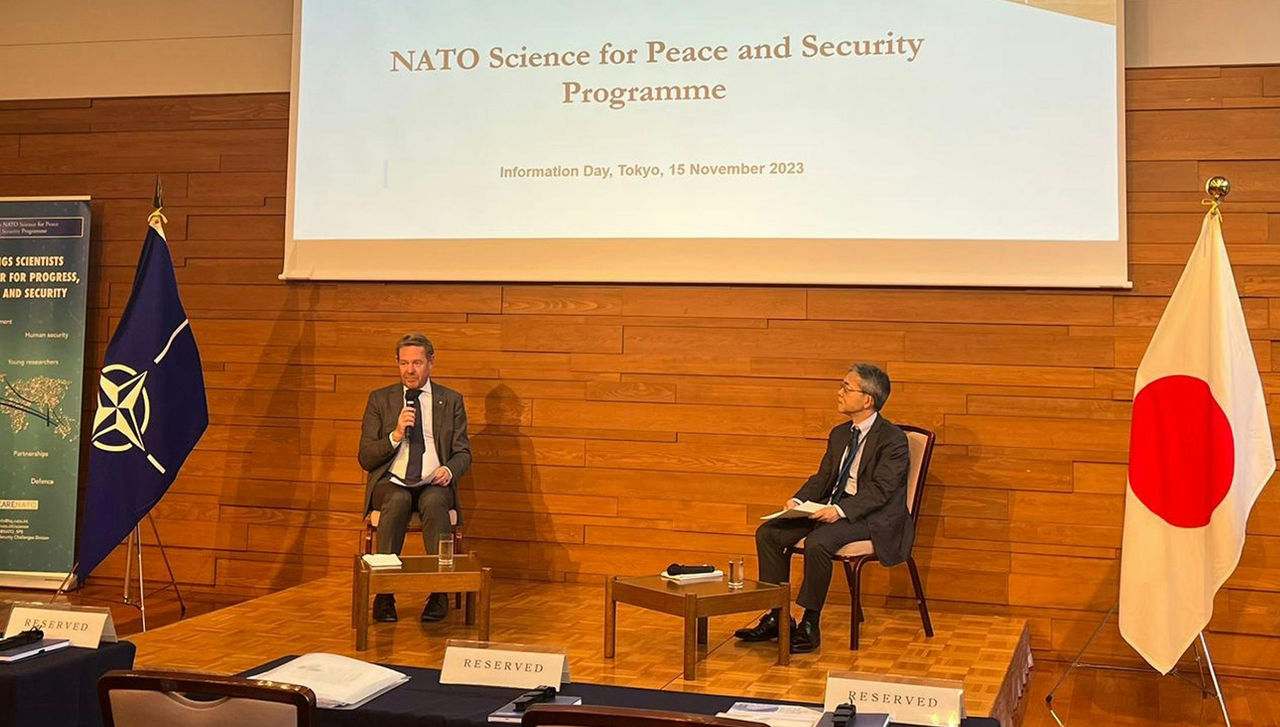
NATO Assistant Secretary General for Emerging Security Challenges David van Weel concluded a successful three-day visit to Japan on 15 November 2023. Deepening NATO-Japan cooperation on cyber defence, cutting edge technologies and defence against hybrid threats was at the core of all discussions with representatives from the Ministry of Foreign Affairs, the National Security Secretariat, the Ministry of Defence, including the Chief of Staff, the Acquisition, Technology and Logistics Agency, as well as with Japan’s scientific community and academia.
On 13 November, Mr van Weel participated in the NATO-Japan Symposium 2023 co-hosted by NATO, Tokyo University, Denmark and the EU. The event addressed the global and interconnected challenges of strategic competition and instability, hybrid threats and economic security.
On 15 November, Mr van Weel joined key decision-makers and experts from the Euro-Atlantic and the Indo-Pacific communities to discuss key geopolitical and security trends in the Indo-Pacific region and their implications for Alliance security. Discussions were part of a two-year ‘Bridging Allies’ initiative supported by the NATO Science for Peace and Security (SPS) Programme. The President of the National Institute for Defence Studies Takeshi Ishikawa also took part in the event.
Later that same day, Mr van Weel, together with Mr Masashi Nakagome, Director General, Ministry of Foreign Affairs of Japan, opened an SPS information day, during which scientists and subject-matter experts from NATO and Japan were briefed on current and future work under the SPS programme, and discussed ideas for future project proposals. The event was co-hosted by NATO, the Ministry of Foreign Affairs and the Ministry of Defence.
At the Vilnius Summit in July, NATO and Japan sealed a new partnership programme that will further enhance cooperation in a wide range of areas, including emerging security challenges and innovation, arms control, maritime security, space, supply chains and resilience. Over the past ten years of its participation in NATO’s SPS programme, Japan co-led 13 activities on topics such as the rapid healing of skin wounds, technologies for radiation detection, approaches and challenges to cyber defence and devices for demining operations.
Researchers from Japan, the Indo-Pacific region, as well as NATO and other partner nations are welcome to participate in SPS activities and share proposals for new research and development projects in the context of the newly launched SPS call for proposals.