
Close
Back


From now on you can download videos from our website
If you would also like to subscribe to the newsletter and receive our latest updates, click on the button below.
Enter the email address you registered with and we will send you a code to reset your password.
The password must be at least 12 characters long, no spaces, include upper/lowercase letters, numbers and symbols.
Click the button to return to the page you were on and log in with your new password.
05 October 2023
1 MIN READ
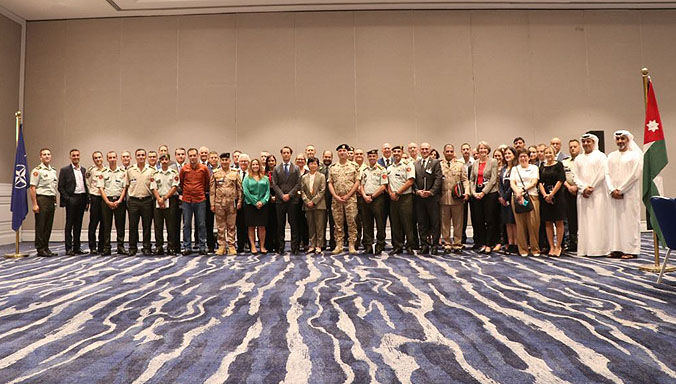
NATO and partner country Jordan co-hosted a conference on Small Arms and Light Weapons (SALW) control in Amman on 3 and 4 October 2023. The event was the first of its kind on SALW organised with partner countries, as part of NATO’s defence and related security capacity building package for Jordan.
The event provided an opportunity to reflect on initiatives, lessons learned, and best practices in SALW control in the Middle East and North Africa in particular, and to exchange views on challenges and potential solutions at regional and global levels. The participants included high-ranking officials from Allied and partner countries, along with representatives from international organisations including the United Nations, the European Union, the League of Arab States, Interpol and the World Customs Organisation.
The first three panels addressed challenges and initiatives undertaken at national, regional and global level respectively. The fourth panel focused on the impact that recent developments in manufacturing, technology and design of SALW have on the efforts to tackle the illicit trafficking of these weapons.
NATO has a long track record of contributing to SALW control. NATO supports partner countries in this area through various projects, including providing training courses, helping in the destruction of excess stockpiles of SALW and ammunition, assisting in the construction of infrastructure, and providing equipment. NATO has established an ad hoc working group on SALW and mine action that meets regularly in the Euro-Atlantic Partnership Council (EAPC) format. This forum of 50 NATO and partner countries is a key platform for information sharing, policy coordination and project implementation.
NATO supports the implementation of the UN Programme of Action to Prevent, Combat and Eradicate the Illicit Trade in SALW, adopted in July 2001. NATO has contributed to UN efforts to develop international standards for ammunition life-cycle management. NATO has also published guidelines on gender mainstreaming in the area of SALW based on International Small Arms Control Standards and UN Security Council Resolution 1325.