
Close
Back


From now on you can download videos from our website
If you would also like to subscribe to the newsletter and receive our latest updates, click on the button below.
Enter the email address you registered with and we will send you a code to reset your password.
The password must be at least 12 characters long, no spaces, include upper/lowercase letters, numbers and symbols.
Click the button to return to the page you were on and log in with your new password.
21 June 2023
1 MIN READ
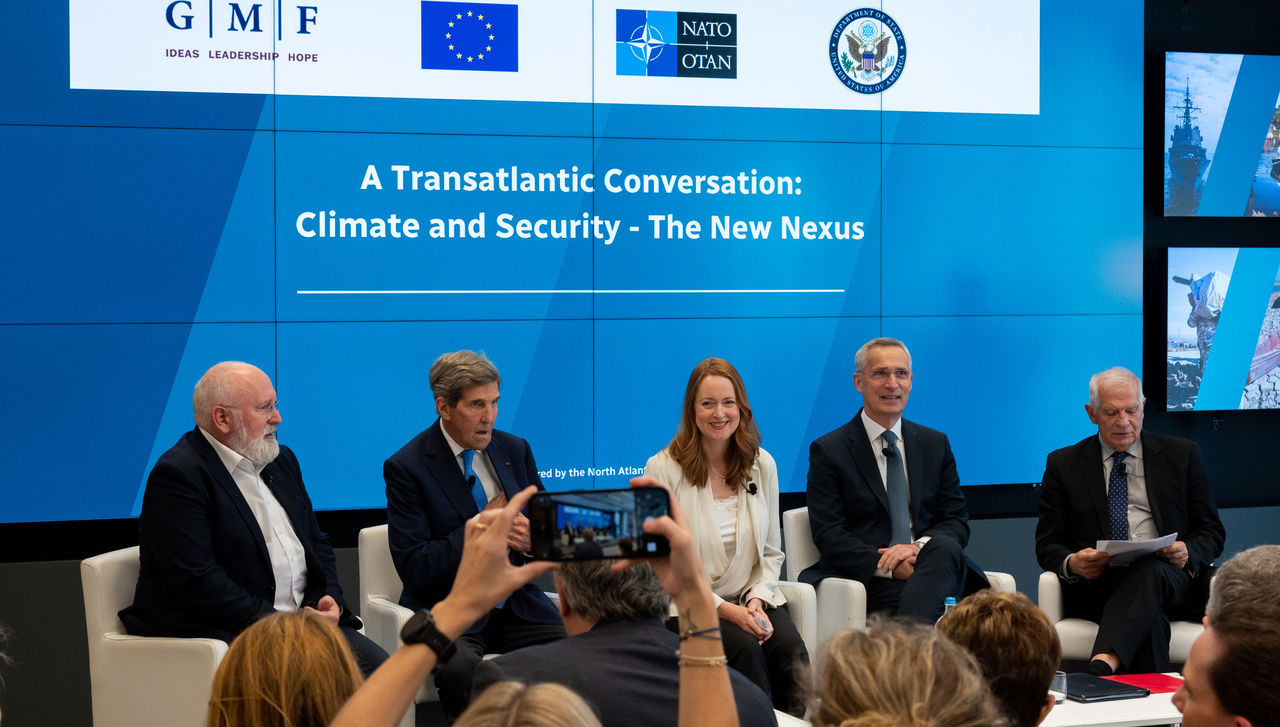
On 21 June, High Representative of the Union for Foreign Policy and Security Policy/Vice-President of the European Commission Josep Borrell, U.S. Special Presidential Envoy for Climate John Kerry, NATO Secretary General Jens Stoltenberg, and Executive Vice-President of the European Commission Frans Timmermans, met in Brussels to discuss the impacts of climate change on peace and security.
They reiterated that climate change and environmental degradation are an existential threat to the planet, and also have immediate, direct, and growing negative implications for security and defence.
To that end, NATO and the EU will continue to strengthen their cooperation to address the security implications of climate change. Building on NATO’s Climate Change and Security Action Plan, and the EU’s upcoming Joint Communication on the impact of climate change and environmental degradation on peace, security, and defence, the EU and NATO will explore possibilities for an intensified dialogue on the impact of climate change and security.
In the lead up to this year’s second annual NATO High-Level Dialogue on Climate Change and Security at the Vilnius Summit and the 2023 UN Climate Change Conference (COP28) in Dubai, they will seek to identify opportunities to cooperate on new insights and operational information about security aspects of climate change and environmental degradation, green standards, and energy efficiency, including to measure greenhouse gas emissions from military activities and installations with the goal of reducing these emissions.
They decided to continue high-level meetings on these issues, with the broad involvement of partners, including at COP28.