
Close
Back


From now on you can download videos from our website
If you would also like to subscribe to the newsletter and receive our latest updates, click on the button below.
Enter the email address you registered with and we will send you a code to reset your password.
The password must be at least 12 characters long, no spaces, include upper/lowercase letters, numbers and symbols.
Click the button to return to the page you were on and log in with your new password.
22 September 2022
1 MIN READ
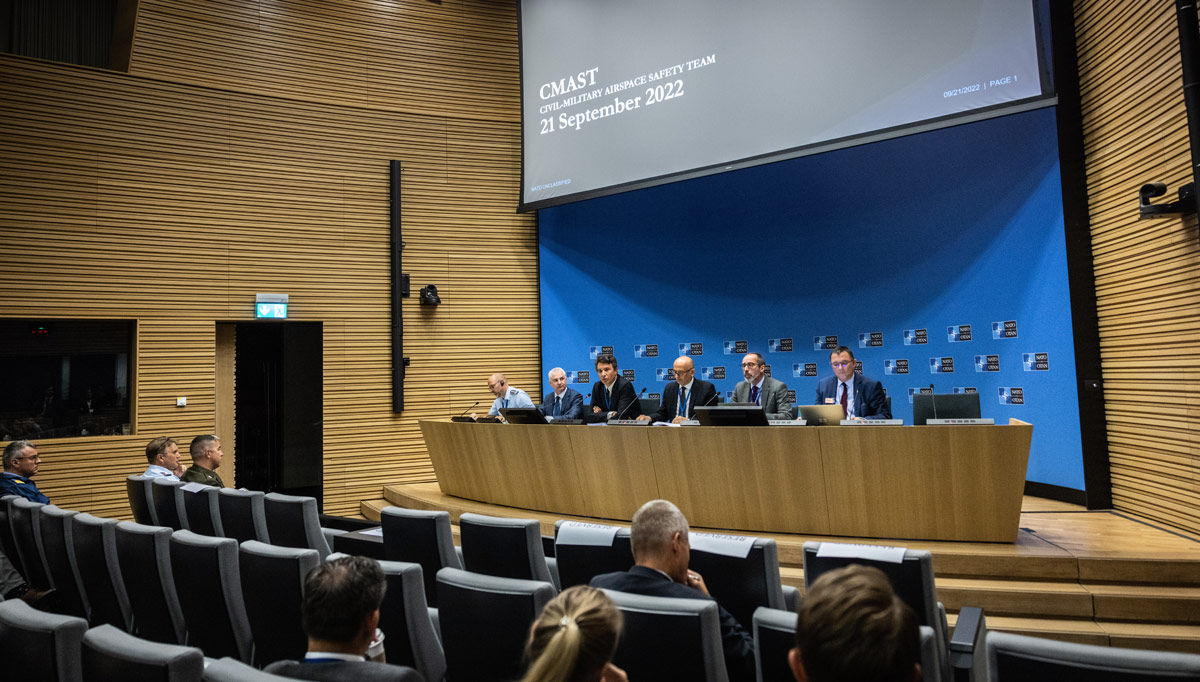
On Wednesday (21 September 2022), NATO hosted civil and military aviation experts as they addressed air safety following Russia’s invasion of Ukraine. The Civil-Military Airspace Safety Team (CMAST) workshop at NATO Headquarters Brussels brought together leading figures in aviation to discuss how civilian flights can continue to operate safely during Russia’s war against Ukraine.
The CMAST is part of NATO’s engagement with the international aviation community to create shared awareness, enhance civil-military cooperation and promote safety of air operations. Today’s workshop was an important opportunity to allow the sharing of information and best practice.
Russia’s further invasion of Ukraine in February 2022 resulted in the closure of Ukraine’s airspace to civilian flights and the unavailability of Russia’s airspace to European carriers causing cancellations and rerouting of civilian flights. NATO air activity has also increased in eastern Europe to keep the skies safe. Therefore, at a time where both civilian and military aircraft are present in close volumes of airspace, coordination among countries and institutions is of paramount importance.
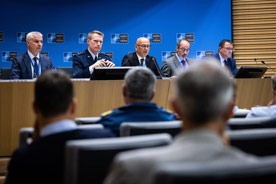
NATO Assistant Secretary General for Defence Investment Camille Grand said: “The Civil-Military Airspace Safety Team event reflects on NATO’s enduring commitment to promote transparency of our defensive air activities in response to Russia’s invasion of Ukraine, building reassurance with civilian air navigation service providers along NATO’s eastern flank and to maintain safety.”
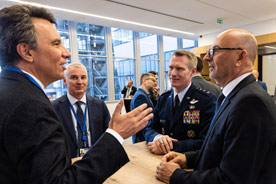
Allied and partner countries took part in the event, along with support from international aviation organisations including EUROCONTROL, the International Air Transport Association, the Civil Air Navigation Services Organisation and the European Aviation Safety Agency. NATO’s military leadership were also part of the discussions, including NATO Air Command and STRIKFORNATO, along with the United States Air Forces in Europe (USAFE).