
Close
Back


From now on you can download videos from our website
If you would also like to subscribe to the newsletter and receive our latest updates, click on the button below.
Enter the email address you registered with and we will send you a code to reset your password.
The password must be at least 12 characters long, no spaces, include upper/lowercase letters, numbers and symbols.
Click the button to return to the page you were on and log in with your new password.
05 September 2022
1 MIN READ
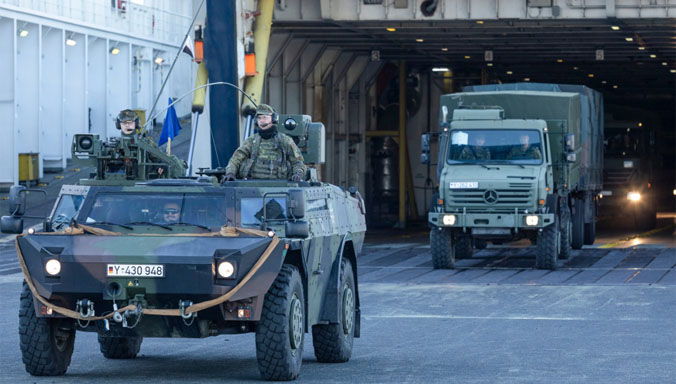
Around a hundred German soldiers arrived in Lithuania on Sunday (4 September 2022), part of NATO’s increased presence on the Alliance’s eastern flank following Russia's invasion of Ukraine.
The German troops make up the command unit of a new brigade, a force usually made up of around 3,000-5,000 soldiers. The soldiers are part of Germany’s 41st tank brigade and arrived in Klaipeda port by ferry from Kiel. The unit consists of about 100 personnel, as well as equipment for command and control, communications and logistics.
"The arrival of the first German troops as part of the NATO brigade represents an important step in strengthening NATO’s deterrence and defence at a critical time for our security, and sending a clear message that NATO will defend every inch of Allied territory,” said NATO Spokesperson Oana Lungescu.
The brigade’s command staff will remain permanently in the Baltic nation, while combat units will join them on rotation for exercises. At the Madrid Summit in June, NATO leaders decided to strengthen NATO’s forward defences, including by enhancing NATO’s battlegroups in the eastern part of the alliance up to brigade level. Germany, which leads the NATO battlegroup in Lithuania, already has some 1,500 soldiers in the country. The four NATO multinational battlegroups were set up in the Latvia, Lithuania, Estonia in Poland after Russia’s illegal annexation of Crimea in 2014. They were enhanced earlier this year in response to Russia’s full-fledged invasion of Ukraine, and four new battlegroups are being established in Bulgaria, Hungary, Romania and Slovakia.