
Close
Back


From now on you can download videos from our website
If you would also like to subscribe to the newsletter and receive our latest updates, click on the button below.
Enter the email address you registered with and we will send you a code to reset your password.
The password must be at least 12 characters long, no spaces, include upper/lowercase letters, numbers and symbols.
Click the button to return to the page you were on and log in with your new password.
11 July 2022
1 MIN READ
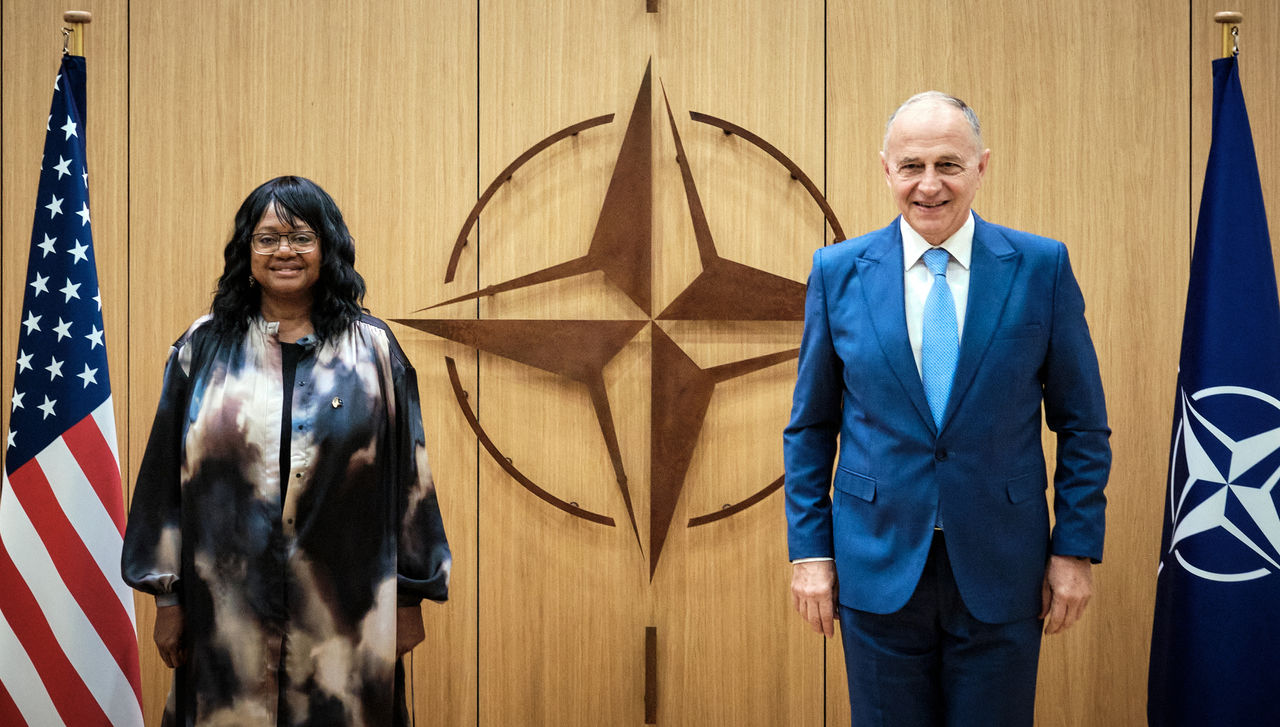
Today (11 July 2022), Ambassador Bonnie Denise Jenkins (US Under Secretary for Arms Control and International Security) visited NATO’s Headquarters, where she met with the NATO Deputy Secretary General, Mr. Mircea Geoană, and NATO Allies within the framework of the Special Advisory and Consultative Arms Control, Disarmament and Non-Proliferation Committee (ADNC).
Discussions were focused on three main themes: (1) Arms Control in the context of Russia’s war of aggression and of NATO’s new Strategic Concept, which was approved at the Madrid Summit; (2) ongoing preparations for the Tenth Review Conference of the Treaty on the Non-Proliferation of Nuclear Weapons (NPT) that will be held in August 2022; and (3) U.S. efforts and priorities in arms control and international security.
At the Madrid Summit, Allied leaders reaffirmed that strategic stability - delivered through effective deterrence and defence, arms control and disarmament, and meaningful and reciprocal political dialogue - remains essential to our shared security. Further Summit outcomes reinforced the importance of arms control, disarmament and non-proliferation to reducing risk and enhancing security, transparency, verification, and compliance. Allies also reaffirmed their commitment to continue pursuing all elements of strategic risk reduction, including tools that promote confidence-building and predictability through dialogue, increase understanding, and establish effective crisis management and prevention. NATO remains an important platform for in-depth discussion and close consultations on these and related efforts.