
Close
Back


From now on you can download videos from our website
If you would also like to subscribe to the newsletter and receive our latest updates, click on the button below.
Enter the email address you registered with and we will send you a code to reset your password.
The password must be at least 12 characters long, no spaces, include upper/lowercase letters, numbers and symbols.
Click the button to return to the page you were on and log in with your new password.
28 June 2022
2 MIN READ
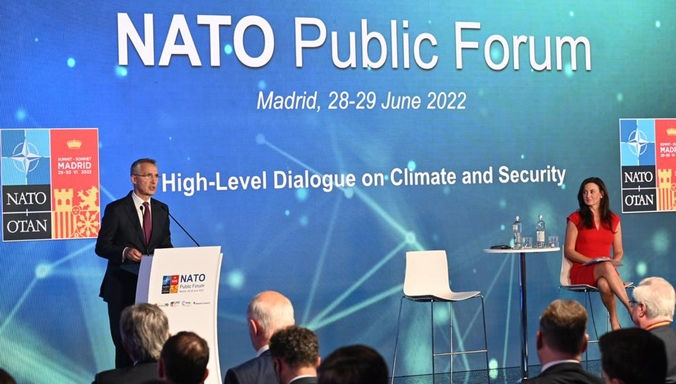
Speaking at the NATO Public Forum on 28 June 2022, the NATO Secretary General Jens Stoltenberg said that climate change is a crisis multiplier and it matters for NATO. Highlighting that “NATO is determined to set the gold standard on addressing the security implications of climate change”, Mr. Stoltenberg noted that the new Strategic Concept to be endorsed in Madrid states that climate change is a defining challenge of our time.
“Today, I am releasing our first assessment of how climate change affects our security, our military assets, installations and activities, as well as our resilience and civil preparedness,” Mr. Stoltenberg said. The Secretary General stressed that NATO must adapt, “providing our armed forces with the equipment they need to operate in extreme heat and cold; training them to assist in disaster relief; reinforcing our coastal facilities against rising water levels; and addressing the security implications of a more economic and military activity in the High North.” Referring to initial steps in NATO’s adaptation to climate change, Mr. Stoltenberg noted that “We now take account of climate change when planning our operations and missions; and when developing new capabilities. This way, we make sure we remain effective in increasingly harsh environments.”
He said that NATO must reduce the impact of military activities on the climate. “To this end, we have developed the first methodology for measuring NATO’s greenhouse gas emissions, civilian and military.” The methodology sets out “what to count and how to count it” and will be made available to all Allies to help them reduce their own military emissions. “This is vital, because what gets measured, can get cut”, Mr. Stoltenberg said. Highlighting that there is a “green energy revolution” happening right now, he stressed that this can be of “huge benefit” for militaries. “Already today, the best new cars are actual electric cars. And I believe that in the future, the most advanced military vehicles, and the most resilient armed forces, will be those that do not rely on fossil fuels”, he said.
The NATO Public Forum is being held at the margins of the NATO Summit in Madrid. It is the first High-Level Dialogue on Climate Change and Security, bringing together NATO Allies with partner nations and other stakeholders from around the world.