
Close
Back


From now on you can download videos from our website
If you would also like to subscribe to the newsletter and receive our latest updates, click on the button below.
Enter the email address you registered with and we will send you a code to reset your password.
The password must be at least 12 characters long, no spaces, include upper/lowercase letters, numbers and symbols.
Click the button to return to the page you were on and log in with your new password.
26 November 2021
1 MIN READ
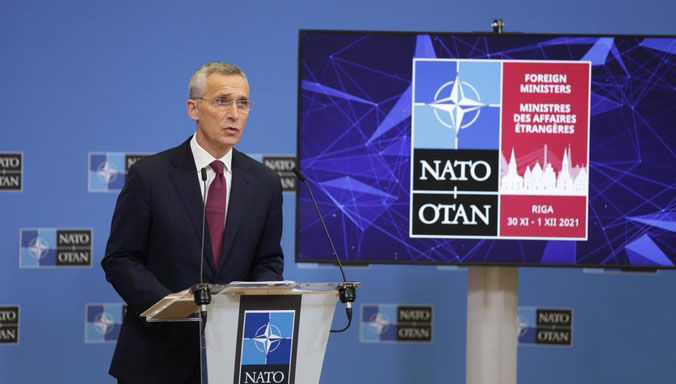
On Friday (26 November 2021), Secretary General Jens Stoltenberg outlined the priorities for the upcoming meeting of NATO Foreign Ministers in Riga, Latvia on 30 November and 1 December.
Mr Stoltenberg said that they will address the continuing build-up of Russian forces in and around Ukraine, saying: “It raises tensions and it risks miscalculation. Russia must show transparency, reduce tensions and de-escalate. NATO’s approach to Russia remains unchanged. We keep our defence and deterrence strong, while remaining open for dialogue.”
Ministers will discuss the situation in the region with NATO’s close partners Georgia and Ukraine. NATO Foreign Ministers will also address the situation on the border with Belarus and the Lukashenko regime’s exploitation of vulnerable people to put pressure on Allies Poland, Latvia, and Lithuania.
Ministers will exchange views on NATO’s role in arms control, disarmament and non-proliferation. The Secretary General said: “Since the Cold War, NATO reduced the number of nuclear weapons in Europe by more than 90%. All Allies support the goal of a world without nuclear weapons, and NATO is determined to maintain its leading role on arms control.”
Mr Stoltenberg also explained that ministers will also consult on NATO’s engagement in Afghanistan and identify the right lessons for future crisis management operations. He said ministers will also discuss NATO’s next Strategic Concept: “It needs to take account of new realities, including Russia’s aggressive actions, a more assertive China, emerging and disruptive technologies, and the security impact of climate change. It will drive our continued adaptation in a more competitive world.”
Ministers will also address developments in the Western Balkans and NATO’s continued role in promoting stability and security in the region. NATO’s partners Finland and Sweden will join this session, as well as EU High Representative Josep Borrell.