
Close
Back


From now on you can download videos from our website
If you would also like to subscribe to the newsletter and receive our latest updates, click on the button below.
Enter the email address you registered with and we will send you a code to reset your password.
The password must be at least 12 characters long, no spaces, include upper/lowercase letters, numbers and symbols.
Click the button to return to the page you were on and log in with your new password.
04 March 2021
1 MIN READ
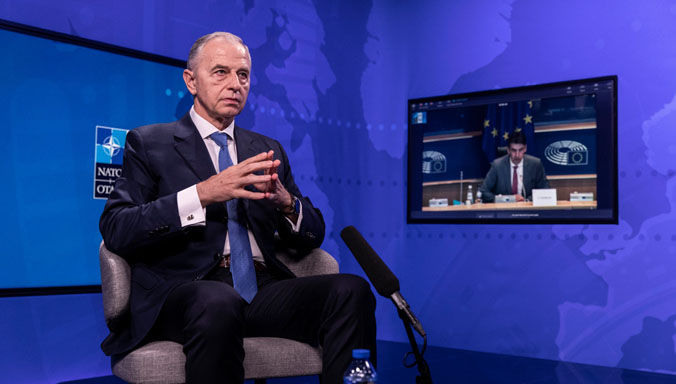
NATO’s Deputy Secretary General Mircea Geoană discussed the external policy dimension of Artificial Intelligence at the European Parliament today (04 March 2021). In a lively discussion with Members of the European Parliament from the Special Committee of Artificial Intelligence in a Digital Age, Mr. Geoană highlighted NATO’s importance as a transatlantic forum for collaboration and coordination on emerging and disruptive technologies (EDT) – as well as the potential of cooperation between NATO and the European Union (EU) in this area.
The Deputy Secretary General outlined NATO’s ongoing work to understand and adopt new technologies and maintain its edge, including the comprehensive roadmap on EDT adopted by NATO leaders in December 2019, and the implementation strategy agreed by Defence Ministers in February this year. He also drew attention to the Secretary General’s proposal for a NATO defence innovation push to promote better transatlantic cooperation on critical technologies, as part of the NATO 2030 initiative.
Artificial Intelligence brings about new opportunities for cooperation between NATO and the EU, Mr. Geoană emphasized. These include the exchange of best practices, but also coordinated efforts to develop the kind of regulation that can foster innovation and set global standards for the ethical use of AI.