
Close
Back


From now on you can download videos from our website
If you would also like to subscribe to the newsletter and receive our latest updates, click on the button below.
Enter the email address you registered with and we will send you a code to reset your password.
The password must be at least 12 characters long, no spaces, include upper/lowercase letters, numbers and symbols.
Click the button to return to the page you were on and log in with your new password.
25 February 2021
1 MIN READ
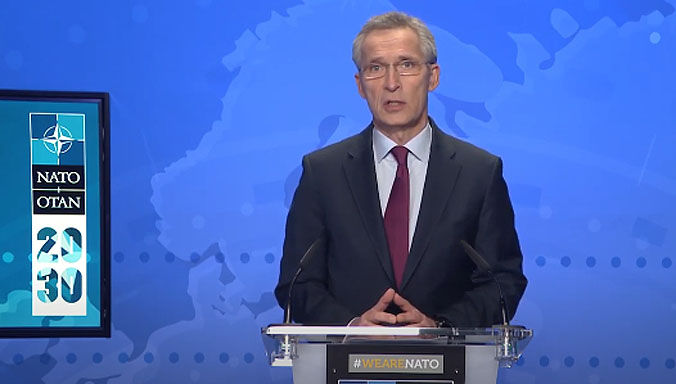
On 25 February 2021, at a high-level online conference, NATO discussed how to enhance its human security approach as part of a broader collective effort with an international community of interest including national experts, civil society, think tank and academic representatives.
NATO’s Secretary General Jens Stoltenberg opened the event. Human security is ‘at the heart of who we are and what we do: an Alliance working together to protect our people and our values – freedom, equality, human rights’, he said. ‘Taking a human security approach is the best way to achieve lasting peace and security’.
The Digital Dialogue on Human Security in NATO was moderated by Dr. Jamie Shea and brought together more than 500 participants. Clare Hutchinson, the NATO Secretary General’s Special Representative for Women, Peace and Security, Air Chief Marshal Sir Stuart Peach, Chairman of the NATO Military Committee, Professor Mary Kaldor, The London School of Economics and Political Science, Dr. Walter Dorn, Royal Military College of Canada and the Canadian Forces College, Eva Svoboda, International Committee of the Red Cross, also participated in the event.
NATO’s five main lines of effort under Human Security are: the protection of civilians; children and armed conflict; countering trafficking in human beings; preventing and responding to conflict-related sexual violence; and cultural property protection.
At NATO’s 2019 Leaders’ Meeting in London, Allies had agreed to step up NATO’s role in human security. In the coming months, new achievements are expected with the development of a NATO policy on preventing and responding to conflict-related sexual violence and the update of NATO’s policy on countering trafficking in human beings. NATO’s 2030 initiative will help take this agenda forward. Continued work on NATO’s Women, Peace and Security agenda also plays an important role in addressing the gender perspective of security.