
Close
Back


From now on you can download videos from our website
If you would also like to subscribe to the newsletter and receive our latest updates, click on the button below.
Enter the email address you registered with and we will send you a code to reset your password.
The password must be at least 12 characters long, no spaces, include upper/lowercase letters, numbers and symbols.
Click the button to return to the page you were on and log in with your new password.
27 May 2020
1 MIN READ
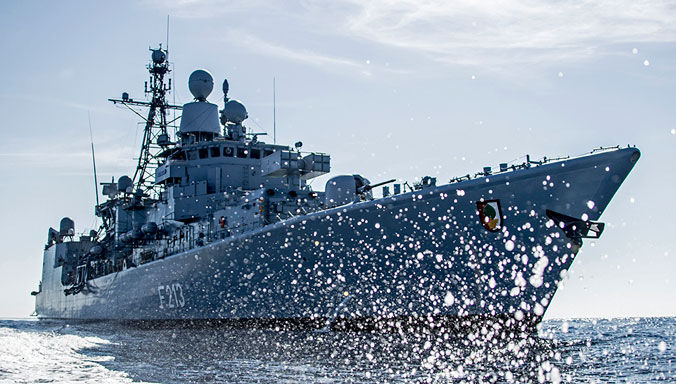
The NATO Communications and Information (NCI) Agency is enabling Allies to tap into satellite communications for their maritime operations and update the cryptographic equipment on their ships. This is an example of how NATO membership gives access to state-of-the art defence technology and the expertise to use it.
The NCI Agency has provided satellite coverage to the German Navy, whose newest asset – frigate FGS Baden-Wurttemberg – was running important tropical weather trials in the Caribbean earlier this spring. NATO experts based in Mons, Belgium, used military satellites to arrange sufficient bandwidth and connectivity to the vessel, helping the German Navy avoid a protracted and expensive tender, and allowing the frigate to execute its mission.
“Whenever they wish to convey a message of appreciation and gratitude, NATO mariners use the signal BRAVO ZULU. I would like to relay my BRAVO ZULU to all people that were involved in providing connectivity for FGS Baden-Wurttemberg,” said Captain Thomas Ackermann from the German Navy Headquarters.
NATO’s satellite communications capability is provided by France, Italy, the United Kingdom and the United States; all Allies can benefit from it. Given the importance of satellite communications for a wide range of activities, from intelligence gathering and navigation, to tracking forces around the globe and detecting missile launches, NATO intends to invest 1 billion EUR in satellite services in the next 15 years.
Meanwhile, the NCI Agency is also delivering important accessories that make it easier for Allies to replace cryptographic equipment on maritime vessels. This equipment is used for secure communications between ships participating in NATO missions and operations, and with the NATO Allied Maritime Command.