
Close
Back


From now on you can download videos from our website
If you would also like to subscribe to the newsletter and receive our latest updates, click on the button below.
Enter the email address you registered with and we will send you a code to reset your password.
The password must be at least 12 characters long, no spaces, include upper/lowercase letters, numbers and symbols.
Click the button to return to the page you were on and log in with your new password.
20 May 2020
2 MIN READ
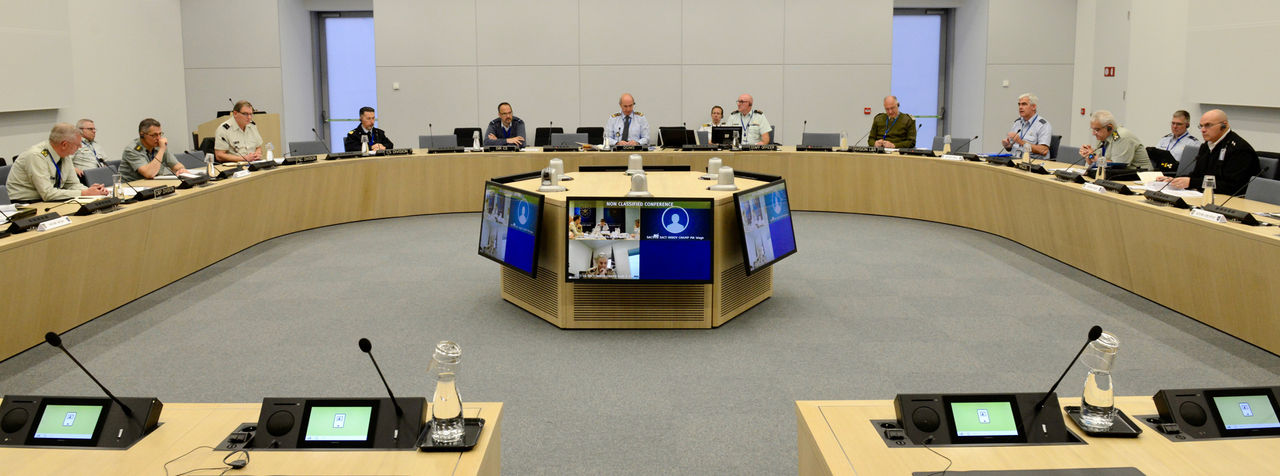
The Director General of the NATO International Military Staff (IMS), Lieutenant General Hans-Werner Wiermann (DGIMS) and, the Director General of the European Union Military Staff, Lieutenant General Esa Pulkkinen (EUMS) co-chaired the first NATO-EU bi-annual meeting this year on 19 May 2020. Due to the prevailing COVID-19 preventative measures, uniquely this conference was conducted by secure video-teleconference with a reduced number of participants in keeping with the social distancing requirements.
In his opening remarks Lieutenant General Pulkkinen emphasised that in spite of the COVID-19 pandemic joint EU and NATO efforts to improve Military Mobility and complete the EUMS’ affiliation to the Federated Mission Networking initiative are ongoing. Specifically relating to the COVID-19 crisis he also commented that “the depth of cooperation reported at our staff-to-staff and structured dialogue on Medical Cooperation has been most impressive particularly regarding the efforts in exchanging information and harmonising medical advice. These are all testament to the continuing strong cooperation between the EUMS and NATO IMS staffs”.
The meeting started with a joint assessment of the development of the Military Staff-to-Staff Informal Coordination Plan. This covered aspects ranging from Force Planning and Force preparation; logistic and medical collaboration; intelligence staff cooperation; as well as Communication and Information Systems and Cyber Defence cooperation with a look forward to the impending release in June of the 5th Joint Declaration Progress Report.
Subsequently, the Conference focused on the update on the implementation of the 74 common military related action items as stated in the Joint Declaration by the President of the European Council, the President of the European Commission and the Secretary General of the North Atlantic Treaty Organisation on NATO-EU relations first signed in December 2016 and later reaffirmed in July 2018 which seek to increase effectiveness and avoid duplication in processes.
Discussions then turned to the COVID-19 crisis and how it has impacted on NATO and EU cooperation. Medical cooperation has deepened with the focus shifting as the pandemic evolved to rapid and frequent information exchange and where possible the harmonisation of medical advice including occupational medical advice and preparatory recommendations for missions and operations. The focus is now moving towards different topics, such as best practice examples for aeromedical information, evaluation and practicability of different test capabilities.
Under the Berlin Plus framework, a more extensive exchange and support for EUFOR Althea has been established enabling a more comprehensive and practical approach to the benefit of both the EU and NATO. “Although we are amidst a global health crisis, working with partners like the EU enables us to have a coordinated and comprehensive approach to existing security challenges. NATO’s primary responsibility is to continue delivering credible and effective deterrence and defence. That is exactly what we are doing”, underscored Lieutenant General Wiermann.
Although COVID-19 has unavoidably caused the cancellation of some training exercises mutual invitations to observe each other’s exercises are ongoing with the EUMS invited to STEADFAST JUPITER-JACKAL 2020, while the IMS will be invited to observe MILEX21.
Then followed briefings from NATO's Allied Command for Transformation on Innovation and Emerging and Disruptive Technologies (EDT) and the Military Planning and Conduct Capability updated the meeting on its command and control transformation and the evolution of the EU military Common Security and Defence Policy training missions.
Since 2013, the DGs’ Conference has been held twice yearly with the participation of IMS Divisions and the Directors of all EUMS Directorates. It is organised in turn at NATO or the EU headquarters in Brussels.