
Close
Back


From now on you can download videos from our website
If you would also like to subscribe to the newsletter and receive our latest updates, click on the button below.
Enter the email address you registered with and we will send you a code to reset your password.
The password must be at least 12 characters long, no spaces, include upper/lowercase letters, numbers and symbols.
Click the button to return to the page you were on and log in with your new password.
12 October 2018
2 MIN READ

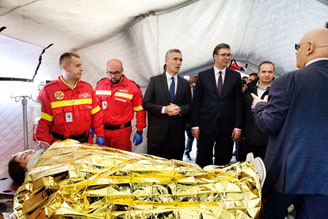
Two disaster relief tools, namely a multinational telemedicine facility and the Next-Generation Incident Command System, were tested during a civil preparedness exercise in Serbia from 8 to 11 October 2018. These tools were developed in the framework of NATO’s Science for Peace and Security (SPS) Programme.
Around 2,000 personnel from about 40 countries trained together in Serbia in a large-scale emergency response exercise based on an earthquake scenario. The exercise provided the opportunity to practise international cooperation and strengthen the ability of teams from different nations to work effectively together to save lives in an emergency situation. “The lessons we learn this week will help us to save more lives in the years to come,” said NATO Secretary General Jens Stoltenberg, who attended the inauguration of the exercise together with President of the Republic of Serbia Aleksandar Vucić.
Increasing the connectivity between first responders
During the event, the Next-Generation Incident Command System (NICS) was tested. This modern communication tool provides situational awareness for widely dispersed first responders and facilitates collaboration among them. It can be used on mobile devices and allows for an easy transfer of information, for example through shared maps. This technology is being implemented in Bosnia and Herzegovina, Croatia, Montenegro and the former Yugoslav Republic of Macedonia1 complementing and connecting existing emergency response systems.
Developing a telemedicine system for emergency situations
Furthermore experts demonstrated the added value of NATO’s multinational telemedicine capability. “This project contributes to increased survival rates and is applicable both in the military and the civilian context,” explained Dr Eyüp Turmus, SPS Advisor and Programme Manager.
In order to save lives in emergency situations, swift access to specialised expertise is essential. This project puts first responders, through modern communication technologies, in direct contact with medical specialists who can assess patients and provide real-time recommendations. The uniqueness of this project lies in its ability to interconnect various national telemedicine capabilities and cultivate an international network of medical specialists.
Working with partners
“Srbija 2018” is the biggest exercise organised by NATO's Euro-Atlantic Disaster Response Coordination Centre (EADRCC), and the first to be hosted by Serbia, a NATO partner. It offers a platform to test technologies such as those developed under the SPS Programme, which aims to promote dialogue and practical cooperation between NATO member and partner nations based on scientific research, technological innovation and knowledge exchange.
1.Turkey recognises the Republic of Macedonia with its constitutional name.