
Close
Back


From now on you can download videos from our website
If you would also like to subscribe to the newsletter and receive our latest updates, click on the button below.
Enter the email address you registered with and we will send you a code to reset your password.
The password must be at least 12 characters long, no spaces, include upper/lowercase letters, numbers and symbols.
Click the button to return to the page you were on and log in with your new password.
24 November 2017
1 MIN READ
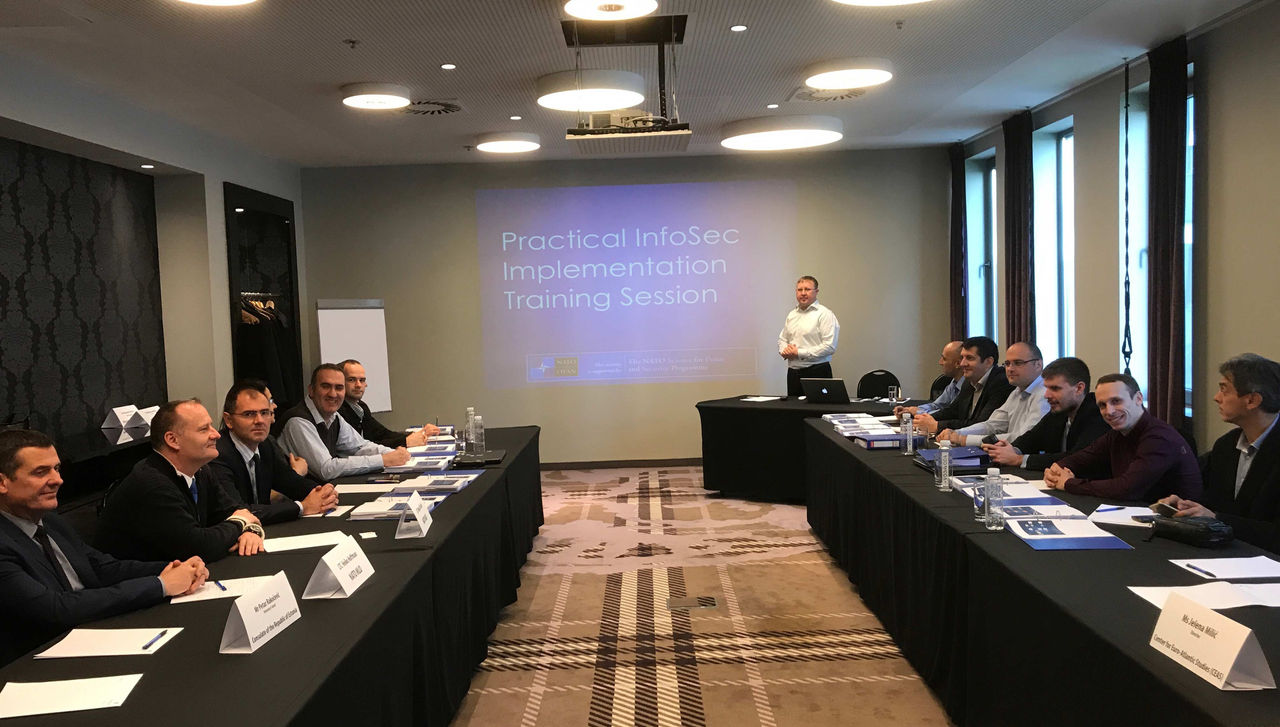
Civil servants from the Office of the National Security Council and Classified Information Protection of the government of Serbia were trained to deal with information systems security (INFOSEC) in real life situations. The training took place in Belgrade and Tallinn from 30 October until 10 November 2017 as part of NATO’s Science for Peace and Security (SPS) Programme.
INFOSEC policy is very important for any organisation as it can provide an additional tool to deal with cyber threats. The SPS advanced training course offered a combination of theoretical and practical sessions designed to respond to real life situations that could potentially be encountered by the 12 participants, with a focus on the actual INFOSEC implementation within their respective organisations.
The course addressed specific cyber security concerns, such as crisis management and protection of classified information that the participants have encountered or are currently dealing with. They learned how to develop and implement specific toolkits and roadmaps to address INFOSEC policies within an institutional framework. The participants also learned best practice approaches that help managers to track, plan and monitor activities in implementing INFOSEC within their organisations.
“It was an excellent opportunity for us to enhance the cooperation between NATO and Serbia in the field of information security. We would like to emphasise the high motivation and good spirit of the group that made the event a success,” said Major General (Ret.) Vello Loemaa of the European Cyber Security Initiative in Estonia, which is the institution that organised the training in coordination with Serbia’s Office of the National Security Council and Classified Information Protection. “We are looking forward to continue the cooperation for secure cyberspace,” he added.
Over the last years, Serbia has become increasingly active within the framework of the SPS Programme. Leading areas of cooperation include cyber defence, defence against chemical, biological, radiological and nuclear (CBRN) agents, counter-terrorism, the Women, Peace and Security agenda, energy, and environmental security.