
Close
Back


From now on you can download videos from our website
If you would also like to subscribe to the newsletter and receive our latest updates, click on the button below.
Enter the email address you registered with and we will send you a code to reset your password.
The password must be at least 12 characters long, no spaces, include upper/lowercase letters, numbers and symbols.
Click the button to return to the page you were on and log in with your new password.
28 September 2017
2 MIN READ
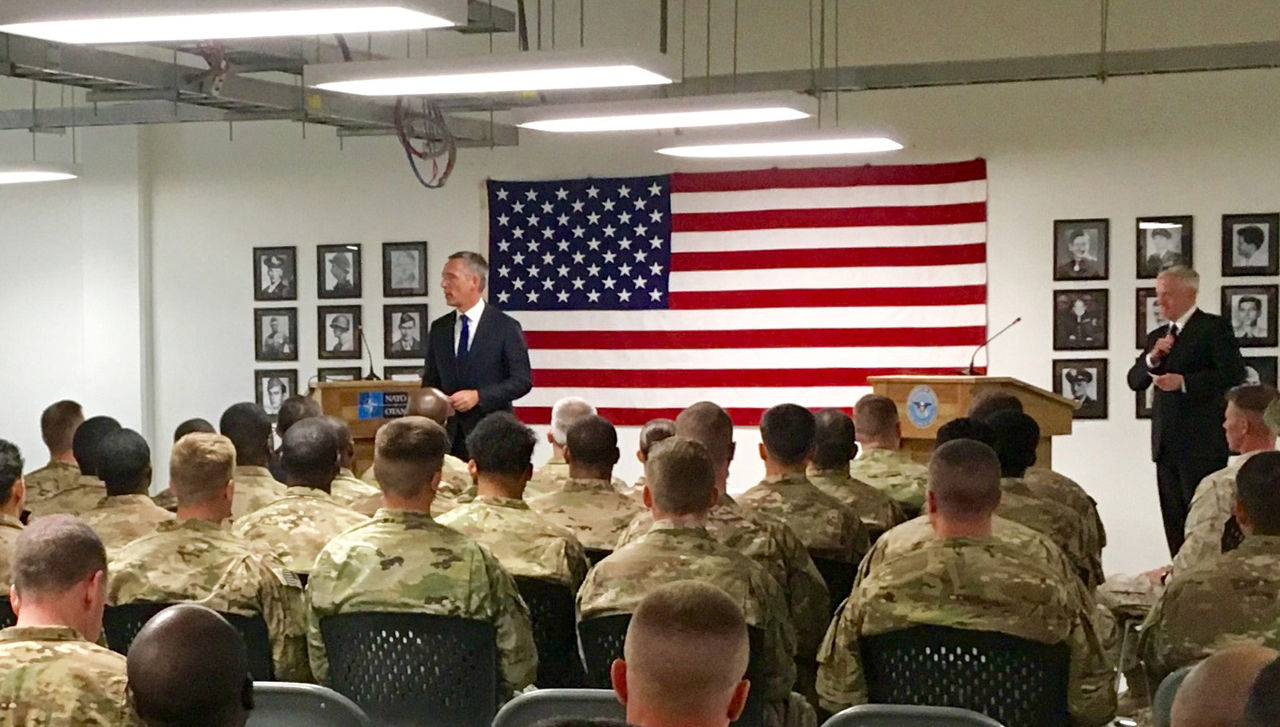
NATO Secretary General Jens Stoltenberg concluded a two-day visit to Afghanistan on Thursday (28 September 2017), following a visit to NATO’s headquarters for southern Afghanistan. The Secretary General received operational briefings from senior military leaders at NATO’s Train Advise and Assist Command in Kandahar, and addressed troops from Allied and partner countries together with General Nicholson, the Commander of the NATO-led Resolute Support mission.
During this visit to Afghanistan together with U.S. Defense Secretary James Mattis, Secretary General Stoltenberg stressed NATO’s support for the Afghan people, for the government’s reforms, and for an Afghan-owned and led peace and reconciliation process. Speaking in Kabul on Wednesday (27 September 2017), Mr Stoltenberg acknowledged that NATO’s presence in Afghanistan has come “at great human cost”, but stressed that the costs of leaving would outweigh those of remaining. “If NATO leaves, we risk Afghanistan returning to a state of chaos: a safe haven for international terrorism.”
Mr. Stoltenberg added that “NATO doesn’t quit when the going gets tough”, welcoming pledges by many nations to make further contributions to the NATO-led Resolute Support Mission to train, advise and assist the Afghan security forces and institutions. The Secretary General welcomed the fact that the Afghan forces “have come a very long way” with NATO’s help, and that they now “lead the fight against the Taliban and international terrorist groups”.
In their meetings, the Secretary General, President Ghani, Chief Executive Abdullah Abdullah and Secretary Mattis discussed the security situation in Afghanistan and reviewed the government’s reforms. Mr. Stoltenberg underlined that “we count on the Afghan government to make good on its commitments”, including reforms on rule of law, fighting corruption and protecting the rights of women and children. He further welcomed President Ghani’s initiative for peace and reconciliation, encouraging “all countries in the region to support this process”. Stoltenberg emphasised that NATO was committed to funding the Afghan security forces until at least 2020, and would continue to provide almost $1 billion in financial support each year.
The Secretary General and Secretary Mattis also held a meeting with senior Afghan officials, including Defence Minister Tariq Shah Bahrami, Interior Minister Wais Ahmad Barmak, National Directorate of Security Director Mohammad Masoom Stanekzai, and National Security Advisor Mohammad Hanif Atmar. The Secretary General also met separately with General John Nicholson, the Commander of the Resolute Support Mission and Ambassador Cornelius Zimmermann, NATO’s Senior Civilian Representative in Afghanistan, as well as with representatives of the Afghan civil society.