
Close
Back


From now on you can download videos from our website
If you would also like to subscribe to the newsletter and receive our latest updates, click on the button below.
Enter the email address you registered with and we will send you a code to reset your password.
The password must be at least 12 characters long, no spaces, include upper/lowercase letters, numbers and symbols.
Click the button to return to the page you were on and log in with your new password.
10 July 2017
2 MIN READ
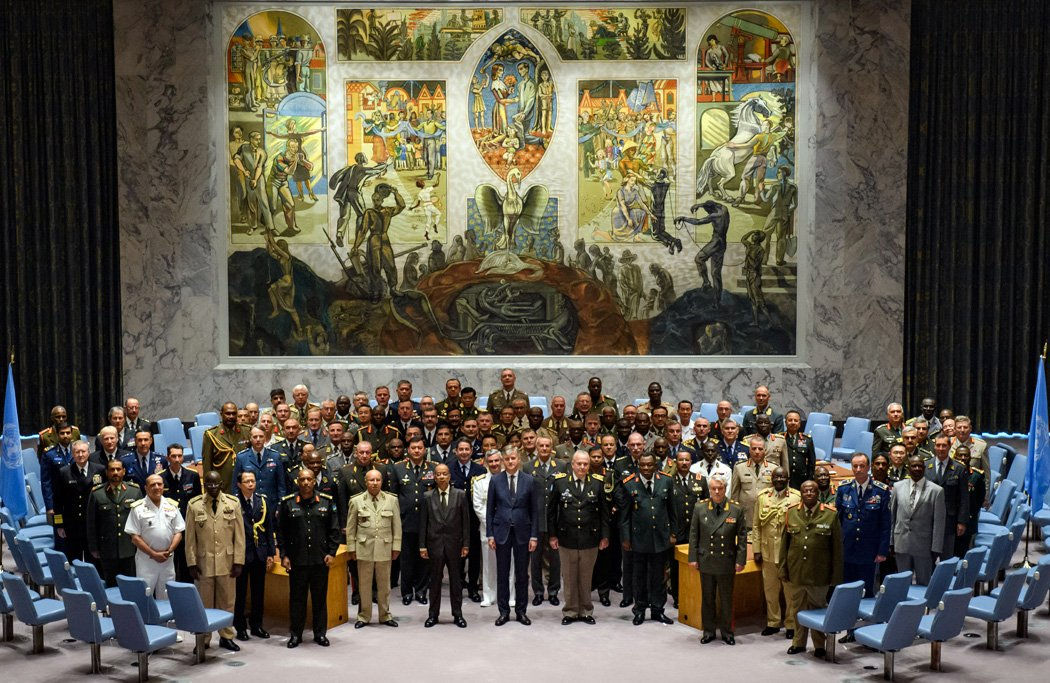
On 6-7 July 2017, Lieutenant General Steven M. Shepro, Deputy Chairman of the NATO Military Committee, represented NATO at the second edition of the United Nations Chiefs of Defence Conference in New York.
The United Nations Chiefs of Defence Conference brought together chiefs of defence (CHoDs) and senior military officials from more than 100 Member States as well as representatives from international organisations such the European Union and the North Atlantic Treaty Organisation. Topics of discussions included issues central to UN Peacekeeping in an ever-evolving security environment.
This year’s edition, which was the first time NATO was invited to participate, focused on the common understanding of the strategic and operational environment since 2015, the ways to better address the most urgent challenges as well as Force Generation, Rapid Deployment, Mission Support, Gender Perspectives and Training. Lieutenant General Shepro acknowledged the importance of such a conference, “it was good to join this important forum as NATO and the UN share a commitment to projecting international peace and stability. We share similar challenges and by working together we can be more coherent, more capable and more effective in our efforts”.
The conference was also an opportunity for Lieutenant General Shepro to discuss enhanced coordination with the Military Advisor of the UN, General Loitey, Deputy Military Advisor of the UN, General Foster and the Chairman of the EU Military Committee, General Mikhail Kostarakos.
NATO and the UN have been cooperating since the early 1990’s on peace-support and crisis-management operations. Enhanced cooperation with the UN – and other international actors like the EU and the OSCE – is an integral part of NATO’s contribution to a “Comprehensive Approach” to crisis management and operations. At the 2015 Leaders’ Summit on Peacekeeping, the NATO Secretary General pledged to enhance support to the UN, in particular in the areas of countering improvised explosive devices, training and preparedness, supporting the UN’s efforts to deploy more rapidly and working more closely on capacity building in countries at risk, both with the UN Nations and the EU.
In video-recorded remarks, the Secretary-General, António Guterres, welcomed the participants to New York and stressed that peacekeeping partnerships had never been more pressing and relevant than today. The Secretary-General also urged “Member States to contribute to the UN’s objective of increasing female participation in its operations, and to integrate a gender-sensitive perspective in all their efforts”.
After a moment of silence for fallen peacekeepers, the Under-Secretary-General for Peacekeeping Operations, Mr. Lacroix opened the conference addressing the participants and highlighting three priorities: strengthening the planning and management of peacekeeping operations; continuing to improve on the delivery of protection of civilian mandates; and pursuing partnerships with regional and other counterparts.