
Close
Back


From now on you can download videos from our website
If you would also like to subscribe to the newsletter and receive our latest updates, click on the button below.
Enter the email address you registered with and we will send you a code to reset your password.
The password must be at least 12 characters long, no spaces, include upper/lowercase letters, numbers and symbols.
Click the button to return to the page you were on and log in with your new password.
09 January 2017
1 MIN READ
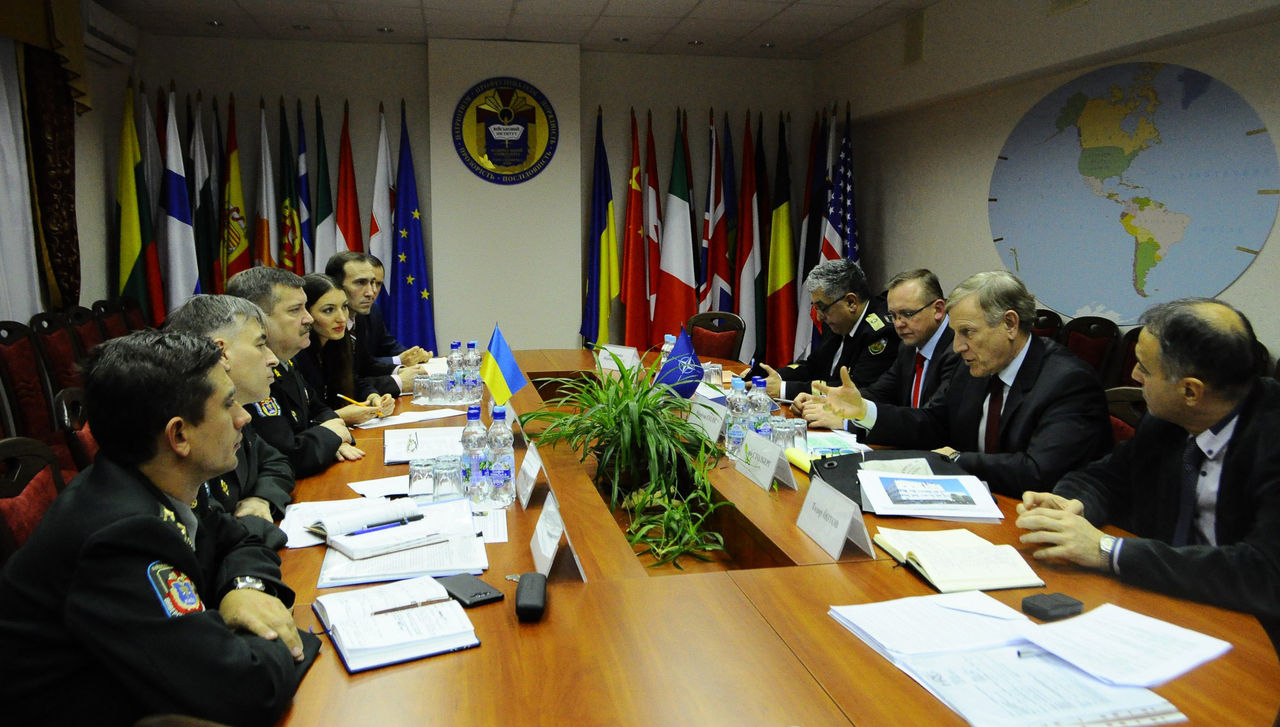
On 12-15 December 2016, a review was conducted of Ukraine’s Defence Education Enhancement Programme (DEEP) with officers from six military educational institutions in Lviv, Odessa, Zhytomyr and Kyiv.
DEEP marks three years and a half of intense work in Ukraine with the support of 14 NATO Allies. This year specifically marks the end of Phase I of the Programme, which focused on institutional and organisational adaptation as well as faculty development. As of 2017, DEEP Ukraine will focus on curriculum development in line with NATO standards.
Over the course of the past years, Ukraine managed to adapt its structures to be highly efficient in offering teaching programmes and activities for new officers and establishing significant connections with major defence universities and academies in NATO member states to this purpose.
''Our work within the DEEP Programme is very important in the context of these changes, whose final result would be the introduction of teaching activities for new officers, the improvement of the overall teaching staff trainings, NCOs trainings, curricula, distance learning and English language teaching,'' stated the First Deputy Minister of Defence of Ukraine, Ivan Rusnak.''We have to change our military education system in such a way that a graduate could start to execute his/her tasks as soon as possible after assignment to a unit.''
On the occasion of the visit of DEEP experts, the First Deputy Minister of Defence emphasised the positive outcomes and successful achievements of the programme in Ukraine. He reiterated Ukraine’s commitment to reform military education and establish a professional corps of non-commissioned officers with a long-term perspective for the future.
The parties discussed the results of their cooperation in 2016, as well as a possible continuation until 2020 in synchronisation with the overall efforts towards the reform of the Ukrainian Armed Forces.