
Close
Back


From now on you can download videos from our website
If you would also like to subscribe to the newsletter and receive our latest updates, click on the button below.
Enter the email address you registered with and we will send you a code to reset your password.
The password must be at least 12 characters long, no spaces, include upper/lowercase letters, numbers and symbols.
Click the button to return to the page you were on and log in with your new password.
27 May 2016
2 MIN READ
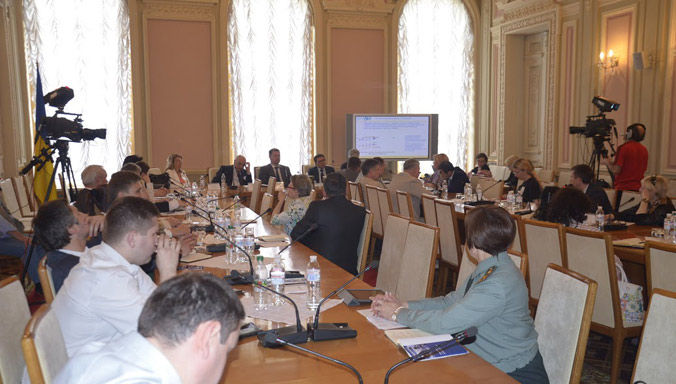
The NATO Science for Peace and Security (SPS) Programme project “A Multinational Telemedicine System for Emergency Situations” was a key topic of a round-table discussion at the Ukrainian Parliament in Kyiv on 27 May 2016, that was broadcast live on Ukrainian national TV. The high-level event was hosted by Dr Olga Bogomolets, Chairman of the Committee of the Ukrainian Parliament on Healthcare, and Advisor to the President of Ukraine on Humanitarian Issues.
In Ukraine, the average time for an ambulance to reach the wounded is 40 minutes, making it the third highest cause of death. Police officers, on the other hand, reach the emergency scene within 5 to 10 minutes. “If police officers would possess telemedicine equipment and were trained to give life support to wounded people, many lives could be saved through telemedicine,”explained Dr Bogomolets.
Dr Raed Arafat, Secretary of State in the Department of Emergency Situations of the Romanian Ministry of Interior and Director of the SPS telemedicine project, supports this view. “A multinational telemedicine system can save lives in case of disaster and conflict, based on practical experience,” he emphasised.
Developing such a capability, including an international network of medical specialists, in order to improve access to health services and survival rates in emergency situations is the main goal of the SPS flagship project. This collaborative project is jointly led by scientists and experts from Romania, the United States, Finland, the Republic of Moldova and Ukraine. The SPS Programme is supporting it through the provision of advanced equipment and training.
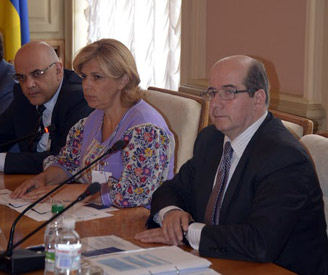
The round-table discussion on the implementation of a national system of telemedicine and paramedicine in Ukraine gave experts the opportunity to discuss recent developments in the field. In his speech, Ambassador Sorin Ducaru, NATO Assistant Secretary General for Emerging Security Challenges, reminded the audience that the SPS project “is unique through its aim to connect different ‘isolated islands’ of telemedicine in one single capability that can have a huge impact for future NATO missions and for civilians within the Euro-Atlantic territory and beyond”.
The system that is applicable to both to the civilian and military sector, will enable telemedicine to cross national borders, allowing medical specialists to engage in major disasters or incidents that require specialised expertise or that are in need of humanitarian aid. Portable medical kits will allow first responders to connect to the system to receive advice from medical specialists in case of an emergency, even in remote areas.
Through the use of modern communication technologies, an international network of medical specialists will be able to assess patients, diagnose them and provide real-time recommendations. This will allow the right aid and care to reach those who need it most quickly, with the potential to save many lives in disasters.
The system was successfully live-tested in September 2015 during the NATO “Ukraine 2015” consequence management field exercise. It was the first time that independent national telemedicine systems interacted to provide medical support in a disaster scenario.
Recently, Ukrainian experts, led by Dr Bogomolets, visited their counterparts in Romania in order to identify best practices in the field of telemedicine and emergency response and visit the emergency response training centre. A telemedicine group also went to Ukraine for an assessment visit where future areas of cooperation in the field of telemedicine were explored. They gave their expert advice in order to identify capacity building measures that could potentially be provided to Ukraine within the framework of the ongoing telemedicine project.