
Close
Back


From now on you can download videos from our website
If you would also like to subscribe to the newsletter and receive our latest updates, click on the button below.
Enter the email address you registered with and we will send you a code to reset your password.
The password must be at least 12 characters long, no spaces, include upper/lowercase letters, numbers and symbols.
Click the button to return to the page you were on and log in with your new password.
07 March 2016
2 MIN READ
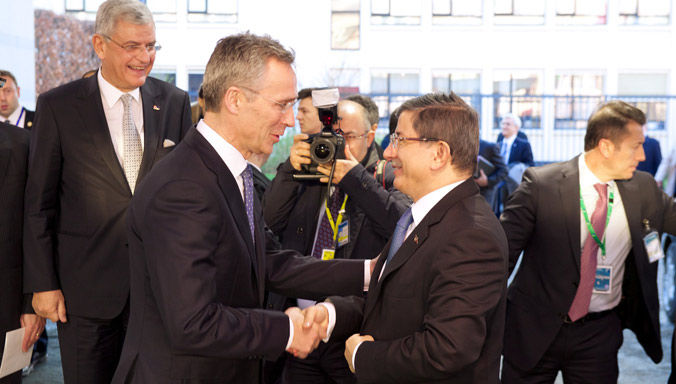
NATO Secretary General Jens Stoltenberg and Turkish Prime Minister Ahmet Davutoğlu met on Monday (7 March 2016) to discuss the conflict and instability on NATO’s southern borders. Mr. Stoltenberg thanked Turkey for its efforts to tackle the current refugee and migrant crisis and stressed that NATO stands in solidarity with Turkey.
The Secretary General underlined that Turkey is generously hosting more than two and a half million refugees and is “bearing the brunt of the greatest refugee and migrant crisis since the Second World War in Europe.” He also praised Turkey’s commitment to NATO’s surveillance deployment in the Aegean Sea. NATO ships are currently collecting information and conducting monitoring to support Turkey, Greece and the EU’s border agency Frontex in their efforts to tackle human trafficking and the criminal networks. Earlier today, the Secretary General also met with Greek Defence Minister Panos Kammenos to discuss the details of NATO’s deployment.
“Over the week-end, we decided to step up our efforts and our support to assist international efforts to deal with the crisis. We are expanding the area of activity into the territorial waters of Turkey and Greece, in close coordination with both Allies. So NATO is starting activities in territorial waters today. We are expanding our cooperation with the EU’s border agency FRONTEX. And we are expanding the numbers of ships in our deployment”, the Secretary General said in a joint press point with Prime Minister Davutoğlu.
Mr. Stoltenberg explained that NATO’s Maritime Command has exchanged letters with Frontex. “This will allow us to exchange liaison officers and to share information in real time. So that Frontex, as well as Greece and Turkey, can take even more effective action. This is a great example of how NATO and the European Union can work together to address common challenges,” said the Secretary General.
During his meeting with Prime Minister Davutoğlu, the Secretary General also discussed the situation in Syria. As part of NATO support to assist with the refugee and migrant crisis, Allies have decided to intensify intelligence, surveillance and monitoring along the Turkish-Syrian border. “This will complement the assurance measures for Turkey we decided late last year, including more AWACS presence and an increased naval presence,” said Mr. Stoltenberg. He added that NATO will also continue to augment Turkey’s air defences with Patriots.
The Secretary General underlined that the Syrian ceasefire remains the best possible basis for renewing efforts to reach a negotiated, peaceful solution to the crisis in Syria. He added that NATO remains concerned by the Russian military build-up in Syria and the eastern Mediterranean: “Russia’s military activity in the region has fuelled the humanitarian crisis and driven more people to Turkey’s borders. It has also caused violations of NATO airspace. So more than ever, it is important to see calm, de-escalation and dialogue.”