
Close
Back


From now on you can download videos from our website
If you would also like to subscribe to the newsletter and receive our latest updates, click on the button below.
Enter the email address you registered with and we will send you a code to reset your password.
The password must be at least 12 characters long, no spaces, include upper/lowercase letters, numbers and symbols.
Click the button to return to the page you were on and log in with your new password.
17 December 2015
2 MIN READ

NATO is working with the Mongolian National Defence University (MNDU) as part of the Defence Education Enhancement Programme (DEEP) to strengthen the provision of military education in Mongolia. The first class of the Mongolian Staff Officer Course (MSOC) successfully graduated on 11 December 2015.
Cooperation through DEEP aims at cementing collaboration between Mongolian and NATO country professional military education institutions. This has helped to modernise teaching methods and curriculum, strengthen the interagency dimensions of the MNDU's academic programme, and carve out a niche for Mongolia as a provider in the NATO and partner education and training community.
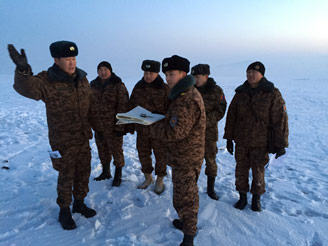
Speaking before the new class of graduating officers, Major General Yadmaa Choijamts, President of the MNDU, expressed his hope that "future cooperation will strengthen day by day." He highlighted the significance of the new Mongolian Staff Officer Course: “This course will play an active role in preparing the high-level staff officer corps in not only in our Armed Forces, but also in other national security agencies.”
DEEP-Mongolia was initiated in 2013 at the request of the Mongolian Ministry of Defence. The programme has bolstered the MNDU's faculty and curriculum development efforts through the academic co-leadership of the George C. Marshall Center and the active involvement of experts from institutions such as the German Staff College in Hamburg and the Slovak Armed Forces Academy in Liptovský Mikuláš.
Through DEEP, Mongolia has taken an integrated approach to officer professional development, as demonstrated by the presence of the Commander of Mongolia’s Land Forces at the MSOC graduation as well as high-ranking representatives from the Law Enforcement University, Police Academy and National Emergency Management Agency.
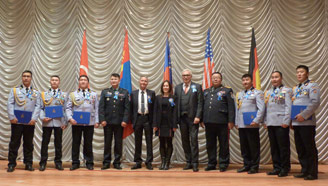
Mongolia and its partners reviewed annual progress achieved on the reform of professional military education at the MNDU from 9 to 11 December 2015. Colonel D. Baasandamba, MNDU Vice President for Academics, explained that Mongolia is "in the process of moving to a new PME system. DEEP's support to faculty development reaches throughout the NDU, bringing about a culture shift at all levels, from tactical to strategic."
DEEP is active in NATO member and partner countries. Through tailored activities, it provides a platform for the sharing of methods and lessons learned, as well as exchange of expertise in counter-terrorism, operational design, exercise planning and crisis management. It has grown since 2007 to support reform in more than a dozen countries, thanks to contributions of more than 70 defence and security studies institutes and the co-leadership of the Partnership for Peace Consortium, co-located with the George C. Marshall Center in Garmisch-Partenkirchen, Germany.