
Close
Back


From now on you can download videos from our website
If you would also like to subscribe to the newsletter and receive our latest updates, click on the button below.
Enter the email address you registered with and we will send you a code to reset your password.
The password must be at least 12 characters long, no spaces, include upper/lowercase letters, numbers and symbols.
Click the button to return to the page you were on and log in with your new password.
05 March 2015
2 MIN READ
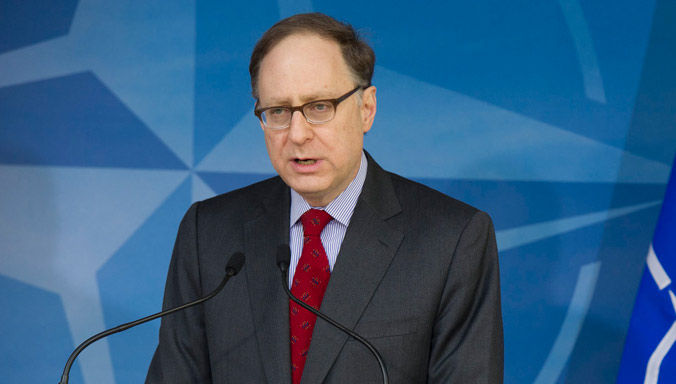
NATO Deputy Secretary General Ambassador Alexander Vershbow has called for deeper cooperation between NATO and the European Union in the fight against new security threats. “We need to work together to manage crises, bring relief, and project stability beyond our borders,” he said. Ambassador Vershbow made his remarks in Riga, Latvia on Thursday (5 March 2015) in a speech to the Interparliamentary Conference for the Common Foreign and Security Policy and the Common Security and Defence Policy. “This is a critical time for the security of all our nations,” Ambassador Vershbow said.
The Deputy Secretary General warned that the Euro-Atlantic community faces “new threats and challenges both on our eastern and our southern borders”. To the east, we see “an angry, revisionist Russia that breaks international rules” and continues to destabilise Ukraine and intimidate its neighbours, he said. Meanwhile, to the south, across the Middle East and North Africa, “ISIL’s violent ideology has poured oil on the fire of extremism and sectarianism”. Ambassador Vershbow noted that migrants fleeing turmoil have placed strain on countries like Italy and Turkey, and that violent ideologies have inspired terrorism on the streets of Europe.
The Deputy Secretary General stressed that NATO and its partners must also be ready to counter hybrid warfare, which combines military intimidation, economic and diplomatic duplicity, and media manipulation. Ambassador Vershbow noted that hybrid warfare has been “central to the Russian strategy” in Crimea and eastern Ukraine. He underlined that any response to hybrid threats should be “multi-faceted”, leveraging the complementary hard and soft power tools of NATO and the European Union.
Ambassador Vershbow also pointed to other areas ripe for deepened cooperation between NATO and the European Union, including support for partners like Ukraine, Georgia, and Moldova; as well as for nations to the south. “There is a key role for the European Union to help these countries with political and economic reforms, to build strong institutions, and to fight corruption,” he said.
The Deputy Secretary General noted that while NATO-EU cooperation has intensified in recent years, “the logic of closer cooperation between NATO and the EU is more compelling than ever before.” He added that the two organisations should “further coordinate our approaches to counter hybrid warfare, dispel propaganda and misinformation, and defend our shared democratic values.”