
Close
Back


From now on you can download videos from our website
If you would also like to subscribe to the newsletter and receive our latest updates, click on the button below.
Enter the email address you registered with and we will send you a code to reset your password.
The password must be at least 12 characters long, no spaces, include upper/lowercase letters, numbers and symbols.
Click the button to return to the page you were on and log in with your new password.
08 November 2014
2 MIN READ
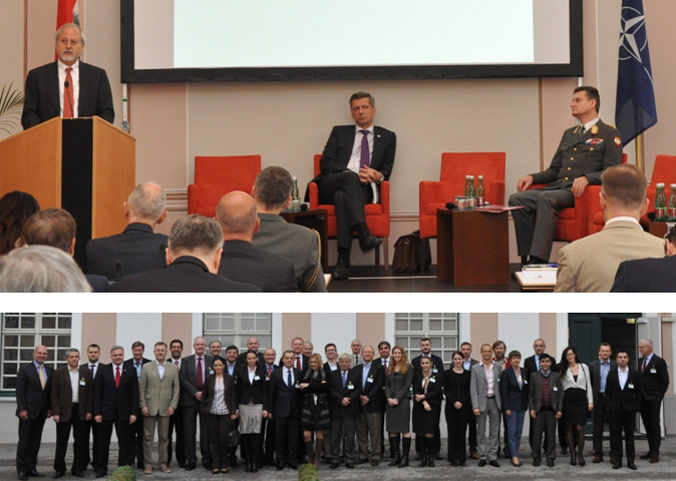
Members of parliament from NATO and partner countries took part in a workshop to examine the risks of corruption in the defence and security sector at the International Anti-Corruption Academy in Laxenburg, Austria on 8 and 9 November.
In the framework of NATO’s Building Integrity (BI) Programme, delegates reviewed current practice and looked at possible collaboration mechanisms to enhance the role of parliaments in the fight against corruption. Members of parliament play a central role in overseeing the activities of defence ministries, the defence industry and private contractors, scrutinising budget, procurement and personnel decisions.
The BI Programme provides practical tools to help participating countries strengthen integrity, transparency and accountability and reduce the risk of corruption in the defence and security sectors. It promotes good practice, processes and methodologies, and provides countries with tailored support to make defence and security institutions more effective. The workshop was the first to be tailored for members of parliament.
Lieutenant General Franz Reissner, Joint Forces Commander of the Austrian Armed Forces, underlined the challenge for these legislative bodies to strengthen transparency, accountability and integrity in the defence and security sector. “Huge amounts of money are invested and therefore the legislator is called to create effective, efficient and enforceable regulations,” he explained. He highlighted Austria’s good practice in the field, referring in particular to the code of conduct for the personnel of the Austrian Ministry of Defence and the Austrian Armed Forces.
High-level representatives from NATO, the NATO Parliamentary Assembly (NATO PA), the Global Organization of Parliamentarians Against Corruption (GOPAC) and the United Nations Office on Drugs and Crime (UNODC) also attended the workshop.
NATO Assistant Secretary General for Political Affairs and Security Policy Ambassador Thrasyvoulos Stamatopoulos stressed the need for collaboration in preventing and responding to corruption. “Corruption kills. It kills economic opportunity and it kills investment. Corruption, like a virus, does not respect borders and cannot be contained by one nation acting alone,” he said. “The defence and security sector is certainly not spared. To the contrary, this sector often benefits from a widespread culture of secrecy and impunity,” he added. Ambassador Stamatopoulos also highlighted the value of NATO’s contribution to the prevention of corruption in this sector. NATO’s experience in operations has shown that corruption has a direct impact on security, with financial and human cost.
NATO will draw on the results of the discussions in developing the BI Programme for 2015-2017.
The workshop was organised by NATO in collaboration with the NATO PA and GOPAC, and hosted by the Austrian Government.