
Close
Back


From now on you can download videos from our website
If you would also like to subscribe to the newsletter and receive our latest updates, click on the button below.
Enter the email address you registered with and we will send you a code to reset your password.
The password must be at least 12 characters long, no spaces, include upper/lowercase letters, numbers and symbols.
Click the button to return to the page you were on and log in with your new password.
11 July 2014
2 MIN READ
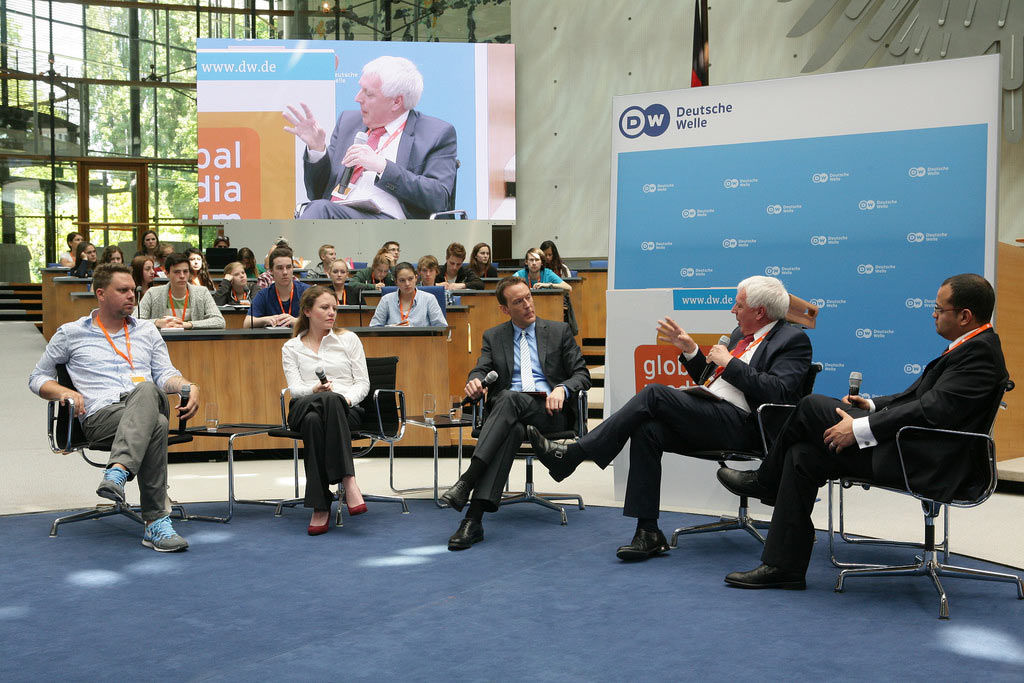
Cyber defence, energy security and scientific cooperation were among the topics discussed at this year’s Deutsche Welle Global Media Forum agenda in Bonn. Alliance officials engaged with an international audience to examine current security threats and NATO’s response to them. The theme of the forum was ''From Information to Participation – Challenges for the Media''.
Dr Jamie Shea, Deputy Assistant Secretary General for Emerging Security Challenges at NATO participated in a panel discussion on cyber threats and internet participation and emphasised the associated challenges. “How to manage cyber-related risks will be the big debate of the future,” he said.
Dr Shea also led a workshop on emerging security challenges in the 21st century which showcased the Alliance’s approach to these new threats. NATO officials explained how, in order to be prepared in the event of a serious incident, NATO and partner countries are training how to respond to cyber attacks in joint exercises.
Christian Lifländer from NATO’s Cyber Defence Section explained how Allies will need to continue to improve their cyber defence capabilities in line with NATO requirements and the evolution of the threat and technology. “Cyber attacks are becoming more widespread and reflect an increased level of sophistication and intensity,” he observed.
Workshop participants also discussed energy security. Michael Ruehle, Head of NATO’s Energy Security Section, pointed out the need for NATO to be aware of the security implications of energy issues, and to support the protection of critical infrastructure and enhance the energy efficiency of the military. “NATO cannot ignore the potential security implications of global energy developments,” he said.
At the workshop, the NATO Science for Peace and Security (SPS) Programme was presented as one instrument to address the new security threats through scientific cooperation with partners. The Programme is one of the Alliance’s most important partnership tools to address non-traditional security issues, including those associated with cyber threats and energy security. In fact, working together with partners to meet emerging security challenges is one of the key priorities of the SPS Programme. In 2013, more than three quarters of all newly approved SPS activities dealt with non-traditional threats.
One example of the projects the SPS Programme currently supports is the Smart Energy Team (SENT). This is a group of experts from six NATO and two partner countries that explores ways to enhance energy efficiency in the military. In 2013, SENT successfully tested innovative energy solutions in cold environments during a field trip in Canada. New initiatives are underway to start joint projects on energy storage systems, data collection on energy performance and alternative power generation.
Over the last two years, the SPS Programme has also funded a series of hands-on cyber defence training courses for system and network administrators. These training courses have helped to enhance the resilience of partners’ national IT infrastructure to cyber attacks. The SPS Programme has also supported workshops to improve computer network defence through incident detection and response and to exchange best practices to develop a cyber security and resiliency policy framework.
The Global Media Forum is an annual conference organised by German broadcaster Deutsche Welle that takes place since 2008. This year it attracted more than 2000 participants from media, civil society politics and business from more than 120 countries. It was the first time that NATO participated in the event.
To listen to the event, please click here: https://soundcloud.com/#dwgmf