
Close
Back


From now on you can download videos from our website
If you would also like to subscribe to the newsletter and receive our latest updates, click on the button below.
Enter the email address you registered with and we will send you a code to reset your password.
The password must be at least 12 characters long, no spaces, include upper/lowercase letters, numbers and symbols.
Click the button to return to the page you were on and log in with your new password.
28 May 2014
2 MIN READ
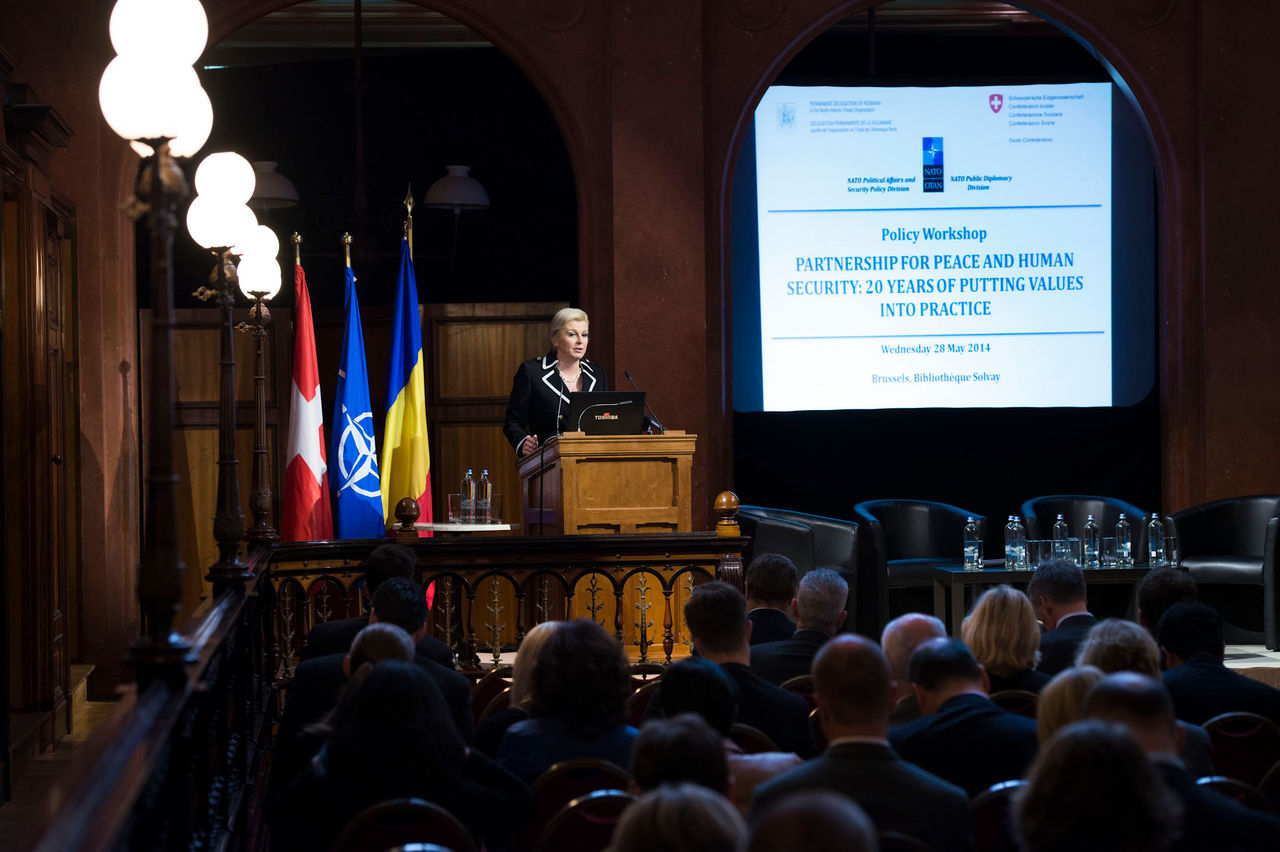
More than 130 experts gathered in Brussels on 28 May to discuss “Partnership for Peace and Human Security”.
Discussions highlighted the collaboration between NATO and partners in promoting key policies related to human security, such as the protection of civilians, UNSCR 1325 on Women, Peace and Security, the Montreux document on Private Military Security Companies, trust funds and the prevention of human trafficking.
High-level representatives from NATO and partner countries joined experts from international think tanks and organisations, including the United Nations, the European Union and the Organisation for Security Co-operation in Europe at the event. NATO Assistant Secretary General for Public Diplomacy Ambassador Kolinda Grabar stressed the importance of partners in supporting NATO Summit priorities: defence capabilities, the transatlantic bond and Afghanistan.
“Partnerships and cooperative security will certainly continue being very present in NATO’s agenda in the coming months and following the Wales Summit,” said Ambassador Grabar.
In an effort to re-energise the NATO partnerships programme, the “Partnership for Peace (PfP) Rebranding” initiative was launched in November 2013, led by Romania and Switzerland. Fourteen other NATO and partner countries are also involved: Austria, Azerbaijan, Czech Republic, Germany, Greece, Ireland, Italy, Moldova, Montenegro, Norway, Serbia, Slovakia, Turkey and the former Yugoslav Republic of Macedonia.1 Romania and Switzerland are the lead nations for the project.
Bénédict de Cerjat, Ambassador of Switzerland to the Kingdom of Belgium and Head of the Swiss Mission to NATO, listed defence and security sector reform, democratic control of armed forces and the protection of civilians as the key achievements of PfP. Ambassador de Cerjat also pointed out that PfP had helped to create a community of shared values with commitment to the preservation of democratic society and respect for international law.
General Director of the Department of Strategic Affairs of the Romanian Ministry of Foreign Affairs, Adrian Davidoiu, emphasised the significant contribution of PfP to defence sector reform in partner countries and perspective members.
The workshop was co-organised by NATO’s Political Affairs and Security Policy and Public Diplomacy Divisions in cooperation with Romania and Switzerland. The event was held in the framework of the PfP Rebranding initiative and marked the occasion of the 20th anniversary of PfP.