
Close
Back


From now on you can download videos from our website
If you would also like to subscribe to the newsletter and receive our latest updates, click on the button below.
Enter the email address you registered with and we will send you a code to reset your password.
The password must be at least 12 characters long, no spaces, include upper/lowercase letters, numbers and symbols.
Click the button to return to the page you were on and log in with your new password.
27 February 2014
2 MIN READ
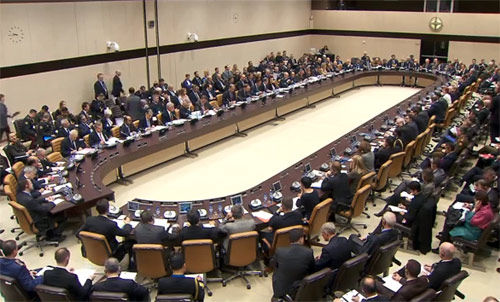
NATO Defence Ministers and counterparts from ISAF partner nations met with Afghan Defence Minister Bismullah Khan Mohammadi on Thursday (27 February 2014), to review ISAF mission progress and to discuss NATO’s relationship with Afghanistan after 2014. “We are focused on completing ISAF, but we also need certainty and predictability to launch our new mission to train, advise and assist the Afghan forces after 2014,” NATO Secretary General Anders Fogh Rasmussen said after the meeting.
The ISAF mission will end on 31 December 2014. In the remaining 10 months, ISAF’s work will focus on enabling the Afghan security forces to take on full security responsibility for the country and providing logistical support for the elections this year.“The Afghan security forces are creating the conditions for secure elections. They have primary responsibility”, the Secretary General said. The ISAF mission has so far provided airlift support for transportation of election material to regional hubs and district polling locations.
Ministers also discussed the implications and risks resulting from delays in finalising required legal agreements, before Allies can establish a follow-on mission. The Resolute Support Mission to train, advise and assist the Afghan security forces after 2014 requires a legal framework. The signature of the Bilateral Security Agreement between the United States and Afghanistan (BSA) is a prerequisite for concluding a Status of Forces Agreement between NATO and Afghanistan, which is currently being negotiated. “If the Bilateral Security Agreement is not signed, we cannot conclude the Status of Forces Agreement. And without the necessary legal framework, there simply cannot be a deployment after 2014. No security agreement. No troops and trainers. These are the hard facts”, Secretary General Fogh Rasmussen said.
He went on to say: “So today, we discussed the need to plan for all possible outcomes, including the possibility that we may not be able to deploy to Afghanistan after 2014, due to the persistent delays we have seen. Let me be clear, that is not the outcome we want. It is not the outcome that we think is in the interest of the Afghan people. However, this is what is at stake”. The ministers were briefed by NATO’s Senior Civilian Representative in Afghanistan, Ambassador Maurits Jochems and by the Commander of the International Security Assistance Force General Joseph F. Dunford.
Ambassador Jan Kubiš, United Nations Secretary-General’s Special Representative for Afghanistan and the European Union’s High Representative for Foreign Affairs and Security Policy Catherine Ashton also attended the meeting.