
Close
Back


From now on you can download videos from our website
If you would also like to subscribe to the newsletter and receive our latest updates, click on the button below.
Enter the email address you registered with and we will send you a code to reset your password.
The password must be at least 12 characters long, no spaces, include upper/lowercase letters, numbers and symbols.
Click the button to return to the page you were on and log in with your new password.
19 December 2013
2 MIN READ
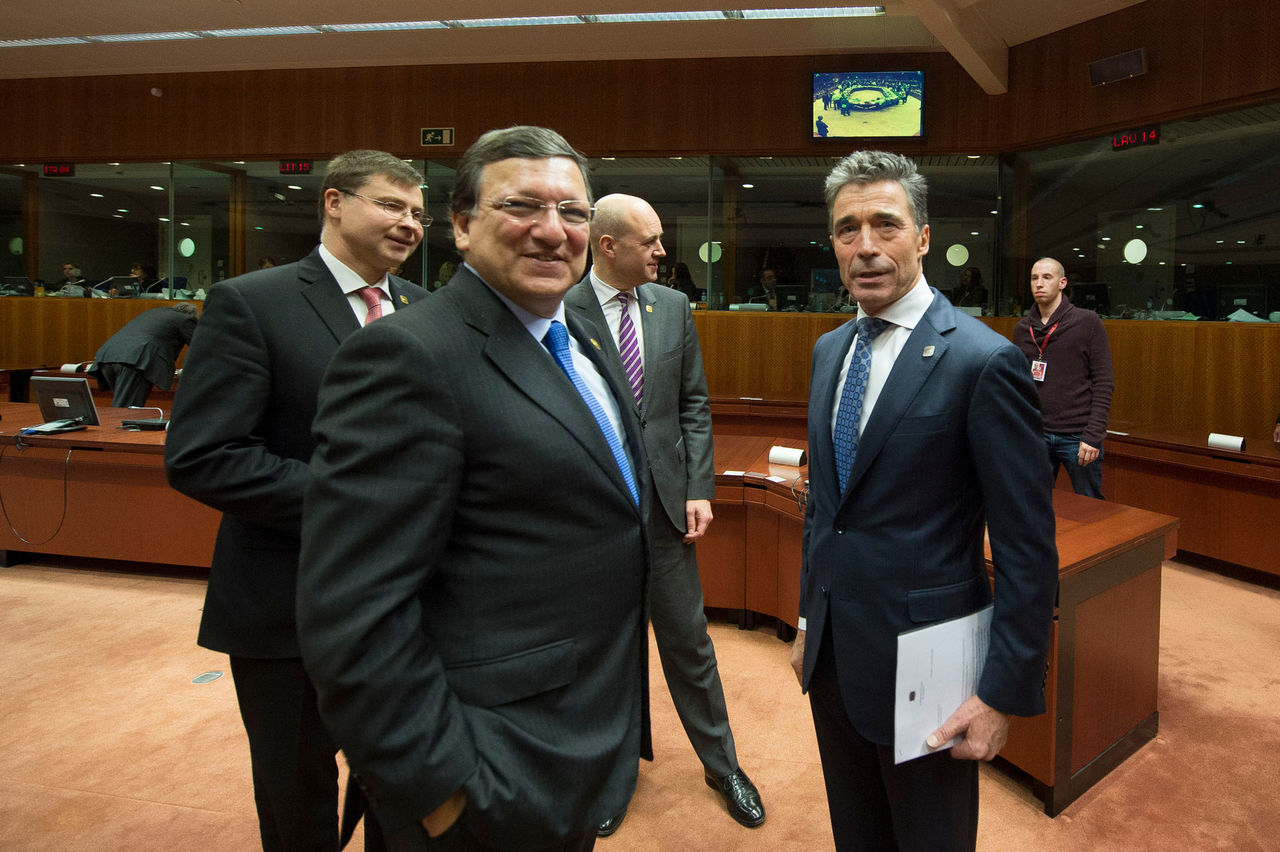
Anders Fogh Rasmussen addressed the European Council on defence in Brussels today (19 December 2013), encouraging European nations to further develop their military capabilities and to ensure greater cooperation and coordination between NATO and the EU. In the first ever address of a NATO Secretary General to a European Council, Mr Fogh Rasmussen told EU heads of state and government that “for Europe to play its full part, we must develop real capabilities, and those capabilities that our nations really need: observation drones, air-to-air refueling, heavy transport.”
Mr. Fogh Rasmussen thanked the President of the Council Herman van Rompuy for the invitation and expressed appreciation for the EU’s focus on defence, as both the EU and NATO agree that defence matters. He said that while over the past years, security challenges have increased, defence budgets have decreased, with some European countries cutting their defence budgets by up to 40 percent in real terms.
But he added that what counts is not just what Europe pays in defence costs, but also what role Europe plays in the world. Describing himself as a committed but concerned European, Mr. Fogh Rasmussen said: “I am concerned that if Europe is unwilling, or unable, to play its full part international crisis management, others will fill the vacuum. And we will reduce our ability to protect our values and defend our interests.”
Focusing on the need for stronger national capabilities, the Secretary General stressed that “ it is not NATO or the EU that possess these assets. They are owned by individual nations. They benefit the nations that have them. And they allow those nations to make a stronger contribution to addressing crises, in any framework they choose – be it EU or NATO or any other way.” To provide tax-payers with better value for money, he called for greater cooperation, coordination and cohesion between the EU and NATO in developing military capabilities and industrial standards; coordinating approaches to maritime and cyber security; and in training, exercises and defence capacity building for partners that need support.
“The time to act is now,” the Secretary General said. “Because unless we Europeans take our security seriously, North Americans will rightly ask why they should. Unless we recommit to our own defence, we risk seeing America disengage – and Europe and America drift apart. This is not what any of us would want, and it would benefit neither us nor the rest of the world.”