
Close
Back


From now on you can download videos from our website
If you would also like to subscribe to the newsletter and receive our latest updates, click on the button below.
Enter the email address you registered with and we will send you a code to reset your password.
The password must be at least 12 characters long, no spaces, include upper/lowercase letters, numbers and symbols.
Click the button to return to the page you were on and log in with your new password.
25 November 2013
2 MIN READ
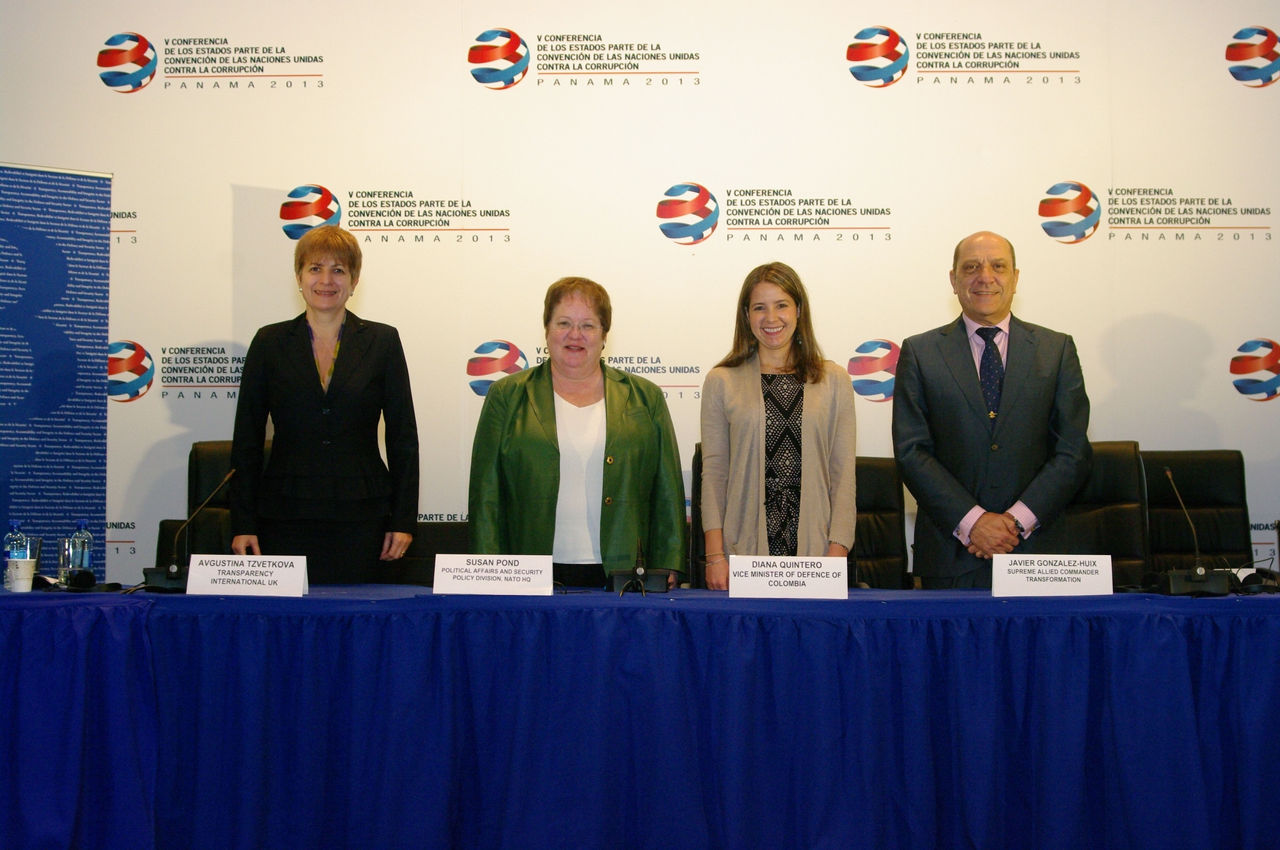
A NATO delegation took part in the Fifth Session of the Conference of State Parties to the United Nations Convention Against Corruption held in Panama City, from 25 to 29 November.
Following an invitation from the United Nations Office on Drugs and Crime (UNODC), NATO conducted a panel highlighting the Alliance’s contribution to promoting good practices and reducing the risk of corruption in the defence and security sector.
Ms Susan Pond, Head of the Building Integrity (BI) Programme at NATO, led the panel discussions, which focused on the impact of corruption on the defence and security sector. Experts also looked at NATO”s ongoing effort to strengthen transparency, accountability and integrity through its BI programme and highlighted the role of education and training in developing institutional and individual capabilities.
Ms Pond underlined the role of NATO as a “political/military organisation committed to the principles of democracy, human rights and the rule of law and making defence institutions effective and efficient”. She added that NATO “addresses corruption through a security lens” and efforts are focused on “prevention and promoting good practice”.
“Corruption increases the cost of defence and security, erodes trust and confidence of citizens and undermines operations,” explained Diana Quintero Cuello, Deputy Minister of Defence of Colombia.
Senior Consultant, Defence and Security Programme, Transparency International UK and former Vice Minister of Defence of Bulgaria Avgustina Tzvetkova emphasised the essential role of BI in launching the anti-corruption reform in the Bulgarian Ministry of Defence. She stressed the importance of “the creation of a strategic environment that provides principles and guarantees that the risk of corruption could be reduced to a minimum. And for the establishment of such an overall environment, NATO BI Initiative has had an outstanding input.” Ms Tzvetkova also stressed the importance of “political will as a precondition for the success of all efforts in anti-corruption reform”.
Vice Admiral Gonzalez-Huix, Deputy Chief of Staff, Joint Force Training, Supreme Allied Command Transformation(SACT), stressed the importance of education and training in building capabilities and sustaining change within the defence and security sector.
NATO experts, supported by the newly established Centre for Integrity in the Defence Sector in Oslo, also took part in the Anti-Corruption Academic Initiative Meeting to discuss development and conduct of anti-corruption studies such those offered at the NATO School in Oberammergau, Germany.