
Close
Back


From now on you can download videos from our website
If you would also like to subscribe to the newsletter and receive our latest updates, click on the button below.
Enter the email address you registered with and we will send you a code to reset your password.
The password must be at least 12 characters long, no spaces, include upper/lowercase letters, numbers and symbols.
Click the button to return to the page you were on and log in with your new password.
04 November 2013
1 MIN READ
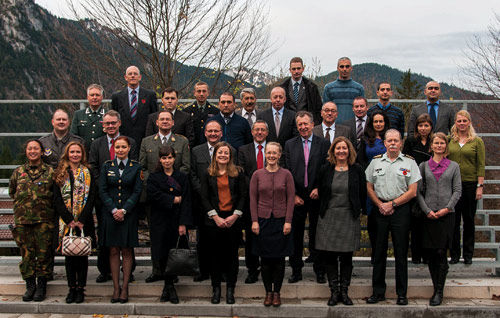
Around 30 national experts from NATO member and partner countries took part in the 2013 “Defence Leadership in Building Integrity” course at the NATO School Oberammergau in Germany from 4 to 8 November.
The course aims to develop capacity building of civilian and military personnel and to provide the foundation for leadership, integrity, good governance and management within the defence and security sector.
”The overarching objective of the course is to develop an understanding for the subject of defence corruption, its nature and occurrence in the personal, functional and political context,” explained Course Director, Magnus Jacobson Silverryd from the Swedish National Defence College. “One key aspect of achieving this objective is to start by providing the participants with a shared theoretical background. This way we make the issue of corruption within the security sector discussable and as a consequence it becomes easier to increase transparency,” he added.
An important feature of the course is that participants are able to share experiences, challenges and best practices. This is ongoing throughout lectures, syndicate exercises and coffee breaks.
Participants also learn to understand the function of the rule of law, its role in building integrity and its function in countering corruption. Special emphasis is also placed on the conduct of officials and other individuals and how this can be strengthened through clear ethical guidance.
The course also looks at the role of media and major organisations, including domestic and international, governmental or civilian. “We emphasise the fact that transparency is a force multiplier when it comes to promote integrity and good behaviour within the security sector,” said Mr Silverryd. “After all, state actors are employed by the citizens to safeguard societal security. The public has the right to know and to demand that their tax-money is spent wisely,” he concluded.