
Close
Back


From now on you can download videos from our website
If you would also like to subscribe to the newsletter and receive our latest updates, click on the button below.
Enter the email address you registered with and we will send you a code to reset your password.
The password must be at least 12 characters long, no spaces, include upper/lowercase letters, numbers and symbols.
Click the button to return to the page you were on and log in with your new password.
24 October 2013
2 MIN READ
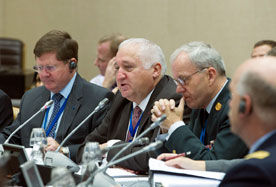
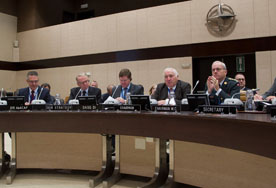
Top national officials responsible for defence procurement in NATO partner and member countries gathered in Brussels for the biennial Conference of National Armaments Directors (CNAD) on 24 October 2013.
Patrick Auroy, Assistant Secretary General for Defence Investment and Permanent Chairman of the Conference opened the morning session with NATO partners. Discussions focused on sharing national experiences in the armaments domain, reviewing the CNAD’s achievements in 2013 and contribution to countering improvised explosive devices. Delegates also examined the influence of emerging technologies on armaments planning.
General Knud Bartels, Chairman of the NATO Military Committee highlighted the importance of multinational cooperation in enabling the delivery of interoperable capabilities to ensure that current and future security challenges are met and NATO forces’ effectiveness perpetually improved.
He also pointed out that the Smart Defence philosophy of working together is not discretionary if countries are to be able to afford the quality and quantity of equipment that is necessary. “If we are not able to break the paradigm of how we do business, it implies that our armed forces will not be equipped as they should,” he said.
Individual nations highlighted contemporary issues in armaments planning, providing a welcome stage to advertise areas of potential or desired collaboration.
NATO Deputy Secretary General Ambassador Alexander Vershbow opened the afternoon session with NATO Allies. Emphasising the need to fill capability gaps and ensure that the Alliance is well prepared for the future, he recalled the role of the Connected Forces Initiative.
“NATO is serious about acquiring capabilities relevant to the future, a major step toward the fulfillment of our Chicago Summit goal of NATO Forces 2020,” he said.
The Deputy Secretary General focused on achievements and continued developments in the context of Smart Defence, as well as priorities for the 2014 NATO Summit in the United Kingdom. “Smart Defence will only succeed through strong and systematic transatlantic defence and industrial cooperation,” he said.
National Armaments Directors approved the new CNAD Management Plan, the tool which will guide the work of the CNAD substructure to optimise capability development in a resource effective manner.
Directors were also briefed on the current state of affairs in the development of capabilities for Ballistic Missile Defence and Joint Intelligence, Surveillance and Reconnaissance (including Alliance Ground Surveillance).