
Close
Back


From now on you can download videos from our website
If you would also like to subscribe to the newsletter and receive our latest updates, click on the button below.
Enter the email address you registered with and we will send you a code to reset your password.
The password must be at least 12 characters long, no spaces, include upper/lowercase letters, numbers and symbols.
Click the button to return to the page you were on and log in with your new password.
16 September 2013
1 MIN READ
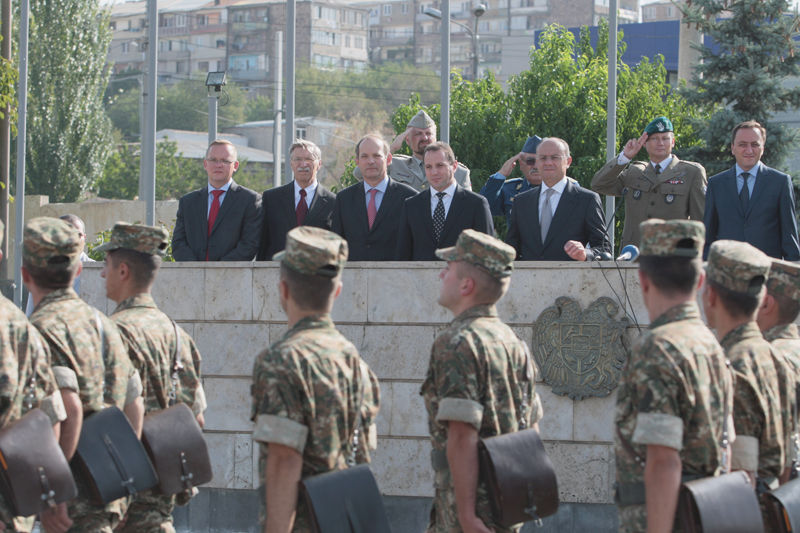
A NATO-led team of experts visited Armenia from 2 to 5 September to conduct the annual review of the country’s Defence Education Enhancement Programme (DEEP). The team examined current and future defence education projects aimed at strengthening the capacity of the Armenian armed forces.
During the visit, Minister of Defence Seyran Ohanyan inaugurated a pilot Command and Staff Course at the Vazgen Sargsyan Military Institute in Yerevan. NATO supported the development of this DEEP project, which is the first of its kind in the country and will be the foundation for training future Armenian military commanders. Students are instructed on military operations and receive professional military education. The possibility of a Master's degree in military science is also being considered.
Other ongoing projects reviewed by the NATO team include the new junior staff officer course and the non-commissioned officer reform progress.
Initial contact in 2007 between NATO and the Armenian authorities concerning defence education as a Partnership Goal led to a formal request for a DEEP in 2008. Armenia aspires to the development of a complete, coherent and modern education system.
DEEPs are tailored programmes through which the Alliance advises partners on how to build, develop and reform educational institutions in the security, defence and military domain. With projects running in 11 countries, they focus in particular on faculty building and curriculum development, covering areas such as teaching methodology, leadership and operational planning.
NATO and Armenia actively cooperate on democratic, institutional and defence reforms, and have developed practical cooperation in many other areas. The country’s Individual Partnership Action Plan (IPAP) lays out its programme of cooperation with NATO.