
Close
Back


From now on you can download videos from our website
If you would also like to subscribe to the newsletter and receive our latest updates, click on the button below.
Enter the email address you registered with and we will send you a code to reset your password.
The password must be at least 12 characters long, no spaces, include upper/lowercase letters, numbers and symbols.
Click the button to return to the page you were on and log in with your new password.
13 October 2010
2 MIN READ
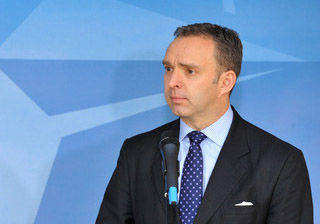
On 13 October, the NATO Senior Civilian Representative (SCR) provided the media with a script of the transition process to Afghan lead.
At a roundtable, which followed a briefing to the International Security Assistance Force (ISAF) troop contributing nations, Ambassador Sedwill insisted that the transition process will be conditions-based, not calendar-driven, and follow a comprehensive approach, where all aspects of security, governance and development will be taken into account.
The transition process is expected to start in the spring of 2011 and be completed by the end of 2014, by which time the Afghan authorities will have taken the lead throughout the country. However, the first tranche of areas candidates for transition will not be announced at the Lisbon Summit, Ambassador Sedwill stressed.
“Doing this months ahead of the starting date could pose sound security risks,” he explained, “and it is for Afghanistan, as a sovereign nation, to make such an announcement.”
While it is estimated that it might take up to 24 months to fully transition one given area to Afghan lead, conditions on the ground will dictate the pace at which transition will be carried out. “All these timelines should not be seen as a prediction but as a commitment,” he underlined.
Four criteria are to drive the transition assessment: the overall security situation; the capacity of the Afghan national security forces; ISAF and Provincial Reconstruction Teams’ (PRT) readiness to shift to a supporting role; and progress with governance and development. It will follow a two-pronged approach, involving key Afghan institutions and functions as well as geographic areas.
“This could lead to a situation whereby transition starts at the sub-district level with the transfer of lead security responsibility to the Afghan National Police” along the lines of the successful transfer of lead security responsibility that occurred in Kabul mid-2008, Ambassador Sedwill explained.
On the 2014 horizon, “we will see changes on the ground as a result of transition,” he indicated. From a security point of view, ISAF troops will become gradually less visible, thinned out and may be redeployed within the country or reinvested as part of training efforts. Provincial Reconstruction Teams will also evolve towards a greater civilian role, focusing on a more traditional model of development delivery.
“In sum, transition is all about Afghan leadership and international partnership,” Mark Sedwill concluded.