
Close
Back


From now on you can download videos from our website
If you would also like to subscribe to the newsletter and receive our latest updates, click on the button below.
Enter the email address you registered with and we will send you a code to reset your password.
The password must be at least 12 characters long, no spaces, include upper/lowercase letters, numbers and symbols.
Click the button to return to the page you were on and log in with your new password.
24 June 2009
2 MIN READ
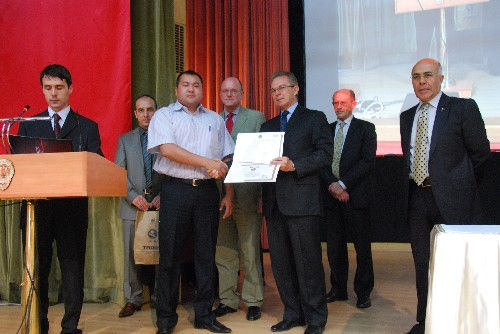
Progress and planning for the NATO-Russia Council (NRC) project for the training of Afghan and Central Asian Personnel were reviewed at a high-level meeting in Ankara, Turkey, on 18 and 19 June.
This project has been one of the most successful and productive NRC initiatives. It has already had a tangible impact on the overall counter-narcotics efforts in Afghanistan and Central Asia. Almost 1000 trainees from the six beneficiary countries have taken part in specialized courses since the initiative was launched in December 2005.
Implementation of the project continued over the past year – despite the serious political crisis that followed Russia’s military action in Georgia in early August 2008 – testifying to the importance attributed to it by contributing partners.
The reinforced session of the project’s executive steering committee was hosted by the Turkish International Academy Against Drugs and Organised Crime (TADOC), which is one of the initiative’s key training providers.
Such high-level meetings help ensure better and more efficient coordination between national experts and their respective agencies, NATO Headquarters, the United Nations Office for Drugs and Crime (UNODC), and the experts and counter-narcotics agencies of the six project-beneficiary countries.
Participants discussed fund-raising and resource requirements for the rest of 2009 and into 2010. While the project has been approved as an ongoing NRC initiative, this is subject to the continued availability of funds.
Experiences and lessons learned from the past year’s activities were also examined. A key element was feedback from the project’s graduates. It is essential to ensure that the project continues to meet the training needs of participating countries, and that the reintegration of project trainees has an impact on the conduct of overall counter-narcotics activities.
Another important objective of the meeting was to discuss how to improve coordination between different trainers to ensure that instruction in joint courses is mutually complementary. Possibilities for broadening the training opportunities offered were also considered.
The pilot project for counter-narcotics training of Afghan and Central Asian personnel was launched by NRC foreign ministers in December 2005 to help address the threats posed by the trafficking in Afghan narcotics. After its pilot phase, NRC leaders meeting in Bucharest in April 2008 agreed that the project would be an ongoing NRC initiative.
The project is being implemented in cooperation with the UNODC, which serves as the executive agent. It seeks to build local capacity and to promote regional networking and cooperation by sharing the combined expertise of NRC member states with mid-level officers from Afghanistan, Kazakhstan, the Kyrgyz Republic, Tajikistan, Turkmenistan and Uzbekistan.
Russia and Turkey host training courses for Afghan and Central Asian personnel at their specialized centres of excellence, and mobile courses are being conducted in each of the six participating countries.
In addition to NRC member countries, Finland has been contributing to the initiative since summer 2007.