
Close
Back


From now on you can download videos from our website
If you would also like to subscribe to the newsletter and receive our latest updates, click on the button below.
Enter the email address you registered with and we will send you a code to reset your password.
The password must be at least 12 characters long, no spaces, include upper/lowercase letters, numbers and symbols.
Click the button to return to the page you were on and log in with your new password.
15 March 2009
2 MIN READ
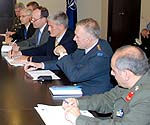
Mid-March 2009, a NATO-led team of experts visited Georgia to address the Georgian request to review the existing military education and training system, and develop a plan of action for reform.
Besides members of the Alliance’s International and Military staffs, and Allied Command Transformation (ACT), the team included ten national experts and one Partnership for Peace (PfP) Training and Education Centre.
During their three day visit, the group held meetings with representatives of the Georgian Ministry of Defence and the Joint Staff of Georgian Armed Forces. They also got acquainted with the local training processes at the National Defence Academy and various training centres. On the basis of their findings, they will produce a plan of action aiming at developing a modern and efficient education and training system.
Supporting Defence reform through education
Launched in 2004 at the Istanbul Summit, the Partnership Action Plan on Defence Institution Building (PAP-DIB) encourages and supports Partners in building effective and democratically-responsible defence institutions.
Allies provide interested Partners with political and practical advice on, and assistance in, the defence and security-related aspects of the domestic reform. A great part of this work is done in the field of education and training.
NATO has significant educational assets, including the NATO School and the NATO Defence College, whose annual conference will this year examine the best ways education can help Partnerships.
Another significant associate in the field of education and training is the PfP Consortium. While its scope is much wider and complex, the Consortium and its working groups are called upon to promote PAP-DIB and related educational needs, by helping to develop relevant education standards and curricula, and by supporting education through collaborative distance learning.
NATO nations, who posses the bulk of expertise, are also the best contributors in pushing education and training matters forward. One concrete element are the visits to Partner countries by multinational teams of experts, led by NATO, to address the various education and training requirements listed in the Action Plans.
These efforts aim at achieving intellectual interoperability. In order to succeed in building a common security and defence culture, a greater common understanding of concepts related to security, defence, and defence reform are required.