
Close
Back


From now on you can download videos from our website
If you would also like to subscribe to the newsletter and receive our latest updates, click on the button below.
Enter the email address you registered with and we will send you a code to reset your password.
The password must be at least 12 characters long, no spaces, include upper/lowercase letters, numbers and symbols.
Click the button to return to the page you were on and log in with your new password.
25 October 2007
2 MIN READ
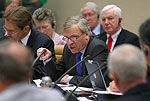
Armament Directors from the 26 NATO countries have moved forward on three key NATO capabilities initiatives: Alliance Ground Surveillance, Missile Defence and Non-Lethal Capabilities.
Decisions taken at the biannual meeting of the Conference of National Armament Directors (CNAD), 25-26 October, have particular significance for both ongoing NATO-led operations and the upcoming Bucharest Summit in 2008.
Progress was made on missile defence. Regarding the Active Layered Theatre Ballistic Missile Defence (ALTBMD) Programme, NATO is moving toward delivering an initial capability in 2010-2012. Schedule challenges are being addressed.
More broadly, on the issue of territorial missile defence, the Armament Directors learned the early results of studies looking at the 2006 Riga Summit tasking on mobile systems and the subsequent task to identify Alliance population centres and territory which would be protected by the proposed US missile defence system in Europe.
When realised, the Alliance Ground Surveillance (AGS) programme will deliver a much needed, enabling capability for NATO. The CNAD reemphasised the need to deliver it by 2012. The Conference reaffirmed the commitment of participating nations to acquire a largely off-the-shelf solution for AGS, consisting of the Global Hawk High Altitude Long Endurance (HALE) Unmanned Aerial Vehicle (UAV) fitted with the state of the art US Multi-Platform Radar Technology Insertion Programme (MP-RTIP) sensor and a - to be developed - ground station. The goal will be contract signature by mid - 2008.
Other important issues addressed by Armament Directors included: launching a non-lethal capability initiative as a flexible response to terrorism, improving transatlantic defence industrial cooperation, rapidly fielding a Joint Intelligence, Surveillance and Reconnaissance (ISR) Capability for the NATO-led International Security Assistance Force (ISAF) and possible CNAD contributions to overcoming critical ISAF in-theatre helicopter shortfalls.
In conjunction with the CNAD meeting, there was an exhibition on “Protecting the Forces, Countering Asymmetric Threats.” Cutting-edge technologies and innovative ideas were presented to the Armaments Directors as well as NATO officials and high-ranking military and political representatives from NATO and Partner countries. The exhibition brought together companies from 16 member and four Partner countries displaying C-IED jammers, thermal cameras, and other force protection technologies.
As has been the custom, at this Autumn CNAD, the NATO National Armaments Directors, were joined by their colleagues from Partnership for Peace countries for a session on the first afternoon. This year, Armaments Directors from 11 Partner countries participated in discussions on practical ways to improve cooperation with the European Defence Agency, on opportunities for collaboration in non-lethal capabilities and submarine rescue systems, and finally on methods to improve capability development with Partners, more generally.