
Close
Back


From now on you can download videos from our website
If you would also like to subscribe to the newsletter and receive our latest updates, click on the button below.
Enter the email address you registered with and we will send you a code to reset your password.
The password must be at least 12 characters long, no spaces, include upper/lowercase letters, numbers and symbols.
Click the button to return to the page you were on and log in with your new password.
Updated: 01 September 2022
The Central Europe Pipeline Management Agency, also referred to as CEPMA, managed the day-to-day operations of NATO’s Central Europe Pipeline System (CEPS). On 1 July 2012, the NATO Support Agency – now known as the NATO Support and Procurement Agency – was established assuming the functions and responsibilities of CEPMA.
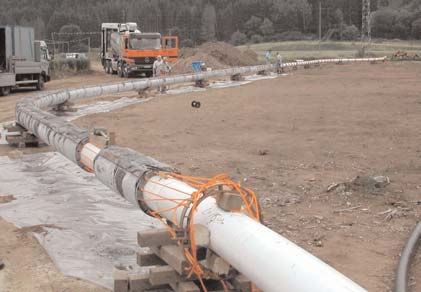
CEPMA was responsible for the 24-hour operation of the CEPS, its storage and distribution facilities.
It was in charge of coordinating the pumping and storage activities of the pipeline, as well as ensuring the technical integrity of the system and quality control.
The day-to-day pipeline operations and maintenance is not centralised. It is executed by four national organisations and their dispatching centres. There are two dispatching centres in Germany; Belgium, France and The Netherlands each have one dispatching centre.
Additionally, the national organisations coordinate the operations with their national authorities. The national organisations are funded from a centralised budget, which was previously coordinated and managed by CEPMA and authorised by the Board of Directors.
CEPMA helped to consolidate the CEPMA budget and those of the national organisations. Since the CEPS is a major network, the budget CEPMA managed was large.
CEPMA was structured in three different departments:
There was also a General Services section that was responsible for providing the overall logistics support for CEPMA and an independent Internal Controller who oversaw the financial situation and reported his findings directly to the General Manager.
In addition to its normal CEPS activities, CEPMA staff fulfilled a number of tasks in relation to the Host Nation for the benefit of all NATO Agencies based in France.
CEPMA operated under the overall authority of the North Atlantic Council. Its governing body was the Central Europe Pipelines Management Organization (CEPMO) Board of Directors (BOD). On 1 July 2012, the NATO Support Organisation – now known as the NATO Support and Procurement Organisation – was established assuming the functions and responsibilities of CEPMO.
When the CEPS was created in 1958, there were two governing bodies: the Central Europe Pipeline Office (CEPO), and the Central Europe Pipeline Policy Committee (CEPPC).
The executive agency, named Central Europe Operating Agency (CEOA), was created on 1 January 1958. It was initially located in the Palais de Chaillot, Paris (which had been NATO’s political headquarters from 1952), before moving to new headquarters in Versailles. These new premises were officially inaugurated on 16 June 1959 by the then NATO Secretary General, Mr Paul-Henri Spaak.
Several decades later, in 1997, the North Atlantic Council endorsed the new CEPMO Charter approved by the two directing bodies. The Charter defined the structure and responsibilities of the then new management organisation of the CEPS: CEPMO, which comprised one single CEPMO Board of Directors (BoD) and the Agency (CEPMA).
On 1 July 2012, the NATO Support Agency was established merging the NATO Maintenance and Supply Agency (NAMSA), the NATO Airlift Management Agency (NAMA) and the Central Europe Pipeline Management Agency (CEPMA). The NATO Support Agency assumed the functions and responsibilities of CEPMA. In April 2015, the NATO Support Agency became the NATO Support and Procurement Agency (NSPA).