Close
Back


From now on you can download videos from our website
If you would also like to subscribe to the newsletter and receive our latest updates, click on the button below.
Enter the email address you registered with and we will send you a code to reset your password.
The password must be at least 12 characters long, no spaces, include upper/lowercase letters, numbers and symbols.
Click the button to return to the page you were on and log in with your new password.
11 December 2025
20 MIN READ
Hello, dear Johann, dear Detlef, dear Wolfgang, good afternoon, and of course, good afternoon to all of you. And thank you for the warm welcome, it is always good to be in Berlin.
Just over 36 years ago, on a now famous night in November, NATO Secretary General Manfred Wörner jumped in his car and drove through the night to Berlin. In the rush, he forgot to tell his staff in Brussels where he was going. Manfred was heading home to Germany to join the crowds celebrating the fall of the Berlin Wall. Today, a section of the Wall stands at NATO Headquarters. It was a barrier to keep people in, and ideas out. Now it is a monument to the force of freedom, a reminder of the power of unity, and a lesson that we must stay strong, confident and steadfast. Because the dark forces of oppression are on the march again. I am here today to tell you where NATO stands, and what we must do to stop a war before it starts. To do that, we need to be crystal clear about the threat. We are Russia’s next target, and we are already in harm’s way.
When I became NATO Secretary General last year, I warned that what is happening in Ukraine could happen to Allied countries too and that we had to shift to a wartime mindset. This year, we took the big decisions to make NATO stronger. At the Summit in The Hague, Allies agreed to invest 5% of GDP annually in defence by 2035, we agreed to increase defence production across the Alliance, and we agreed to continue our support to Ukraine. But this is not the time for self-congratulation, I fear that too many are quietly complacent, and too many don’t feel the urgency, too many believe that time is on our side. It is not, the time for action is now. Allied defence spending and production must rise rapidly, our armed forces must have what they need to keep us safe, and Ukraine must have what it needs to defend itself - now. Our governments, parliaments, and our citizens have to be in this together. So that we can continue to protect peace, freedom, and prosperity, our open societies, our free elections, and a free press.
We must all accept that we must act to defend our way of life, now. Because this year, Russia has become even more brazen, reckless, and ruthless, towards NATO, and towards Ukraine. During the Cold War, President Reagan warned about the “aggressive impulses of an evil empire”. Today, President Putin is in the empire-building business again. He is throwing everything he has at Ukraine, killing soldiers and civilians, destroying the havens of humanity; homes, schools and hospitals. So far this year, Russia has launched over 46,000 drones and missiles against Ukraine. Russia is likely producing 2,900 attack drones a month, and a similar number of decoys to distract air defences. And in 2025, Russia produced around 2000 land-attack cruise and ballistic missiles, it is close to peak production.
And while Putin is trying to destroy Ukraine, he is also devastating his own country. There have been over 1.1 million Russian casualties since he began his war in 2022, and this year, Russia has lost on average 1,200 troops a day. Think about that, more than a million casualties so far, and 1,200 a day, killed or wounded, this year alone. Putin is paying for his pride with the blood of his own people, and if he is prepared to sacrifice ordinary Russians in this way, what is he prepared to do to us? In his distorted view of history and the world, Putin believes that our freedom threatens his stranglehold on power, and that we want to destroy Russia. Putin is doing a good job of that all by himself. Russia’s economy is now geared to wage war, not to make its people prosperous. Russia is spending nearly 40% of its budget on aggression, and around 70% of all machine tools in Russia are used in military production. Taxes are going up, inflation has skyrocketed, and petrol is rationed. Putin’s next presidential campaign slogan should be: “Make Russia Weak Again.” Not that he’s troubled by free and fair elections, of course.
And how is Putin able to continue his war against Ukraine? The answer is China. China is Russia’s lifeline. China wants to prevent its ally from losing in Ukraine. Without China’s support, Russia could not continue to wage this war, for example, about 80% of critical electronic components in Russian drones and other systems are made in China. So, when civilians die in Kyiv or Kharkiv, Chinese technology is often inside the weapons that killed them, and let’s not forget that Russia also relies on North Korea and Iran in its fight against freedom, with ammunition and military equipment.
So far, Putin has only played the peacemaker when it suits him, to buy time to continue his war. President Trump wants to end the bloodshed now, and he’s the only one who can get Putin to the negotiating table. So, let’s put Putin to the test, let’s see if he really wants peace, or if he prefers the slaughter to continue. It is essential that all of us keep up the pressure on Russia, and support the genuine efforts to bring this war to an end. NATO’s support means Ukraine can defend itself today, be in a strong position to secure a just and lasting peace, and be able to deter any Russian aggression in the future. Billions of dollars’ worth of critical military hardware is flowing into Ukraine, sourced from the United States, paid for by Allies and Partners. This is firepower only America can provide. We are doing this through a NATO initiative indeed we call PURL. Since it was launched this summer, PURL has supplied around 75% of all missiles for Ukraine’s Patriot batteries, and 90% of the ammunition used in its other air defence systems. And I want to thank Germany and other Allies for their support. PURL is keeping Ukraine in the fight and protecting its population, and I count, indeed, on more Allies to contribute to PURL, and to step up support to Ukraine in many other ways. Because we must strengthen Ukraine, so they can stop Putin in his tracks.
Just imagine if Putin got his way; Ukraine under the boot of Russian occupation, his forces pressing against a longer border with NATO, and the significantly increased risk of an armed attack against us. It would require a truly gargantuan shift in our deterrence and defence. NATO would have to substantially increase its military presence along the eastern flank, and Allies would have to go much further and faster on defence spending and production. In such a scenario, we would long for the days when 3.5 percent of GDP on core defence was enough. That number would grow massively, and with that imminent threat, we would have to act fast. There would be emergency budgets, cuts to public spending, economic disruption, and further financial pressure. In that scenario, painful trade-offs would be unavoidable but absolutely necessary to protect our people. So, let’s not forget: Ukraine’s security is our security.
NATO’s own defences can hold for now but with its economy dedicated to war, Russia could be ready to use military force against NATO within five years. Russia is already escalating its covert campaign against our societies. Russia’s list of targets for sabotage is not limited to critical infrastructure, the defence industry, and military facilities. There have been attacks on commercial warehouses and shopping centres, and explosives hidden in parcels, and Poland is now investigating sabotage against its railway network. This year we have seen reckless airspace violations by Russia. Whether it is drones over Poland and Romania, or fighter jets over Estonia, such incidents put lives in danger and raise the risk of escalation. And while we often think of the risk primarily in terms of our eastern flank, Russia’s reach is not limited to land. The Arctic and the Atlantic are additional avenues, a reminder, yet again, of why this Alliance has been so crucial for so many years, on both sides of the Atlantic. So, we are working together to ensure the safety and security of all Allies, on land, at sea, and in the air. We have increased our vigilance and strengthened our deterrence and defence along the eastern flank with Eastern Sentry, and we continue to protect our critical infrastructure at sea, with Baltic Sentry. NATO’s response to Russia’s provocations has been calm, decisive, and proportionate but we need to be prepared for further escalation and confrontation.
Our enduring commitment to NATO’s Article 5, that an attack on one, is an attack on all, sends a powerful message. Any aggressor must know that we can, and will, hit back hard, and that is why we made the crucial decisions in The Hague. On defence spending, on production, and support for Ukraine. And yes, we are seeing important progress. Look at ammunition production, we have seen a sixfold increase in European production of 155-millimeter artillery shells, compared with two years ago. I visited a new factory in Germany, in Unterlüß, this year which plans to produce 350,000 artillery shells a year. Germany is fundamentally shifting its approach to defence and industry to increase defence production, and the investments Germany is making in its armed forces are extraordinary. Around 152 billion is planned for defence by 2029, 3.5 percent of its GDP by 2029. Germany is a leading power in Europe and a driving force in NATO. German leadership is essential for our collective defence. Its commitment to doing its fair share for our security is an example to all Allies.
We need to be ready because at the end of this first quarter of the 21st century, conflicts are no longer fought at arms-length. Conflict is at our door. Russia has brought war back to Europe, and we must be prepared for the scale of war our grandparents or great-grandparents endured. Imagine it, a conflict reaching every home, every workplace, destruction, mass mobilisation, millions displaced, widespread suffering and extreme losses. It is a terrible thought, but if we deliver on our commitments, this is a tragedy we can prevent. NATO is here to protect one billion people, on both sides of the Atlantic. Our mission is to protect you, your families, your friends, and your future. We cannot let down our guard, and we won’t. I count on our governments to keep up with their commitments, and go further and faster because we cannot falter or fail. Listen to the sirens across Ukraine, look at the bodies pulled from the rubble, and think of the Ukrainians who might go to sleep tonight and not wake up tomorrow. What is standing between what’s happening to them, and what could happen to us? Only NATO.
I have a duty as Secretary General to tell you what lies ahead if we don’t act faster, invest in defence, and continue our support for Ukraine. And I know this is a hard message as we head towards the festive season, when our thoughts turn to hope, light and peace. But we can take courage and strength knowing that we stand together in NATO, with determination and in the knowledge that we are on the right side of history. We have a plan, we know what to do, so let us deliver. We must.
Thank you.
Wolfgang Ischinger (Moderator)
Thank you. Thank you so much, Secretary General. Great speech, if I may say.
We don't have a lot of time. We have approximately - because Secretary General has an important follow up meeting. We have approximately 20 minutes. So, if you have a good question to ask, let me know.
But let me use my privilege of sitting up here by asking the first question to both of you.
Everybody knows, as has been said publicly, that we have entered what appears to be a critical moment in the negotiations about how to end and when to end the Ukraine war. I'd really like to have your view and your view also, Foreign Minister, how close are we?
Do you really believe that there is - you've expressed some skepticism in your remarks that there is a willingness by the Russian side to sign a quote, unquote deal. How close are we? Some people have told me that it might be possible to get something done before Christmas. Well, how wonderful would that be? Is that an illusion?
NATO Secretary General Mark Rutte
It's difficult to say. The honest answer, and I can only say that President Trump, the Americans are working tirelessly to get this done, and I really want to commend them for that. And Germany and France and United Kingdom, Poland, Italy and the other European Allies and Canada are helping. And there, the Netherlands, to support wherever they can the peace effort. And of course, there are various elements. One is, how do you reconstruct Ukraine? There was some news yesterday that progress is being made there. We know that it will be crucial, after a long-term ceasefire/a peace deal, that the Russians will never, ever try again to attack Ukraine. So there have to be security guarantees in place of such a quality and level that Putin knows, if he tries again, the reaction will be devastating. And we all know there will be a delicate, difficult discussion about territory, which in the end, only the Ukrainians can decide about. Do I think that when it comes to Ukraine, the US and Europe to get to one page? Yes, I'm positive. I think we can. Am I sure that the Russians will accept? I don't know. This is the test, which I also said in my speech. We have to test Putin already on whether he is serious. And the guy is willing, last month to suffer 25,000 of his own people. 25,000 people dead. Not seriously wounded. No, killed. Dead. 25,000. 1.1 million dead or seriously wounded over the last four years. So, let's see whether he is getting to a point where he thinks that this is unsufferable for him and his people. And that he wants to make a deal. But that's, of course, the big test coming up,
Wolfgang Ischinger (Moderator)
All right. Thank you very much. Since we're here three men on the stage, I'll go to a lady first. There is a lady who is raising - let's go to that lady first,
Question
Anja Wehler-Schöck, international editor at Tagesspiegel. Secretary General, both you and Minister Wadephul have stressed the value of unity, that cohesion, both within the EU and NATO, is our strength. However, we've seen the 28-point plan that tried to formulate commitments to third parties and NATO about NATO's future. We've seen communication coming out of Washington saying that NATO's capabilities in Europe should be served within a very steep timeline. How do you convince someone who does not see value in unity and cooperation of just that aim and maybe as a plan B? Do you see a future for our NATO where the US is explicitly or implicitly withdrawn, your opinion or other Coalition of the Willing within NATO?
NATO Secretary General Mark Rutte
To your second question? No, I don't see that. I think it is crucial that we keep the transatlantic bond as strong as it is today. And it is very strong. When you look at the National Security Strategy the US brought out, I know there was a lot of talk, of course, in European capitals. But look at what is it actually saying: complete commitment to European security, complete commitment to NATO and a complete commitment to the fact that we can only defend the Euro-Atlantic area if we stick together. And yes, there's a lot you can discuss about but this is at the core there. When you take President Trump, when he was in his first term, and now in his second term, he has been extremely clear that he is totally committed to NATO, having one big irritant, the fact that Germany, the Netherlands, and many other countries were not even getting to the old 2%, let alone spending what he is spending 3.5%.
And now in The Hague, we have dealt with this. We decided to move to the 3.5%, equalise with the US. I think it is his biggest foreign policy success when it comes to the Euro-Atlantic area, and not only because we want to equalise with the US, but because we need to spend this money to keep ourselves safe from the Russians. And also taking a careful look at the Chinese military build-up taking place today. And Europe is now stepping up. Germany is leading that whole phase of stepping up with the defence spending here, Germany's presence in Baltic Sentry, Eastern Sentry, the Coalition of the Willing, where Germany and the UK and France and others are working together to agree on what is necessary to keep Ukraine safe post a peace deal. And, of course PURL, so the money needed to buy from America to give essential weapons to Ukraine, again, Germany taking the lead.
So, Europe is stepping up. Germany taking the lead there, but many others also absolutely stepping up, including the Netherlands, the Scandinavians, the Baltics, and of course, many others. So, we are in a much better place. So, I'm absolutely convinced this alliance is there to stay, and it is crucial also in the US interest. Because you cannot defend the US without an Arctic which is defended. And for the Arctic, you need NATO. You cannot defend the US without a safe Atlantic, and you need NATO to keep the Atlantic safe. Look at the nuclear submarines the Russians have who might want to sail towards the US coast. And you cannot keep the US safe without a safe Europe. And the Americans know this. All the senior policy makers, from the White House down to the State Department, the Pentagon, they all know this, and they all agree with this.
Wolfgang Ischinger (Moderator)
Great. If you ask a question, please identify yourself, and please make sure we know whether you address the question to both speakers or only to one of them. Let's go to Matthias Gebauer first, and then we'll go to this side of the aisle.
Question
Hi, it's Matthias Gebauer, German magazine Der Spiegel. Mr. Rutte, I have one question. You very much underlined the ongoing and permanent threat Russia poses to Europe. But you also mentioned right now that Russia is also a threat to the US. On the other hand, in the just very recent national security strategy the White House put out, Russia is not really, not even named as a threat. It's quite the opposite. It's named as, we want to stabilise the relations towards Russia, which is a stark contrast also to the Communiqué of The Hague Summit, where Russia is mentioned as the main threat to NATO. How, as NATO Secretary General, how do you want to align these two views? And did you already talk to President Trump about the contents of the National Security Strategy and this very opposing lines towards Russia?
NATO Secretary General Mark Rutte
Well, again, let me tell you, in all my discussions with the United States when it comes to NATO, when it comes to defence of the US itself, and the collective defence of the Euro-Atlantic. And I don't want to repeat the previous question, because we do not have so much time. But let me refer to my reaction to the previous question. I think there's the evidence that the US is not in NATO only because they didn't want to repeat the mistake they made after the First World War of not being involved. They are in NATO because it is providing them with the direct security they need for their future. And it has to do, of course, with Europe, and that's clear in the NSS, in this national security strategy, that they are completely committed to the European security, NATO security, and working together. But it also has to do, as I said, with the Arctic and the Atlantic. These are three key elements of NATO which are there not only to keep Europe safe, but to keep the whole of the Euro-Atlantic safe. And when it comes to the Indo-Pacific, they also have to spend time there. That's clear. And NATO is not directly involved. We have a close cooperation with many countries there in this Indo-Pacific for cooperation. But it was the American President explicitly asking me, when I first visited him in the White House in March this year, after he got back into office after the inauguration, to make sure that we kept that relationship as the IP4 close because he and all the senior policy makers know that these two theatres, the Indo-Pacific and the Euro-Atlantic, are closely connected.
Wolfgang Ischinger (Moderator)
All right, we'll go to this side over there, where were the questions here, gentleman over there.
Question
Jan Tombinski, Polish ambassador to Berlin. One question to Secretary General. In all this discussion about security guarantees for Ukraine, I've nothing heard about reduction of Russian military presence on our borders? Is it a part of a discussion? Because this would be the best security guarantee for Ukraine, the militarization of Crimea or of occupied territories, at least, to reduce the Russian presence on, against Ukraine and against us.
NATO Secretary General Mark Rutte
Ambassador, I understand the question, of course. I am aware of various stages of all the discussions. I cannot go into all the details, but what I was talking about was primarily focusing on making sure that whatever the military power of the Russians, and at his moment that's considerable, given their extreme investments now in defence. Total defence budget, $200 billion, and with their purchasing power, that's about the same as the whole of European NATO is spending on defence, in terms of purchasing power.
So, it's really a lot of money, and they don't have all the bureaucracy we have, so they can take the decisions quickly, easily, move to this wartime economy, as they have done, and that's why they are posing a threat immediately. What we need to do with the security guarantees, first of all, is to make sure that they will never try again, by knowing that our reaction will be, as I said, devastating, that's the now the prime focus.
Wolfgang Ischinger (Moderator)
We have time for maybe two more questions. There is the lady, yes in the fourth row there.
Question
Sorry. My name is Anna [inaudible]. I'm the chair of the [inaudible]. My question is addressed to both gentlemen. In your brilliant speech, Secretary General, you referenced the fall down of the Berlin Wall. And I remember when I was a young diplomat, we drew extraordinary insights from the fragility both of the Eastern European, and I apologize about this to our European friends, and Russia in the Soviet Union, in particular. Question: To what degree in your strategic foresight and insights, does intelligence, knowledge, and I'm aware you cannot share everything here, play a role about the actual fragility, potential fragility, of the current Kremlin regime? And how does that weigh? If it does, Foreign Minister, how does that weigh in your defence strategy? Thank you.
NATO Secretary General Mark Rutte
Yes, of course, you already gave a part of the answer yourself, that it's a bit difficult to get too much into that, but let me just more generally react that I was 14 years Prime Minister of the Netherlands, and I had a lot of dealings with Putin before he invaded Crimea, and then after Crimea, because of MH-17, the downing of the Malaysian airplane, where 298 people died. And I had a lot of calls with Putin then, and met him later in G20 meetings on that subject.
And I've stopped long time ago to guess what's up in his head. I look at the facts. And the fact that you have a dictator willing to sacrifice 1.1 million of your own people, take Pokrovsk. We are all now intimately aware of the geography of Ukraine. We all know what Pokrovsk is in Donbas, in Donetsk, and that small city of 60,000 people. They started to onslaught on that city in the summer of 2024. It is now the end of 2025, they still have not captured it.
And in the meantime, on the on this front line, they are losing, last month, 25,000 people getting killed. If you have a dictator willing to do this, because you have this crazy idea of some historical whatever he has, then, then you have to be very careful, and we have to stand ready. And that's why it is crucial that the biggest economy in Europe, and that is Germany, with its enormous power, has decided, already under Schultz, with the Zeitenwende, and then, and then with Chancellor, when this government was formed in March, even before the government was formed, under the leadership of now Chancellor Merz, to make this extraordinary investment in this defence.
It is crucial, please. I know also in Germany, some people are questioning, do we, do we really need to do this? Yes, if you love the German language, and you do not want to speak Russian. It is crucial. It is a sine qua non, because otherwise, this guy will not stop with Ukraine. That's, I think, what we have to be very watchful of.
Wolfgang Ischinger (Moderator)
We have time for one last question, over there.
Question
Jana Puglierin, European Council on Foreign Relations. Just one quick question. Coming back to the US national security strategy. There is a passage in there saying that the US wants to rebalance strategic stability in Europe. Coming back also to the nuclear aspect. How do you interpret this? What does that mean? What is the US thinking behind rebalancing strategic stability with the Russians in Europe?
NATO Secretary General Mark Rutte
Well, what we have seen over time, of course, is that basically, let Russia to the side for a moment, but when we look at the Russian at the American foreign policy and its approach to NATO, first of all, there was this big irritant of the European and Canadian Allies not spending the same as the Americans were spending. That is now dealt with. And again, Germany even six years before the 2035 deadline getting to this 3.5%. Crucial. Then the Americans have always been clear also that they expect Europe to do more, to do more of the heavy lifting. And why is that? Because the US also has to concentrate on the Indo-Pacific and other parts of the world, and knowing that these theaters are more and more getting interconnected. So that's what you will see over the coming years. A shift, not dramatic, but to some extent, in Europe, we will have to take care more of our own events. This whole rumor about 2027 is not right. US has also confirmed that. So that's off. This Reuters report on Friday was not right. But more generally, yes, it's clear that Europe will have to step up, and that's exactly what we are doing.


NATO Secretary General Mark Rutte meets with Friedrich Merz, Federal Chancellor of Germany
NATO Secretary General Mark Rutte meets with Friedrich Merz, Federal Chancellor of Germany
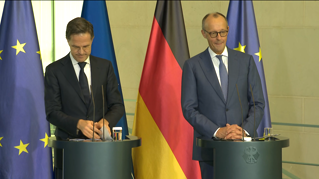
Joint press conference by the NATO Secretary General with the Federal Chancellor Friedrich Merz
Joint press conference by the NATO Secretary General with the Federal Chancellor Friedrich Merz
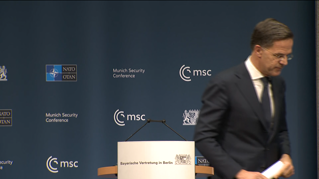
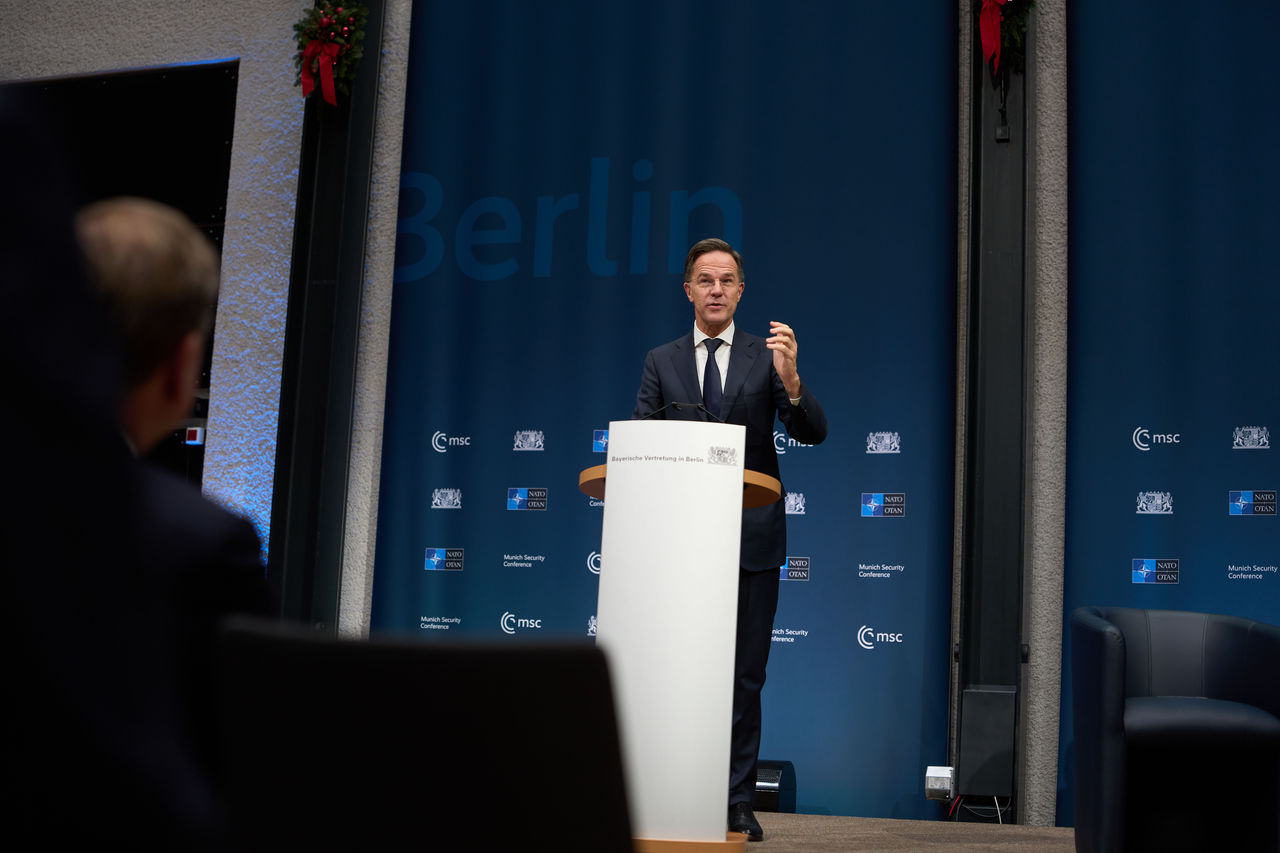
Keynote speech by NATO Secretary General Mark Rutte
Moderated discussion with NATO Secretary General Mark Rutte and Johann Wadephul, Federal Minister for Foreign Affairs
NATO Secretary General Mark Rutte meets with Johann Wadephul, Federal Minister for Foreign Affairs of Germany
Moderated discussion with NATO Secretary General Mark Rutte and Johann Wadephul, Federal Minister for Foreign Affairs
NATO Secretary General Mark Rutte meets with Johann Wadephul, Federal Minister for Foreign Affairs of Germany
NATO Secretary General visits Germany