
Close
Back


From now on you can download videos from our website
If you would also like to subscribe to the newsletter and receive our latest updates, click on the button below.
Enter the email address you registered with and we will send you a code to reset your password.
The password must be at least 12 characters long, no spaces, include upper/lowercase letters, numbers and symbols.
Click the button to return to the page you were on and log in with your new password.
25 September 2025
3 MIN READ
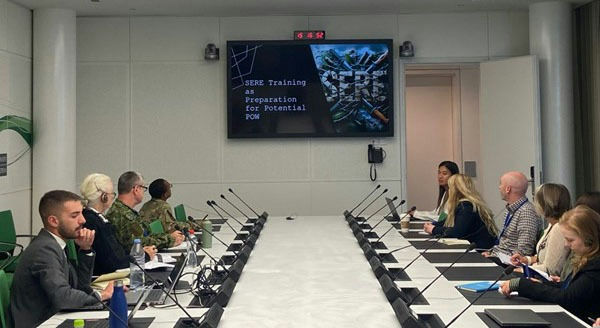
On 25th September 2025, the IMS Office of the Gender Advisor (GENAD) hosted its monthly deep dive session. This iteration focused on integrating gender perspectives into the handling, protection, and release and reintegration of Prisoners of War (PoWs).
The GENAD Office was pleased to welcome an expert panel, featuring Dr Abhimanyu George Jain, Legal Advisor at the International Committee of the Red Cross (ICRC); Dr Kateryna Busol, Legal Advisor at the International Centre for Transitional Justice and Associate Professor at Kyiv-Mohyla University; and Master Sergeant Jakob, Survival Evasion Resistance Extraction (SERE) Specialist at the Special Operations Training Centre, German Army.
Dr Jain opened the discussion, briefing on the legal framework governing the protection of PoWs and ongoing efforts to update the ICRC commentaries on the Geneva Conventions and their Additional Protocols. The updated commentaries reflect that women participate across all roles in armed conflict, and increasingly perform combat roles with a higher rate of capture. This indicates the need to adapt these important guiding documents.
Dr Jain emphasised that the legal principle of equal treatment does not mean that all PoWs should be treated in the same way, but rather that appropriate provisions must reflect the substantive needs, vulnerabilities and requirements of women, men, girls and boys. Gender mainstreaming in the handling, protection and release of PoWs is therefore not only desirable or useful, but a legal requirement. Practically, this means that attention must be paid to ensure that women have access to appropriate rations, clothing, and medical care, for example.
Dr Busol discussed Ukraine as a case study, emphasising that although the number of Ukrainian PoWs has increased and received greater media attention since 2022, the phenomenon has been ongoing since 2014. The majority of sexual violence in detention is perpetrated against men, reflecting the demographics of the Ukrainian armed forces. She explained that male detainees are more likely to be subject to sexual torture or threats of sexual violence against family members and comrades.
Through the reparations framework, survivors should have access to psychological support, healthcare and housing. Additionally, all teams who deal with former detainees should include both women and men, so that freed PoWs and civilian detainees may choose professionals they feel most comfortable engaging with. Furthermore, as sexual mutilation can lead to impeded reproductive functions, if not death, Ukraine has explored ways for soldiers to preserve reproductive material so that they can still have families.
Moving to the tactical-operational dimension, MSgt Jakob discussed how soldiers are trained for potential capture, emphasising resilience through preparation. All speakers highlighted how the changed defence posture has incurred changing attitudes – once viewed as an unlikely scenario for NATO Member Nations’ militaries, there is increasing recognition of the need to train soldiers for possible detention. Accordingly, training should be continuously updated to fit the environment that soldiers will deploy into.
However, MSgt Jakob noted that gender perspectives are not currently adequately integrated into NATO concepts and documents, and consequently may be lacking in SERE or Reintegration training. Practically, this means that soldiers may not be adequately prepared for the risk of conflict-related sexual violence in detention and that Reintegration Debriefing Teams can lack diversity. This may contribute to the limited discussion of issues such as sexual violence during reintegration debriefs, potentially undermining the effectiveness of SERE training and the recovery and redeployment of soldiers. To address this, NATO and its member nations need to strengthen, adapt and implement existing regulations to better reflect gender considerations.