
Close
Back


From now on you can download videos from our website
If you would also like to subscribe to the newsletter and receive our latest updates, click on the button below.
Enter the email address you registered with and we will send you a code to reset your password.
The password must be at least 12 characters long, no spaces, include upper/lowercase letters, numbers and symbols.
Click the button to return to the page you were on and log in with your new password.
15 January 2026
2 MIN READ
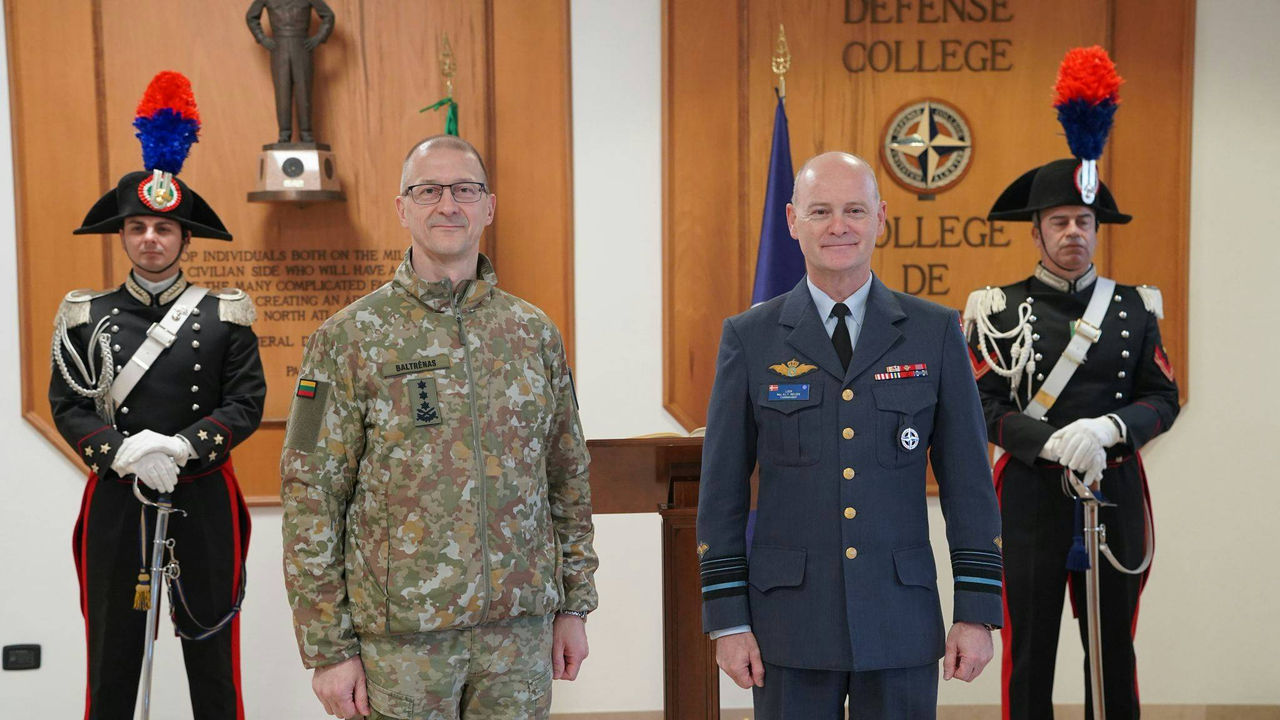
Lieutenant General Remigijus Baltrėnas, Director General of the International Military Staff (DGIMS) with Lieutenant General Max A.L.T. Nielsen, NATO Defense College Commandant
Rome, 14 January 2026 – Lieutenant General Remigijus Baltrėnas, Director General of the International Military Staff (DGIMS), paid a two-day visit to key NATO structures in Italy, including the Joint Force Command (JFC Naples) and the NATO Strategic Direction-South Hub, in Naples, and the NATO Defense College, in Rome.
At the JFC Naples, Lieutenant General Baltrėnas met with the Chief of Staff, Lieutenant General Rodolfo Sganga, who briefed on the security dynamics of NATO’s southern flank, cooperation with the Southern Neighbourhood, the command's role in NATO deterrence and defence plans, and updates on the NATO Mission in Kosovo (KFOR) and the NATO Mission in Iraq (NMI).
“Allies understand the significant impact that instability in the southern neighbourhood have on NATO overall, shared security. The role of JFC Naples in contributing to safeguard NATO’s southern flank is absolutely critical. Military personnel and civilian staff in Naples work tirelessly to ensure that NATO’s awareness and readiness align with the demands for security, today and tomorrow,” stated Lieutenant General Baltrėnas.
The JFC Naples is one of three Joint Force Commands operating within NATO’s Command Structure. Its primary mission is to plan and conduct military operations to preserve the peace, security, and territorial integrity of Alliance member states within the Supreme Allied Commander Europe’s (SACEUR) Area of Responsibility and beyond.
Later, at the NATO Strategic Direction-South Hub (NSD-S Hub), Lieutenant General Baltrėnas received detailed briefings outlining its activities and challenges. The NSD-S Hub enhances NATO’s understanding of political, economic, and social dynamics in Africa and the Middle East through cooperation and dialogue with regional actors.
At the end of the visit, DGIMS confirmed how NATO’s improved grasp of regional dynamics in areas such as North Africa, the Middle East, the Sahel, Sub-Saharan Africa, and surrounding regions allows us to identify opportunities for cooperation and strengthen stability and security along NATO’s southern borders.
Finally, in Rome, DGIMS visited the NATO Defense College (NDC), led by Lieutenant General Max A.L.T. Nielsen, NDC Commandant. They reviewed the progress of senior-level education programs, explored emerging trends in modern warfare, and examined innovative approaches to preparing future strategic leaders.
Departing the College, DGIMS stated: “The NATO Defense College in Rome plays a pivotal role in training future leaders from NATO Allies, Partners, and international entities, equipping them with a 360-degree understanding of defence and security. Throughout its history, the NDC has trained more than 9,000 officers, many of whom have gone on to hold strategic-level leadership positions. The college plays an immense role in securing NATO’s future. Our responsibility is to prioritize its support, management, and continued evolution, ensuring the institution effectively prepares leaders for the challenges of tomorrow’s warfare.”