Fermer
Retour
Accédez aux ressources médiatiques officielles de l'OTAN. Un contenu de qualité professionnelle, diffusé sur les dernières actualités. La référence pour les professionnels des médias.

Accédez aux ressources médiatiques officielles de l'OTAN. Un contenu de qualité professionnelle, diffusé sur les dernières actualités. La référence pour les professionnels des médias.
Désormais, vous pouvez télécharger des versions complètes ou partielles de nos vidéos depuis notre site Web.
Si vous souhaitez également vous abonner à la newsletter et recevoir nos dernières mises à jour, cliquez sur le bouton ci-dessous.
Entrez l'adresse e-mail avec laquelle vous vous êtes inscrit et nous vous enverrons un code pour réinitialiser votre mot de passe.
Le mot de passe doit comporter au moins 12 caractères, sans espaces, inclure des lettres majuscules/minuscules, des chiffres et des symboles.
Cliquez sur le bouton pour revenir à la page sur laquelle vous étiez et connectez-vous avec votre nouveau mot de passe.
Maria Tadeo, Euronews
Well, thank you very much. There've been a lot of questions, and I'm sure the room is full now, so thank you very much. There's a lot of interest, and let's get straight into it, Secretary General. Can you confirm that Russia sent a letter to NATO that said, if the Russian Federation, its territory, including Kaliningrad, comes under any threat, they will resort to the full arsenal, which includes also nuclear weapons? In the letter, they use the term nuclear weapons in the letter.
NATO Secretary General Mark Rutte
Well, I'm not at liberty to disclose what they sent us, but this is what they reported more or less to the media. So let me just refer to what the Russians reported to the media and leave it at that. What we did, we reacted, and basically what we said is, “hey, listen, we are defensive alliance, and stop the nuclear threat. This is absolutely not called for and not helpful. And particularly stop the war in Ukraine, which is unprovoked war of aggression against Ukraine.” So, we have been clear in our reaction, which was short and concise. But what was exactly in a Russian letter, I think it's up to them to disclose it.
Maria Tadeo, Euronews
To disclose it. But if you sent a response, it’s because they sent you a letter in the first place. If we assume that the media does a good job, this letter did say, the Russian Federation said, if any of our interests in the Russian Federation territory, which also includes Kaliningrad, is threatened in any way, we will use all of our capabilities, including nuclear weapons. Is there a threat, an escalation that implies the risk of nuclear weapons being employed against the Baltics is now real?
NATO Secretary General Mark Rutte
No, it's not. Putin knows that he can never win from NATO, so I don't take this that seriously, but of course we had to reply and make clear to him that NATO is a defensive alliance, as I said, and stop the war in Ukraine, and stop the nuclear threats because it's not helpful. And NATO is so much stronger than Russia is, so there's no way they can ever beat us.
Maria Tadeo, Euronews
The Prime Minister of Bulgaria was here, we did an interview just an hour ago, and he said, "You have, and everyone here in this room has to be clear, that you are dealing with a country that has nuclear capabilities – it is a nuclear-armed country.” I presume Bulgaria is a NATO country, probably had seen that letter and the response too. There’s a lot of frenzy around the situation in the Baltics and a security scenario that has or seems to have deteriorated over the past three weeks, what are the scenarios you’re preparing for? Because something seems to have changed beyond language.
NATO Secretary General Mark Rutte
Listen, let’s zoom out a little bit. What’s happening? 43,000 Russians killed or seriously wounded a month now in Ukraine. Ukraine holding the front line, doing much better than only a half year or a year ago, striking deep inside Russia. Allies supporting Ukraine in terms of weapons delivery, etc. So, this is the picture. So, Putin is not winning this. So, let’s assume that he is a bit worried and a bit rattled. And I think the best way to deal with this is to have a little bit of calm here. On the NATO side, we can allow a bit of calm, but also a bit of making sure we continue with what we are doing, so the carry-on part, which is investing in our defence, and we are doing it. I see the Chief of Defence of the Netherlands here, they are massively stepping up defence spending in the Netherlands, and the same for Germany and basically for the whole of NATO territory, equalising with the United States. Not only because we have to equalise with the United States, but because we need all these capabilities, because Russia clearly has a strong military, and we want to stay ahead. But most important for now is to keep the support for Ukraine going. What Putin tries to do – don’t forget – by these letters and these hybrid grey zone activities, they try to divide us and lose the focus on Ukraine. We will not. So, every hybrid, whatever happens in Europe, will be met with more support for Ukraine, not less support for Ukraine. That’s the message. Calm, carry on, keep the support for Ukraine going. That’s how we deal with it.
Maria Tadeo, Euronews
We'll talk about Ukraine in a second, but just to understand this clearly, because over the past three weeks, ever since the CIA boss went over to Moscow and that was reported, there has been this real frenzy around whether or not something is in the making, could happen, not imminently, but that now moves away from Ukraine into a NATO country. I was in Riga two weeks ago. You could feel there's a sort of nervousness that I had not detected previously. In your own assessment, and you have one of the best intelligence in the world, is the risk assessment really, truly the same it was three weeks, three months ago, a year ago?
NATO Secretary General Mark Rutte
Yes, and let's not forget, if the Russians want to do something against Finland or one of the Baltic nations or Poland or whichever country in NATO, we will see a build-up. And let me, if you don't believe me, let's listen to the Latvian and Estonian politicians. They are saying “hey, we will be the first to call you if we think there is a serious threat” against, for example, Estonia or Latvia.
Maria Tadeo, Euronews
But they have to say it.
NATO Secretary General Mark Rutte
But in the meantime, their message is, please stop being so worried. We have prepared for this. We have planned for this, and this is true for the whole of NATO. We will defend every inch of NATO territory, every square kilometre, square mile. There is no doubt, Putin knows this, so that threat is not there. And if anything happens, we are ready to counter it. We will always be defensive, but, if necessary, of course we will defend ourselves. But the most important thing is, this is all happening because it's not going well for him in Ukraine. He wants to divide us. He wants us to lose the attention when it comes to Ukraine. Keep the support going. And let me also quote Radek Sikorski, the Foreign Minister of Poland, who said, “For every hybrid threat to Poland, we will do more for Ukraine instead of less for Ukraine.” That's the best reaction, by the way, when it comes to how to counter hybrid grey zone threats to NATO territory.
Maria Tadeo, Euronews
You say, if you don't believe me, let's just listen to the Baltic politicians. They are politicians. They have to say there is no imminent risk. It is politics, and it's also damaging the business environment – I was told that clearly in Riga by a number of officials, this conversation is not good for investment. But the question, and this is why I want to insist to you, is because the word of NATO really matters. Should we just take away from this conversation that, regardless of the letters, the trip of a CIA top officer or not, nothing has changed? And even if Russia was planning to do something, you are prepared for it, and this is NATO territory, we'll be protected?
NATO Secretary General Mark Rutte
There is no imminent threat to NATO territory. If there is a build-up, we will see it and we will deal with it. If anything happens otherwise, we will also deal with it, because we have prepared and trained for this. We have a single command structure. We have 32 Allies working together. We have a fantastic Supreme Allied Commander in Alexus Grynkewich, the American general. So, we are in perfect shape, both when it comes to the to the hybrid and when it comes to whatever might happen more. And we have to be clear-eyed: Russia is not doing well in Ukraine, and this is all about that. And every minute we spend on this is exactly what Putin loves us to do: being rattled and talking about “oh, what's happening here, what's happening there?” Calm. We are stronger. Carry on, keep on investing. And most of all, make sure that Ukraine has what it needs to stay in the fight – they need the support, particularly air defence, but also all the other stuff they can get.
Maria Tadeo, Euronews
Let's talk about Ukraine now. How do you see things evolving in the next few months? We had a report this morning from our correspondent there. She said – and she's been there now four or five days straight – it is worse than at any other point this year so far. There's a real concern that the air defence is, I don't want to say depleted, but close to. Is it as bad as it sounds? Do we get to winter in a better shape?
NATO Secretary General Mark Rutte
No, it's much better. The problem, yes, is with the pummeling of cities by the Russians. That's true. So, they are hitting hard at the infrastructure, critical energy infrastructure at cities. So that's taking place, and there is a lack of interceptors, and that means that the Europeans and the Americans, we are all working in conjunction to get as much as possible to Ukraine to make sure that they can defend themselves. But when it comes to the front line, as I said, look at Donetsk, Sloviansk, Kramatorsk, these key cities. The Ukrainians are doing much better now than only half a year, a year ago. Look at what they are doing in striking deep inside Russia and taking out some of the key logistical systems in Russia when it comes to the energy infrastructure, when it comes to their systems of warehouses, etc. So, Ukraine is doing fine, but it is absolutely true, an issue when it comes to big cities and energy infrastructure and logistics under threat, and there we can help as Europeans and Americans and Canadians to make sure that they have what they need.
Maria Tadeo, Euronews
How can we accelerate, or how can that process be accelerated? Because the Ukrainians would say we want it, and the NATO Summit, in theory, should have brought that to fruition, to get the licenses to be able to do the Patriots. That is not really moving.
NATO Secretary General Mark Rutte
On the licences, discussions are going on, but that won't help them in the short term, because it takes quite some time if you have the licences to build these missiles. So that's for the U.S. and Ukraine to discuss.
Maria Tadeo, Euronews
Is that moving along? Because there's been a lot of concerns.
NATO Secretary General Mark Rutte
I think it is moving along but I'm not involved in that. We track that, we trace that, but that is particularly between the U.S., which has these companies on its territory, which is building the Patriot systems. We know that in Germany, when it comes to PAC-2s, we now see massive production sites being built between MBDA and Raytheon to RTX to build the PAC-2 interceptors in Germany. So, all of this is happening, but this will not help Ukraine in the short term. For next winter and for the next coming weeks and months, they simply need more interceptors. Please. Onno (Netherlands Chief of Defence), whatever you can still give them. It's saving lives. And also, our Supreme Allied Commander is saying to those European countries still having these Patriot interceptors, “whatever you can give, please do, because it is crucial now to keep Ukraine strong”. But Ukraine is not doing worse than some time ago. They are doing better because the front line and striking deep inside Russia, they are doing much better than only half a year ago.
Maria Tadeo, Euronews
You mentioned certainly when it comes to the Europeans that if you have any in stock, you should send them now. You didn't name the countries, but we've seen clearly in Brussels, there's been ongoing pressure on Spain and Greece in particular. Is this now the time to say whatever you have really send it now? There is no imminent threat on the southern flank.
NATO Secretary General Mark Rutte
That's not how it works because we have to make sure, of course, that we have enough also to protect ourselves. But that's not up to me. That's the Chief of Defence, the Supreme Allied Commander, assessing what are the stockpiles we need in NATO territory, and based on that assessment, what can we still give to Ukraine? There is still room for that, but hey, that's not for me to say. “Hey, send everything” – that's not my message.
Maria Tadeo, Euronews
How much of a drag is the war in Iran on Ukraine? Because you could argue they feel collateral damage out of the situation. It is a war that, in theory, as we understood, the President of the U.S. said over the summer was done. Clearly, it is not done, the oil is not coming out, and now there's also energy pressure feeding into this conversation. How much of a problem is a war in Iran when it comes to the situation in Ukraine?
NATO Secretary General Mark Rutte
Yeah, but let's also assess, and here we might not always all of us agree, that it was only the United States which was capable of taking out the nuclear capability of Iran – which was a threat, potentially soon, not only for Israel and the Middle East, but also for us here in Brussels.
Maria Tadeo, Euronews
You really believe that?
NATO Secretary General Mark Rutte
I absolutely believe that, yes. So, the American President taking out that threat, degrading that capability, is crucial. And of course, every war also has its downsides, that's clear, but I'm looking at the upsides here. And by the way, with all the extra investments European countries are now making in their defence – this 3.5 percent leading to the 5 percent overall defence spending – this will lead to a situation where, in the future, this stronger Europe in a stronger NATO, where the Europeans will be able to take care of their backyard themselves. It should be us doing this, not the Americans. Why are the Americans doing it, taking out the Iranian nuclear capability? Because we can't. But in the future, we have to make sure that, as Europeans, we can do this ourselves. It is anyway a bit strange that to protect ourselves here in Europe from 140 million Russians, 600 million people living in NATO territory in Europe, that we need a country which is six to eight hours flight from here, with 340 million people, to defend ourselves against the Russians. We should be able to do that ourselves, that's exactly what we are working on. Still, the US being involved not only in the nuclear sense but also in the conventional sense, but the Europeans taking much, much more responsibility for the defence of this part of NATO.
Maria Tadeo, Euronews
The flip side, some would argue, and again going back to the knock-on effect on Ukraine, some would say the war in Iran, it's not clear how this answers whether there's a strategy to do it, and it is having an impact on Ukraine directly because the President of the U.S. is now saying, “Do not hit the refineries because I don't want to see oil prices going up.” It is having a knock-on effect. So how can you undo this this dynamic?
NATO Secretary General Mark Rutte
I'm not going to comment on everything which is said by…
Maria Tadeo, Euronews
But do you worry about the ramifications and the energy markets with this war?
NATO Secretary General Mark Rutte
There are always downsides when war breaks out. That's clear. But hey, let's face it. Europe was not able to take out the nuclear capability of Iran. We couldn't. We didn't have the capabilities. In 10 years, we can and we should. It should not be the Americans doing it. It should be us doing it. It should also be us taking care of the Houthis in the Red Sea and not the Americans. But hey, of course there are always ramifications. But the ramifications start from a premise that it is good that the Americans did this, and I'm one believing that it was absolutely essential for the Americans to take on Iran.
Maria Tadeo, Euronews
And do you believe the vast majority of the Alliance agrees with your assessment?
NATO Secretary General Mark Rutte
No, I don't think so, but I don't care. You asked me of my opinion.
Maria Tadeo, Euronews
To that point, at this stage, do you see a NATO that is together in its collective decision making, or actually, you would argue there are real tensions because the interests are moving in different ways? Meaning, for the Europeans, they believe Iran has had a negative implication on Ukraine, and we've seen it this morning, a lot of these companies present here, they say, NATO pushes forward American contracts, and we want to build our own industry. European companies should go first.
NATO Secretary General Mark Rutte
No, we are talking about Iran. That Iran, last time…
Maria Tadeo, Euronews
Two points of tension. They're both…
NATO Secretary General Mark Rutte
No, no, no. Iran is outside NATO territory. So, let's be honest. NATO is focused on the Euro-Atlantic, and when it comes to the Euro-Atlantic and defending ourselves against Russia, which is our long-term threat, we are totally on one page. The US, Canada, the 30 NATO Allies in Europe, there is no problem. No, we were discussing Iran, and hey, you are allowed to have your differences of opinion when it comes to Iran. By the way, the Europeans are also totally in agreement that the freedom of navigation has to be restored, both in the Strait of Hormuz and in the Red Sea, and we see now increasingly European countries being active there: Lithuania, Latvia, Estonia, helping out with demining in the Strait of Hormuz. This is even before this so-called permissive environment will emerge, hopefully, in the future. So, already they are there, there are some other European countries active there more discreetly, helping out with de-mining. Why? Because the US is great, but the US lacks two capabilities. One is icebreakers; you don't need them in the Strait of Hormuz; and demining capacity, which the Europeans have an ample supply, so it's very good that Europeans are more and more helping. And also, 5,000 American planes took off from European bases since the end of February in support of Epic Fury. So again, Europe being one big power projection platform for the United States.
Maria Tadeo, Euronews
So, you're saying, because publicly, let's be honest, the war is not popular in Europe. We've seen a number of European leaders who come out of it very openly, saying “it was a bad idea, and my population doesn't support it.” Would you say there's an element of performative – well, they're just politicians – there’s an element of “I disagree, but actually, I'm providing much more support than I say in public”?
NATO Secretary General Mark Rutte
No, no, that’s too negative. I take all those comments very seriously. But what I'm telling you is that the nuclear capability of Iran, in my assessment, is a direct threat not only to the Middle East but also to Europe. That it was only the United States which was able to degrade it. Yes, when you have a war like this, that will have also negative consequences, but you have to take them into account. And Europe is now stepping up when it comes to the Strait of Hormuz, was already stepping up when it came to making sure that the U.S. could make use of its infrastructure and facilities in Europe in support of Epic Fury, and this is Allies – this is not NATO because NATO is not active in Iran, I mean, it's outside NATO territory – but this is Allies working together, making sure that we have great atmosphere within the alliance, but also making sure that we are there for each other when necessary.
Maria Tadeo, Euronews
How is the atmosphere in the Alliance at this point?
NATO Secretary General Mark Rutte
It's great. It's the best it has ever been, because you have now a Europe which is taking responsibility for its own defence. President Trump loves NATO. He only hated one element, which was the fact that we were not spending enough…
Maria Tadeo, Euronews
And multiple other things. He also said he had been - at the NATO Summit, he was not very happy going into the NATO Summit. Then came out happy out of it. But he said he was not happy at his NATO Summit and his NATO Allies because of the war in Iran, but…
NATO Secretary General Mark Rutte
When I speak to President Trump, he's totally clear-eyed why NATO is crucial also for the United States. Jonas Støre, the Norwegian Prime Minister, showing him the map of these nuclear submarines of Russia, which are a threat not to Norway, they are a threat to the United States. They might end up at the shores of the United States if we, as NATO, would not block them. So NATO – and note, this is just one example – is not only there to protect Europe, but is also there to protect Canada, it's there to protect the United States. I was just last week with Matt Whitaker. He was just here, also presenting. He is the Ambassador, fantastic Ambassador of the U.S. to NATO. We were both visiting his home state, Iowa. So, I brought this message to the American Midwest. I will continue doing that, also to discuss with the American people that NATO is not only there for historical reasons for the U.S. to stay involved in Europe after the Second World War, but also to make sure that the U.S. mainland stays safe, and therefore NATO is crucial. And finally, in the U.S., in all the senior circles, in the Pentagon, in State, and in the White House, there is widespread agreement that if China would move against the First Island Chain, that there is no doubt that, at the same moment, Putin will keep us busy here, and then we need a stronger European element in NATO. This is NATO 3.0, a stronger Europe in a stronger NATO, to make sure that the US doesn't have to spread its resources too thinly.
Maria Tadeo, Euronews
And, just as a final point on this, the reason why I ask how is the mood is because right now we see competing priorities. The U.S. is sending this message: do not hit the refineries because it's affecting the energy market. What I detect from the European leadership is that they are okay with Ukraine hitting deeply into Russia because that is the moneymaker for Russia. As NATO Secretary General, when you look at both scenarios, do you say, “at this point, I rather they continue just hitting Russia deeply, even if it comes with ramifications in the energy market”? It's the best balance.
NATO Secretary General Mark Rutte
I look at another scenario. I look at another fact, and the fact is that, when it comes to the war in Ukraine, there is only one person who can bring that to an end, and that person is not living in Europe. That person is living in the White House, and the American President is the only one -
Maria Tadeo, Euronews
You really believe this?
NATO Secretary General Mark Rutte
Yes, I really believe this. He was the only one who could break the deadlock with Putin. He did. He started the dialogue. He sent some of his senior advisers to work diligently with the Russians and the Ukrainians to bring this war to an end. So far, it has not been successful, but they are working on this. I commend them for that, and that's what we need to do. But for Ukraine to enter into peace talks, we collectively, with the United States and Canada and the Europeans, have to make sure they are as strong as possible, and we need to bring this war to an outcome where Ukraine is sovereign, can defend itself, is viable, and can continue as an independent nation.
Maria Tadeo, Euronews
And in the realpolitik, I'm pretty sure 99.9% of everyone here would say President Trump will have to be – if there's any sort of peace – at that table. But I want to ask you: the ceasefire he promised did not happen. The energy ceasefire is not happening either. In your mind, is there really now any path in which we see from now until the winter any sort of mediated ceasefire of any way, or actually this is just war?
NATO Secretary General Mark Rutte
Of course, we all hope for it. I know. And I spoke with some of the senior American people involved in this last week in New York, they are working day in, day out to get it done. I support them wherever I can. I know that the whole European leadership is behind this effort, because we all want this war to end. But hey, you need two to tango. So far, it doesn't seem that Vladimir Vladimirovich Putin is willing to tango when it comes to a peace deal, and as long as he is not making himself available for that, it is a bit difficult. But hey, we always know that these wars end with a peace deal, and we always know you need negotiators and you need somebody with clout who can do that. And the American President breaking the deadlock with Putin when he came into office, I think, was essential. And we can then criticise that it has not been done. No, I mean this is very difficult, it takes time, but over time, I'm sure that will be successful. I don't know whether it will be before winter. At the moment, we don't see Putin willing, it seems, to engage.
Maria Tadeo, Euronews
When you look at NATO, you also accomplished the 5%, and then of course there's the famous Trump trillion. Some dispute that it's an effective trillion, but the President does say, “we will get to the 1 trillion”. What we've seen this morning here is there is a lot of cash and money to be put forward, but there are differences in terms of what do we buy. And the European industry would say there needs to be a clear European preference. This is taxpayer money. The U.S. Ambassador today said, “it is clear the Europeans are creating instruments that will limit U.S. abilities to play in these contracts”. In your mind, do you go, “as long as you pay and you're a NATO member, you buy what you want”?
NATO Secretary General Mark Rutte
First of all, it's more than 1 trillion. But then, on the question you ask, the problem is not, do you buy in Europe or do you buy in the United States? The problem is, can you buy? The money is there, but the defence industrial base in Europe is underdeveloped. It is not producing enough. Too many factories are still not working full time, are not churning out their products 24/7.
Maria Tadeo, Euronews
So, there is no bias for a manufacturer in Europe?
NATO Secretary General Mark Rutte
No, the same is true for the United States. Also, the United States needs to ramp up its output. It is exactly what Trump tries to do. It's the quadrupling of the five big primes in the U.S. etc. So, the problem is not… if only we had the luxury of this discussing “buy European” or “buy American”. Now, I would say buy. And generally speaking, being a free market politician, I think it's always better if you have these free markets functioning as open and independent as possible, but at the moment I think it is a discussion of luxury whether you buy European or American, because we cannot buy on both sides. There is not enough production not in Europe, not in the United States to fulfil all the demand signals now. So, this is my message to industry: invest. You know there is a long-term demand. There is a long-term commitment to spend so much more. You know that 30 percent, approximately, of all defence spending is spent in the industrial base. So, develop the industrial base. Make sure we have the latest innovations there. And we know that European companies, Thales, investing in the US, US companies investing in Europe. It is a transatlantic defence industrial base. It is working as one, and that's exactly what it should be. The only problem is, it has to produce much more than it is doing at the moment. The good news is, industry is ramping up, and we had that in Ankara with the 50 billion extra defence industrial contracts being closed there, and the 40 billion when it comes to the Drone Edge, so that these were huge announcements, which will also help to accelerate the investments in the defence industrial base.
Maria Tadeo, Euronews
So, Made in Europe is a Brussels debate? It exists in the Brussels circles?
NATO Secretary General Mark Rutte
If only we could have a luxury to have that debate. At the moment, the problem is, we do not produce enough. Look now at Ukraine. So, we have the Aster-30s, the SAMP-Ts from Italy and France, fantastic systems. We have the Patriot system from the U.S. Both of them do not produce enough. This is just one example. If only France and Italy would be able to really ramp up the production of SAMP-Ts and Aster-30s. If only Raytheon, Lockheed Martin would be able to quadruple, as the President has requested, as soon as possible the production of PAC-3 interceptors for Patriot systems, then we will be in good shape, and then we can have a debate: do you buy European or American? But at the moment, I would say, more generally speaking, let's look at this as one big transatlantic defence industrial market, and there is enough money for everybody, and there will be a piece, a defence dividend coming from this, because all these investments will also lead to societal returns, not only in the defence output from the defence industrial base, but also innovation and everything else.
Maria Tadeo, Euronews
And Secretary General, just a final question: what do you think NATO 3.0 means? Because I see two different schools. One says, it means an Alliance in which we pay, we both commit, so it will equalise the relationship. It will be stronger because we will commit more. There are some in Europe who would say, ultimately, NATO 3.0 means they will pull back the troops. We will have to pay more. We will have to pay for their weapons. And in exchange, what we get is the nuclear umbrella. That is it. That is NATO 3.0. Which one is it?
NATO Secretary General Mark Rutte
Well, it's more like the first than the second, but let me be more precise.
Maria Tadeo, Euronews
It's too negative, the second one?
NATO Secretary General Mark Rutte
Yes, I mean it's a bit of a crazy assumption that it will be the second one, and you don't mean this, because if the US -
Maria Tadeo, Euronews
[To audience]: So what do we think?
NATO Secretary General Mark Rutte
No, but if the US would only be here with the nuclear umbrella, of course, from a strategic and tactical point of view, that would not be very wise, because you want also to be there then, if you have a nuclear umbrella, in the conventional sense, for all kinds of tactical, strategic reasons, the military people can explain to you why that is important. So, the U.S. will stay involved in Europe also in the in the conventional domain. No, the problem was that NATO was not sustainable. It is not sustainable that you have a country, the United States, being overly responsible for the defence of 600 million Europeans. We are the richest part of the world. There is no part of the world which is richer than Europe, and then we are totally over dependent on a country so far away, 340 million people, to defend against 140 million Russians. That's not sustainable. That's what we are changing now. That means that - and this is the paradox - the United States, thanks to the fact that Europe is stepping up, will be much more committed to Europe, because they need Europe and a secure Atlantic and a secure Arctic. Look at the Greenland debate: we were able to bring to a successful outcome last week, the Danes and the Greenlanders and the Americans, very successfully. Case in point that we need a secure Arctic, secure Atlantic, secure Europe to keep Europe, the Arctic, and the United States safe. The problem was there was a total lack of equality in terms of spending. That's now being redressed, not only because Trump wants this, but also because we have to spend much more in Europe to be able to defend ourselves against the Russians.
Maria Tadeo, Euronews
Your team says you have to go and you have to leave in time. So, I don't want to have any problems with NATO at this point, but just as a final question, would you say ultimately all of this is chit chat because the big problem in Europe will be China?
NATO Secretary General Mark Rutte
No, China is extremely relevant, and as I said, if something happens in the China would move against Taiwan or somewhere else in the First Island Chain, that will have a huge impact on Europe and the U.S. On the U.S. first of all, because they will try to do everything to stabilise the situation in the Pacific, but they will need Europe to take indeed responsibility much more than we do at this moment for our own defence, because you cannot require from the US to spread its resources too thinly. And yes, of course, China is extremely relevant, and we assess that, for the moment, Russia is the long-term threat against NATO. We will see how China develops. We know they are sitting by 2030 on 1000 nuclear warheads. They have massive investments in their military, and it's not only to organise parades in Beijing.
Maria Tadeo, Euronews
Well, on that note, Secretary General, thank you very much for joining us. Thank you very much.


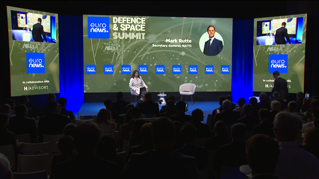
NATO Secretary General Mark Rutte participates in the Euronews Defence & Space Summit 2026
NATO Secretary General Mark Rutte participates in the Euronews Defence & Space Summit 2026
NATO Secretary General Mark Rutte participates in the Euronews Defence & Space Summit 2026
NATO Secretary General Mark Rutte participates in the Euronews Defence & Space Summit 2026
NATO Secretary General Mark Rutte participates in the Euronews Defence & Space Summit 2026
NATO Secretary General Mark Rutte participates in the Euronews Defence & Space Summit 2026
Participation by the NATO Secretary General in the Euronews Defence & Space Summit 2026
30 September 2026